UAE Redesigns 5-Gigawatt AI Data Center Plan After Iranian Attacks
-

- by THEFLGHT,
- September 12, 2026
- in Artificial-Intelligence
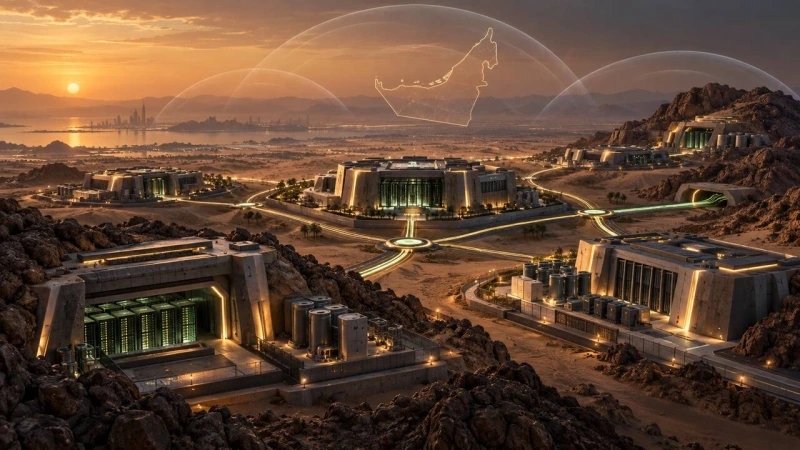
The UAE AI data center plan for a 5-gigawatt campus is being redesigned after Iranian attacks exposed the vulnerability of concentrated digital infrastructure in the Gulf. Officials are considering a distributed network of hardened facilities instead of placing the full project at one site in Abu Dhabi.
The reported redesign includes four major resilience measures:
- Distributing later phases across multiple emirates.
- Building some computing capacity underground.
- Adding blast-resistant structures and redundant utilities.
- Integrating drone, missile and electronic defenses.
UAE AI Data Center Plan Moves Beyond One Campus
Reuters reported on September 11 that the UAE is quietly revising the project’s blueprint, citing six people familiar with the deliberations. Four sources said the 10-square-mile campus originally planned near Abu Dhabi will likely become a network of data centers across the country.
The changes have not been finalized, and Reuters could not determine their effect on costs or the construction schedule. G42 said the campus is progressing as planned while its specifics remain under continuous review against the security, resilience and operational standards expected of critical infrastructure at this scale.
That distinction is important. The UAE has not canceled the 5-gigawatt ambition or announced a replacement project. It is reconsidering where later capacity will sit and how the infrastructure will be protected, while construction on the initial Stargate UAE phase is expected to continue with security modifications.
Stargate UAE Keeps Its First 200-Megawatt Target
The broader UAE-US AI Campus was announced in May 2025 as a 5-gigawatt computing development. An official SoftBank announcement described Stargate UAE as a 1-gigawatt cluster inside that campus, developed with G42, OpenAI, Oracle, Nvidia, Cisco and SoftBank.
Construction on the first $30 billion, 1-gigawatt phase began last year, according to Reuters. The first 200 megawatts are due to enter service in 2026, and people briefed on the review said this initial phase should proceed, although its defenses may be strengthened.
At full scale, five gigawatts would make the campus one of the largest AI infrastructure projects outside the United States. The project is central to the UAE’s strategy of converting energy wealth, capital and international partnerships into a cloud-computing and advanced-model hub.
The alliance also carries geopolitical conditions. The UAE agreed to reduce AI ties with China and invest in American Stargate facilities in exchange for access to Nvidia accelerators and other advanced U.S. technology, tying the buildout to Washington’s controls over strategic computing hardware.
Related Research
Iranian Attacks Change the Infrastructure Threat Model
The review began after Iran launched missiles and drones at Gulf countries hosting U.S. forces in response to American and Israeli strikes, people familiar with the process told Reuters. Two Amazon Web Services data centers in the UAE and one in Bahrain were damaged during attacks in March.
Iran’s armed forces later identified Stargate UAE as a potential target in an April video. Reuters reported that the complex is being built near Al Dhafra Air Base outside Abu Dhabi, a location that hosts U.S. troops and has itself been targeted during the conflict.
Concentrating thousands of accelerators, networking systems and sensitive government workloads at one location can simplify operations, power delivery and cooling. It also creates a single high-value target whose disruption could affect many customers, agencies and model services at once.
A distributed design trades some of those efficiencies for resilience. Separate sites can reduce correlated physical risk, but they require additional fiber links, security perimeters, power connections and operational teams. Training systems spread across distant facilities may also face latency constraints that do not apply inside one tightly connected campus.
Underground Facilities and Air Defenses Raise Costs
Officials are considering underground construction, blast-resistant concrete, backup power and redundant cooling, according to the Reuters sources. Sensitive military data could be placed inside mountains in the northern or northeastern emirates, where terrain differs from the flatter desert surrounding Abu Dhabi.
Air-defense planning reportedly includes drone and missile interceptors as well as electronic jamming. Those systems would move data-center protection beyond conventional physical security and cybersecurity into the military defense of energy and communications infrastructure.
Hardening will be expensive. Underground construction complicates ventilation, cooling, fire safety and maintenance, while redundant utilities consume land and capital. Defensive systems also require continuous staffing and coordination with national authorities rather than ordinary commercial facility management.
Yet the economics of an outage can be larger still. AI clusters combine scarce chips with high-bandwidth memory, storage and specialized networks; damage can interrupt cloud services and strand models or data even when backups exist elsewhere. Regional disruptions can also undermine investor confidence in Gulf states marketed as stable technology hubs.
The first measurable checkpoint remains the planned 200-megawatt opening in 2026. Any change to that milestone, the original Abu Dhabi footprint or the allocation of later phases across the emirates would reveal how far the security review is altering the project’s delivery plan.
Partners must also decide which workloads require maximum physical protection. Government and defense data may justify underground or mountain-based facilities, while commercial inference could run at conventional sites with geographic redundancy and hardened backup systems.
The redesign shows that AI infrastructure strategy is no longer only about chip supply, electricity and cooling. In exposed regions, planners must account for missiles, drones, communications outages and the possibility that a hyperscale computing campus becomes a strategic target.
For the UAE, success will mean preserving the promised scale while avoiding a single point of failure. The project’s next public blueprint will indicate whether distributed resilience can coexist with the dense, high-speed architecture required to train and serve frontier AI models.




0 Comments:
Leave a Reply