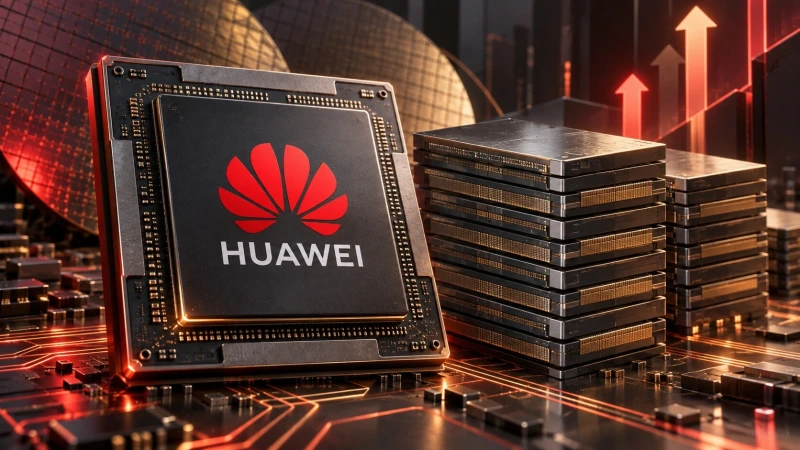
China AI Chipmakers Raise Prices as HBM Shortage Hits Huawei
China AI chipmakers raise prices as a global shortage of high-bandwidth memory pushes up the cost of Huawei, Cambricon and other domestic accelerators. Huawei is now quoting its Ascend 950DT card above 250,000 yuan, according to three people familiar with private pricing discussions cited by Reuters.
The reported increases span current products, planned chips and a major customer allocation:
- Huawei Ascend 950DT quotes rose 20% to 50% in two months.
- Cambricon's planned 690 chip rose 20% to 30%.
- Iluvatar CoreX doubled ByteDance shipments to 100,000 GPUs.
China AI Chipmakers Raise Prices Across Product Lines
Reuters reported the increases on September 10 after speaking with three people who requested anonymity because the negotiations are private. Huawei, Cambricon, MetaX and Iluvatar CoreX did not respond to the news agency's requests for comment, so the quoted prices should be treated as channel indications rather than public list prices.
The Ascend 950DT increase is the largest disclosed change. Its new indicated price of more than 250,000 yuan, about $37,000 at Reuters' conversion, is between one-fifth and one-half higher than quotes customers received two months earlier, depending on contract terms.
Huawei has said the 950DT will become available in the fourth quarter of 2026. The company positions the card for both developing AI models and generating model responses, while the related 950PR is designed to process user requests before they reach a model.
Pricing pressure is not limited to the newest hardware. Reuters' sources said the 950PR rose from roughly 60,000 yuan at the start of 2026 to more than 80,000 yuan. The older Ascend 910C board increased from about 90,000 yuan to more than 110,000 yuan.
HBM Supply Turns Into the Cost Bottleneck
High-bandwidth memory is stacked close to an accelerator so the processor can move large quantities of model data with far less delay than conventional memory arrangements. Training and serving large models depend on that bandwidth, making HBM a critical part of an AI card rather than a peripheral component.
Advanced HBM supply remains concentrated among SK Hynix, Samsung Electronics and Micron. When demand exceeds available supply, accelerator makers face both higher component prices and limits on how many complete cards they can assemble, even when their processor dies are ready.
The pressure is more acute in China because Washington expanded semiconductor controls in December 2024 to restrict certain HBM products used in advanced computing. Reuters' sources said Chinese chipmakers increasingly obtain the memory through grey-market channels, where prices can be several times those paid outside China.
Huawei says the Ascend 950 series will use its own memory technologies: HiBL 1.0 with the 950PR and HiZQ 2.0 with the 950DT. It has not publicly explained where or how that memory is manufactured, leaving an important part of the supply chain opaque.
Cambricon, MetaX and Iluvatar Reprice Domestic Supply
Cambricon has raised the indicated price of its next-generation processor, tentatively called the 690, by 20% to 30% from levels discussed two months ago, Reuters reported. The company has not formally launched the chip; its current flagship remains the 590.
Smaller rivals MetaX and Iluvatar CoreX have also increased prices, according to the same reporting. The pattern suggests the constraint is affecting the wider domestic accelerator market rather than one supplier's product cycle or a single contract negotiation.
At Iluvatar, scarce inventory is also changing allocation decisions. One source said the company doubled planned 2026 GPU shipments to ByteDance to 100,000 units and redirected some hardware intended for internal use. Huawei remains ByteDance's largest domestic supplier, followed by Cambricon and Iluvatar, Reuters reported.
Those reallocations show how large platform companies can secure priority when supply tightens. Smaller model developers and cloud customers may face longer waits, higher rental prices or greater pressure to optimize workloads for whatever accelerators are available.
Higher Hardware Costs Complicate China's Nvidia Replacement Drive
Chinese suppliers gained a strategic opening as U.S. restrictions limited access to Nvidia's most advanced processors. The HBM shortage now demonstrates that replacing a leading accelerator involves more than reproducing the compute silicon: memory, packaging, interconnects, software and reliable volume production all determine usable capacity.
For data-center operators, higher card prices raise the upfront cost of building clusters. They can also increase the price of model training and inference if buyers pass those costs into cloud rates, enterprise deployments or API services.
The clearest near-term signals will be whether Huawei ships the 950DT on schedule, whether Cambricon formally launches the 690 at the new price, and whether domestic memory technologies expand fast enough to ease reliance on restricted HBM. Until then, supply allocation may matter as much as benchmark performance.




0 Comments:
Leave a Reply