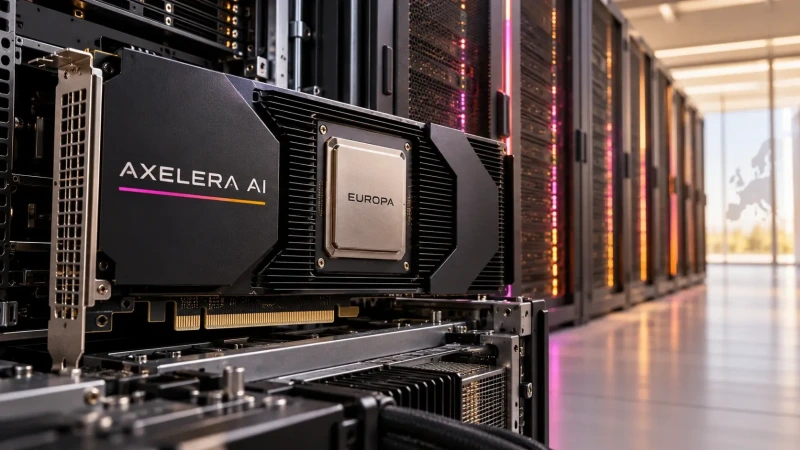
Axelera Launches Europa AI Chip for Dell and Supermicro Systems
-

- by THEFLGHT,
- September 15, 2026
- in Artificial-Intelligence
Axelera launches Europa AI chip products for Dell and Supermicro systems, moving its second-generation inference architecture into shipments for enterprise servers and European AI factories. The Dutch semiconductor company says more than 600 customers now use its wider accelerator portfolio.
The September 15 launch turns Europa from an announced processor design into commercially available hardware. Axelera also disclosed signed supply contracts worth tens of millions, while carefully distinguishing its $1.5 billion sales pipeline from completed orders or recognized revenue.
The Europa launch establishes five concrete milestones:
- Europa-based chips and PCIe cards are shipping now
- Dell XE5 and Supermicro 111AD systems are validated
- Signed AI-factory deals are worth tens of millions
- The company reports more than 600 customers
- Europa targets inference rather than model training
Axelera Launches Europa AI Chip Into Production Systems
Axelera's official launch announcement says Europa is available as a standalone chip, a half-height PCIe card called Axelera Edge 232p and a full-height card called Axelera Server 250p. Standard form factors are meant to add inference capacity to existing servers without rebuilding an entire rack around a proprietary system.
Europa is designed to run trained models, including generative AI, vision-language models, agentic systems and computer-vision workloads. That is different from training a frontier model, which demands huge clusters and high-speed links among thousands of accelerators.
Inference is the repeated production work performed after training: generating tokens, analyzing video, interpreting sensor data or executing a model inside an enterprise application. Cost, latency and energy use become especially important because every customer request consumes additional compute.
Reuters reported that Axelera has signed multiple AI-factory supply contracts. Chief executive Fabrizio Del Maffeo said the completed agreements are worth tens of millions, but declined to disclose their precise customers and values.
The company is pursuing a potential sales pipeline of $1.5 billion. A pipeline measures opportunities under discussion and must not be treated as bookings, revenue or a forecast that every deal will close.
Europa AIPU Uses In-Memory Compute and RISC-V Cores
Europa combines eight second-generation AI cores with Axelera's digital in-memory computing technology. The architecture performs calculations close to data stored in SRAM, aiming to reduce the energy and delay created when conventional processors repeatedly move information between compute units and external memory.
According to Axelera's technical announcement, the processor delivers as much as 629 TOPS at INT8 precision. That measure counts low-precision operations commonly used for efficient inference; it is not directly comparable with benchmark results produced under different numerical formats or model workloads.
The chip also includes 16 RISC-V vector-processing cores for work surrounding the AI model, such as data preparation and output processing. An integrated H.264 and H.265 decoder handles media streams, allowing the host CPU to spend more time on application logic.
Its memory system includes 128 megabytes of on-chip L2 SRAM and a 256-bit LPDDR5 interface rated at 200 gigabytes per second. Axelera packages the processor in a 35-by-35-millimeter footprint and connects Europa cards through PCIe Gen4.
Axelera says an Edge 232p system can produce up to six times more tokens per second per watt than competing GPU-based products. The company notes that this result comes from its internal testing against publicly available competitor data, so independent workload-level benchmarks will be important.
Background Reading
Dell and Supermicro Validate Europa PCIe Cards
The Axelera Edge 232p is available in validated configurations of Dell's XE5 and Supermicro's 111AD, according to the company. Validation matters because enterprise buyers need confirmed compatibility across cooling, power, firmware, drivers and operating-system support rather than a chip specification alone.
Axelera says its broader systems ecosystem also includes Advantech, Axiomtek, HPE, Lenovo and Seco. The same Voyager software toolchain supports both Europa and the earlier Metis platform, which can reduce the amount of application work required when developers move between form factors.
Europa expands beyond Metis's original emphasis on edge deployments. Metis can analyze cameras or sensor streams near the place data is collected, while Europa adds the memory capacity and processing headroom needed for heavier language, multimodal and server workloads.
The distinction is strategically useful for Axelera. It can sell compact accelerators for robots, drones and industrial devices while addressing enterprises that want to run models on premises for privacy, data-sovereignty, latency or predictable-cost reasons.
AI Factory Contracts Test Europe's Inference Strategy
Axelera is supplying projects connected with Europe's effort to turn supercomputing centers into AI factories. Reuters identified Dell and systems integrator E4 alongside Axelera in Italy's IT4LIA initiative and Luxembourg's MeluXina project.
Those deployments give the launch a policy dimension. European institutions want local researchers and companies to access advanced computing while reducing dependence on a small number of U.S. hardware and cloud suppliers.
A European chip does not automatically create a sovereign supply chain. Manufacturing, memory, packaging, networking and software can still depend on companies outside the region. Europa's practical contribution is narrower: another accelerator option designed in Europe and integrated into systems enterprises can purchase now.
Axelera says its products are deployed across defense, robotics, drones, retail, telecommunications, aerospace and security. The company's figure of more than 600 customers covers its complete portfolio, not 600 Europa installations.
The next evidence will come from named supply contracts, independent performance tests and production availability across more server models. Customers will compare Europa with GPUs and other accelerators on supported models, latency, throughput, power consumption, software maturity and total operating cost.
Europa's launch gives Axelera a credible route from edge inference into enterprise servers and public AI infrastructure. Whether it becomes a durable alternative will depend on converting the reported pipeline into deployments that developers can reproduce and operators can measure.



0 Comments:
Leave a Reply