Anthropic Australia Data Center Lease Covers 2.16GW Campus
-

- by THEFLGHT,
- September 16, 2026
- in Artificial-Intelligence
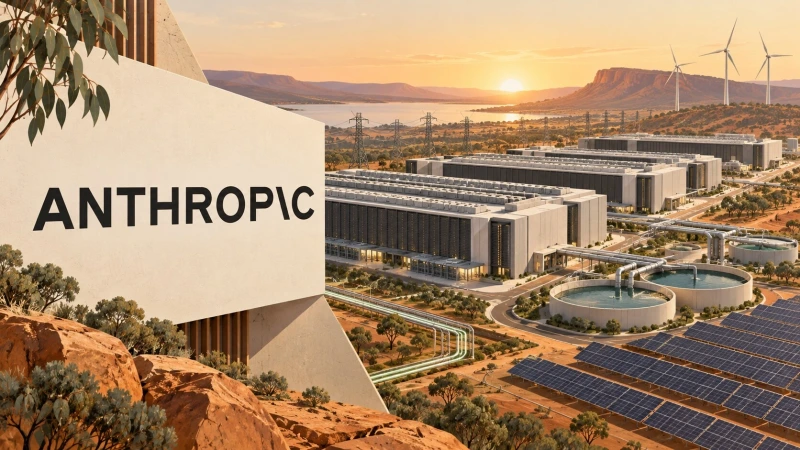
The Anthropic Australia data center lease covers the planned 2.16-gigawatt Western Downs Digital Park in Queensland, giving the Claude developer its first contracted computing site in the country. The campus is expected to begin coming online in 2027, subject to Australian foreign-investment approval.
The agreement has four defining features:
- A 2.16-gigawatt planned capacity near Dalby.
- Inference workloads rather than model training.
- Closed-loop, air-cooled systems to limit water demand.
- Renewable power contracts and developer-funded grid connections.
Anthropic Australia Data Center Lease Reaches 2.16 Gigawatts
Reuters reported on September 16 that Anthropic signed a lease covering the entire proposed campus, citing two people familiar with the agreement. The site sits on farmland about 250 kilometers from Brisbane and would rank among the world's largest computing facilities if fully built.
Queensland Premier David Crisafulli announced the deal in state parliament, describing it as Anthropic's first major Australian investment. The proposed Western Downs Digital Park would be developed by Singapore-based Zerra DC near Dalby and connected to the Braemar power station.
The parties have not published a joint commercial announcement. Reuters said Anthropic and Zerra declined to comment, while the deal remains subject to approval by Australia's Foreign Investment Review Board. Those conditions leave the final timetable, financing structure and phased capacity dependent on regulatory and construction milestones.
A reported A$31.9 billion project value describes the broader planned development rather than a disclosed payment by Anthropic. No lease price, contract duration or minimum-capacity commitment has been made public.
Western Downs Digital Park Is Designed for Claude Inference
The Queensland capacity would be used for inference, according to one Reuters source. Inference is the process that runs a trained model to answer prompts, analyze documents or generate code; training creates or updates the model itself using much larger datasets and sustained computing runs.
That distinction gives the site a clearer role. Local compute can reduce the distance between Australian customers and Claude services, improve response times, and help enterprises keep processing within a domestic operating environment. It also separates day-to-day model serving from the copyright and content questions surrounding training data.
Australia is preparing rules that would limit the use of domestically produced content for AI training. An inference-focused deployment lets Anthropic add regional capacity without making the proposed facility dependent on how those training provisions are ultimately written.
The design also reflects the resource constraints facing large AI campuses. Reuters reported that Zerra would use renewable power-purchase agreements, pay grid-connection costs rather than passing them to existing customers, and deploy a closed-loop, air-cooled system intended to reduce demand for clean water.
Zerra DC Must Deliver Power, Cooling and Construction at Scale
Zerra says it develops and operates hyperscale campuses across Australia, Japan and India, providing land acquisition, permitting, power aggregation, design, construction and operations. Western Downs would test that integrated model at an unusually large scale.
A 2.16-gigawatt nameplate does not mean the full load arrives on opening day. Hyperscale campuses are normally delivered in phases as substations, generation contracts, network links and customer halls become available. The first 2027 opening would therefore be an initial milestone, not completion of all planned capacity.
The electricity plan will attract close scrutiny. Queensland wants data centers to add generation rather than raise household costs, while communities are demanding safeguards for water, land and grid reliability. Crisafulli said such projects must protect local water supplies and give affected communities a voice.
Air cooling and closed-loop circulation can reduce water consumption, but they do not remove the campus's power requirements or the need to reject heat. The decisive disclosures will be the project's phased load, energy contracts, backup generation, water balance and grid-upgrade schedule.
Australia Competes for AI Infrastructure Investment
Anthropic follows OpenAI in reserving Australian data-center capacity. The country offers available land, renewable-energy potential and proximity to Asia-Pacific customers, while established hubs in the United States and parts of Asia face crowded grids and longer connection queues.
Economists cited by Reuters estimate Australia's data-center investment boom could reach A$150 billion, or about US$107 billion, by 2030. Capturing that spending could expand construction, power and fiber investment, but the employment payoff after construction may be smaller than the capital headline suggests.
For Anthropic, the lease secures a regional base before Australia's 2027 resource rules take effect. For Queensland, it is a test of whether an enormous AI load can be connected without shifting infrastructure costs to existing electricity users.
The next credible checkpoints are regulatory approval, a detailed construction schedule and signed power arrangements. Until those appear, the 2.16-gigawatt figure should be treated as the campus's planned ceiling rather than capacity guaranteed to operate in 2027.
Related Coverage


0 Comments:
Leave a Reply