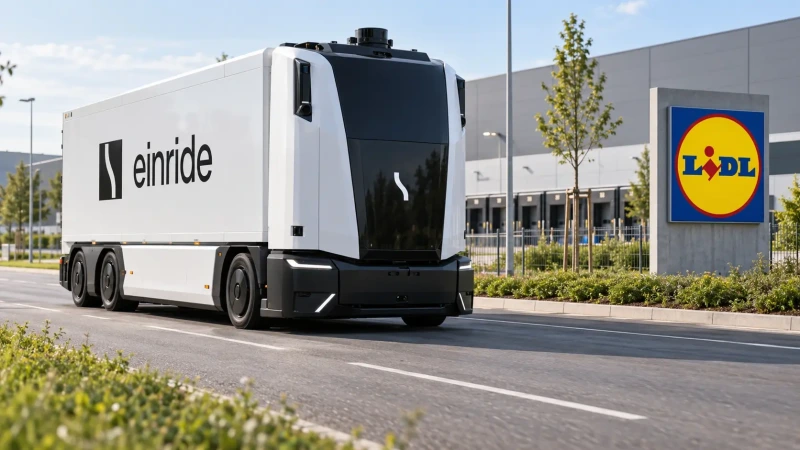
Einride Autonomous Truck Launches Into Daily Lidl Service in Germany
-

- by THEFLGHT,
- September 15, 2026
- in Artificial-Intelligence
The Einride autonomous truck has entered daily Lidl service on German public roads, carrying goods between a distribution center and a store in Edermünde. The electric vehicle operates without a driver or safety operator aboard.
The deployment is narrower than unrestricted self-driving across Germany: it is a Level 4 system authorized for a defined logistics route. Even so, moving a cab-less truck from trials into recurring retail work marks a practical step for autonomous freight in Europe.
The launch combines four concrete elements:
- Daily goods transport on a public road
- No driver or safety operator inside the truck
- Germany's first KBA permit of its kind
- A planned expansion to a multi-stop milk run
Related Coverage
Einride Autonomous Truck Enters Daily Lidl Freight Service
Einride and Lidl announced the deployment on September 15, saying the vehicle now runs directly between a Lidl distribution center and a retail store. Unlike a demonstration with a safety driver ready to intervene, the cab-less truck has no conventional driving compartment and nobody onboard.
The companies describe the operation as Germany's first regular public-road deployment of a cab-less autonomous truck. Reuters independently reported that the vehicle is operating at SAE Level 4, the category in which an automated system performs the driving task within its approved operating conditions.
The route turns a familiar retail transfer into an early commercial test bed. Repeated journeys between known facilities allow the operator to measure reliability, loading coordination and road behavior while limiting variables that would multiply across a national network.
KBA Permit Defines the Level 4 Operating Domain
Germany's Federal Motor Transport Authority, known as the KBA, granted the permit after safety validation, according to the companies' announcement. Einride and Lidl called it the first authorization of its kind in the country.
The permit is important because Level 4 does not mean the vehicle can drive everywhere in every condition. The system is designed to manage the complete driving task within a defined operational domain, which may restrict geography, route, road type, weather or other conditions.
That distinction makes the Edermünde project commercially relevant without overstating its reach. The public-road authorization covers an actual freight workflow, but it does not establish nationwide permission for Einride trucks to travel autonomously on arbitrary routes.
Einride has pursued this controlled-deployment approach in several markets. In a recent U.S. securities filing, the company said its broader platform combines electric freight vehicles, charging infrastructure and software used to plan and monitor transport operations.
Lidl Plans a Multi-Stop Milk Run
The initial movement links two Lidl locations, but the partners intend to develop it into a multi-stop milk run. In logistics, that means one vehicle follows a recurring route serving several collection or delivery points rather than shuttling only between two facilities.
A successful expansion would test more difficult coordination problems. The autonomous system would need to fit multiple arrival windows, loading processes and traffic segments into one reliable schedule while maintaining the conditions attached to its operating authorization.
Lidl is part of Schwarz Group, one of Europe's largest retail organizations. The announcement said further deployments across the group are under discussion, giving the Edermünde route potential importance beyond one store if operational results support a broader rollout.
The companies also framed the project as a response to commercial-driver shortages and supply-chain reliability. Autonomous trucks could cover repetitive, predictable links while human drivers focus on routes or tasks that still require greater flexibility and judgment.
Electric Cab-Less Freight Faces the Scale Test
Removing the cab changes more than the driving system. A purpose-built autonomous vehicle can allocate its physical design around cargo and electric operation, but it also depends on dependable remote oversight, charging, maintenance and facility processes that conventional trucks handle differently.
The economic case will therefore depend on the whole logistics system, not simply whether the vehicle can stay in its lane. Utilization, energy costs, loading delays, permit expansion and intervention rates will determine whether the model can compete with established road freight.
Einride reported in its securities filing that its connected fleet had completed more than 14 million electric miles and 450,000 shipments by the end of 2025. Those company figures cover its wider freight operations, not autonomous public-road miles from this German project.
For Lidl and Einride, the immediate evidence will come from daily execution in Edermünde. If the route remains reliable and the KBA approves additional operating domains, the planned milk run and possible Schwarz Group expansion could show how quickly cab-less freight moves from tightly bounded deployments into repeatable retail logistics.





0 Comments:
Leave a Reply