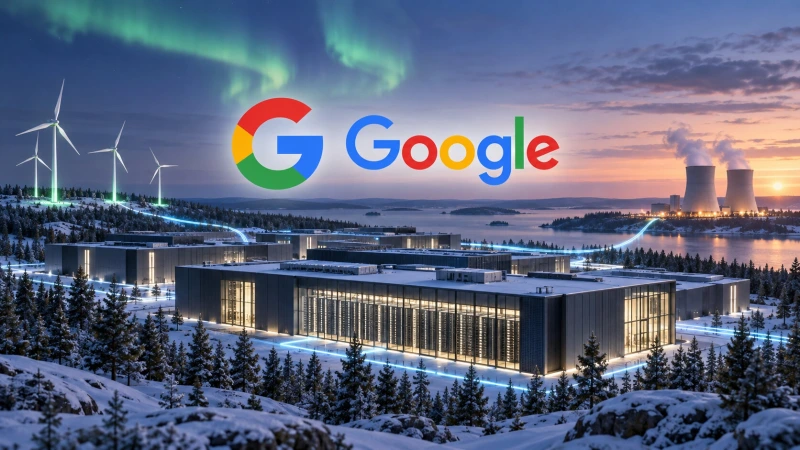
Google Invests €13 Billion in Finland AI Infrastructure and Nuclear Power
-

- by THEFLGHT,
- September 09, 2026
- in Artificial-Intelligence
Google Finland AI infrastructure investment will total at least €13 billion over 2027 and 2028, the company announced on September 9. The program covers three new data centers, expansion around its established Hamina campus, grid projects and energy agreements intended to support rising demand for Gemini, Search, Maps and YouTube.
Google’s Finland plan combines four major commitments:
- New infrastructure in Hamina, Kajaani, Muhos and Vaala.
- A 22-year agreement tied to the Loviisa nuclear plant.
- Additional wind capacity and a 94-megawatt battery system.
- Local training, community and environmental programs.
Google Invests €13 Billion Across Four Finnish Locations
Google described the program as its largest single investment in Europe. Reuters reported that three new data centers will be built in northern Finland, while Google’s announcement identifies Hamina, Kajaani, Muhos and Vaala as the locations receiving infrastructure, partnerships or community investment.
Finland has hosted Google infrastructure for more than 15 years. The company converted a former paper mill in Hamina into a data center and developed a seawater-based cooling system there, giving it an operating base before the new northern and central projects begin.
The geography is central to the expansion. Colder weather can lower server-cooling costs, and northern Finland offers existing grid capacity near carbon-free generation. Siting large computing loads closer to power production may also reduce the need to move electricity across congested transmission routes.
Google estimates that construction in 2027 and 2028 will support more than 37,000 jobs nationwide and contribute €3.6 billion annually to Finnish gross domestic product during that phase. Those figures are company projections and will depend on permitting, construction schedules, supplier spending and the pace at which the facilities enter service.
The Loviisa Agreement Links AI Demand to Nuclear Power
The most consequential energy component is a 22-year power purchase agreement with Finnish utility Fortum. Reuters reported that Google will buy up to half of the output from the Loviisa nuclear power plant between 2030 and 2049, providing long-term revenue certainty for its life-extension program.
Google calls it the company’s first nuclear-energy agreement outside the United States. Fortum plans to extend and modernize Loviisa so the plant can operate through 2050, while the two companies will also examine opportunities for new reactors at the site.
Loviisa currently accounts for about 10% of Finland’s electricity supply and employs roughly 580 people, according to Google. Keeping that capacity online offers continuous low-carbon power that can complement wind generation, particularly during cold and calm periods when electricity demand is high.
The contract does not mean Google’s data centers will connect directly to a dedicated reactor. Power purchase agreements provide financial support and match consumption with generation through the grid, while the physical electricity mix continues to reflect all plants supplying the Finnish system.
Related Research
Wind, Batteries and Flexible Computing Support the Grid
Google is pairing the nuclear agreement with two onshore wind projects developed by Valorem and Suomen Hyötytuuli. The contracts bring its total new-to-grid wind capacity under agreement in Finland to 629 megawatts, according to the company.
A 94-megawatt battery planned near the Kajaani site is expected to begin operating in late 2027. The system is designed to balance short-term supply and demand and reduce price volatility when wind output falls, rather than provide continuous power for an entire data-center fleet.
Google also plans to explore demand response with grid operator Fingrid. That arrangement could temporarily reduce computing loads during periods of system stress, building on capabilities tested at Hamina during the 2022–2023 European energy crisis.
Electricity availability and household prices are politically sensitive as data-center construction accelerates. Finnish Prime Minister Petteri Orpo said available information indicates the country has enough electricity, while Google says its portfolio is designed to add supply and avoid pushing consumer costs higher.
A Google-commissioned study modeled a hypothetical one-gigawatt load in the Oulu–Kajaani region and estimated that northern siting could save Finnish energy consumers €520 million over 20 years compared with locating the same demand in the south. The estimate is a scenario analysis, not a guaranteed outcome from the announced facilities.
Finland Becomes a Larger European AI Infrastructure Hub
The investment places Finland deeper in the competition to host European AI computing. Stable grids, low-carbon electricity, cool temperatures and available land have made Nordic markets attractive as hyperscalers seek capacity without relying entirely on crowded data-center regions farther south.
Google is allocating another €31 million over four years to communities around the four locations. Its plans include AI training for more than 4,400 workers through local colleges, data-center career opportunities for 100 students, and projects covering forests, wetlands and public recreation.
The buildout still faces the ordinary execution risks of infrastructure at this scale. Grid connections, environmental approvals, equipment supply and local construction capacity will determine when each facility operates and how closely the economic impact matches Google’s forecasts.
Energy is becoming inseparable from AI strategy as model training and inference expand. Google’s Finnish package shows the emerging template: commit capital to compute, secure long-duration power, add grid-balancing resources and locate new demand where electricity and cooling conditions are comparatively favorable.
The first measurable milestones will arrive with construction activity in 2027, followed by the Kajaani battery and eventual data-center openings. The nuclear contract begins in 2030, giving Finland and Google several years to complete the Loviisa upgrades and integrate the new computing load into the national grid.


0 Comments:
Leave a Reply