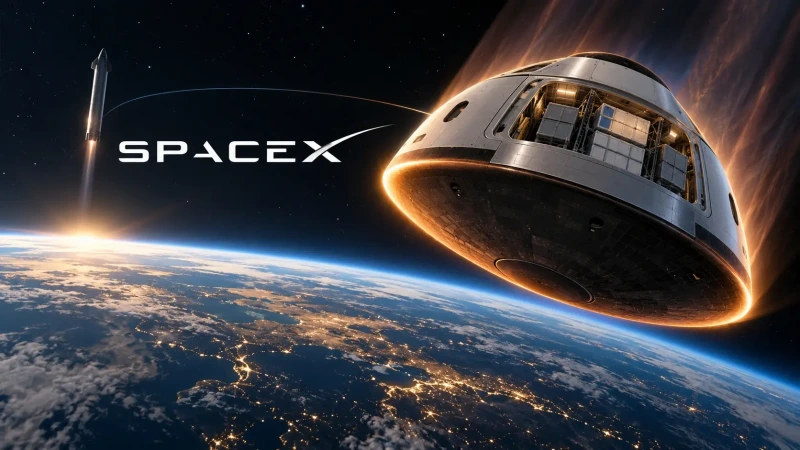
SpaceX Starfall Wins First Customer for 2028 Starship Mission
SpaceX Starfall has won its first known customer, giving the company’s orbital cargo-return system a commercial mission target after its June demonstration. Luxembourg-based Space Cargo plans to place its BentoBox payload system inside a Starfall capsule on a Starship flight scheduled for 2028.
The deal links SpaceX’s heat-shield and reentry technology with a European mission integrator serving researchers and manufacturers. Space Cargo says BentoBox could secure up to one tonne of customer payloads for return to Earth, although Starship remains in development and SpaceX has not independently announced the mission date.
The agreement establishes four important milestones:
- Space Cargo becomes Starfall’s first known customer.
- The partners are targeting a Starship flight in 2028.
- BentoBox is designed to hold up to one tonne of payloads.
- Life-science and biotechnology users form a major target market.
SpaceX Starfall First Customer Sets a 2028 Target
Reuters reported on September 15 that Space Cargo signed a mission agreement for SpaceX’s Starfall program. Space Cargo chief executive Nicolas Gaume described his company as the first customer and said the capsule would fly on Starship’s first commercial mission in 2028.
That timetable should be read as Space Cargo’s plan, not a completed SpaceX launch commitment. SpaceX did not respond to Reuters and has not publicly established when Starship will begin commercial missions. The rocket’s development has run behind earlier schedules, making launch readiness the deal’s largest execution dependency.
Starfall is a disk-shaped aluminum capsule protected by a heat shield roughly 10 feet, or three metres, across. SpaceX can launch the capsule on Falcon 9 and eventually Starship, giving customers a way to send experiments or manufacturing equipment through low-Earth orbit and recover products that must return safely.
The company flew a Starfall demonstration mission in June. That test moved the project beyond a paper design, but a successful customer service requires more: predictable launch integration, reliable deorbiting, atmospheric guidance, thermal protection, recovery and transfer of payloads back to their owners.
BentoBox Adds One Tonne of Customer Payload Capacity
Space Cargo will install its BentoBox system inside the Starfall capsule. BentoBox is a modular platform intended to provide power, data handling and controlled conditions for experiments and production hardware, while the surrounding reentry vehicle supplies transport and thermal protection.
The European Space Agency’s Business in Space Growth Network describes BentoBox as an autonomous, return-capable platform for research, in-space manufacturing, product development and technology testing. Its customers span life sciences, advanced manufacturing and other fields that require access to microgravity followed by reliable recovery.
Space Cargo told Reuters that the Starfall version could secure as much as one tonne of different customer payloads. The company’s current systems handle about 200 kilograms, so the planned configuration would materially increase the amount of experimental hardware and manufactured material that one mission could bring home.
Nearly half of the potential customers for the first Starfall flight are in life sciences and biotechnology, according to Space Cargo. Microgravity can change fluid behaviour, crystal growth and material formation, creating research conditions that cannot be reproduced precisely under Earth’s gravity.
The Starfall Heat Shield Turns Reentry Into a Service
Launching hardware into orbit is only half of the commercial problem. Customers developing pharmaceuticals, specialty materials or optical products also need those results returned without destructive heating, excessive vibration or an unpredictable recovery schedule. Reentry therefore becomes a logistics service rather than a final spacecraft manoeuvre.
Starfall converts experience from SpaceX’s larger Dragon capsules into a smaller uncrewed return product. The heat shield must survive hypersonic atmospheric flight while the capsule steers toward its recovery region. Payload integration must also protect delicate samples and maintain any environmental conditions required after orbital operations end.
Space Cargo’s role is to aggregate demand and manage customer equipment inside BentoBox. That can lower the integration burden for laboratories that lack their own spacecraft teams: one intermediary packages several experiments, coordinates interfaces and books transport rather than each customer negotiating a separate capsule mission.
The arrangement is not exclusive to Starfall. BentoBox also has plans involving German startup ATMOS Space Cargo’s Phoenix capsule and the European Space Agency’s Space Rider. A multi-vehicle strategy gives Space Cargo alternative routes to orbit and reduces dependence on one launch schedule or return architecture.
SpaceX will face established and emerging competition. Varda Space Industries has already flown multiple return capsules, using them to demonstrate the recovery of materials processed in orbit. Other providers are developing inflatable heat shields, reusable spaceplanes and dedicated reentry vehicles for scientific, commercial and defence customers.
Microgravity Manufacturing Still Depends on Starship Execution
The proposed mission is strategically important because Starship promises much greater volume and flight frequency than today’s return systems. Space Cargo’s chief executive said capacity and cadence were central to the deal. Larger, more frequent missions could make orbital production less like a rare experiment and more like a repeatable supply chain.
That opportunity remains conditional. Starship must complete additional flight tests, deploy payloads reliably and receive the regulatory approvals needed for a commercial schedule. Its next planned test is expected to pursue the program’s first deployment of SpaceX-built Starlink satellites, another step toward routine orbital work.
The 2028 target also carries a useful signal beyond this one capsule. If the mission flies as described, it would show Starship supporting an external commercial payload rather than only SpaceX’s own satellite deployment and development objectives. Delays would affect both Starfall and the customers whose research timelines depend on recovery.
Pricing has not been disclosed, so the business case cannot yet be compared directly with competing return services. Customers will judge the offering by total mission cost, schedule certainty, payload survival, recovery speed and the quality of data and environmental control maintained throughout the flight.
The clearest near-term evidence will come from contracts with additional payload customers, published integration requirements and progress on Starship’s commercial launch sequence. Starfall now has a named customer and a defined use case; turning that agreement into a reliable orbital round trip will determine whether SpaceX can make cargo return a scaled business.




0 Comments:
Leave a Reply