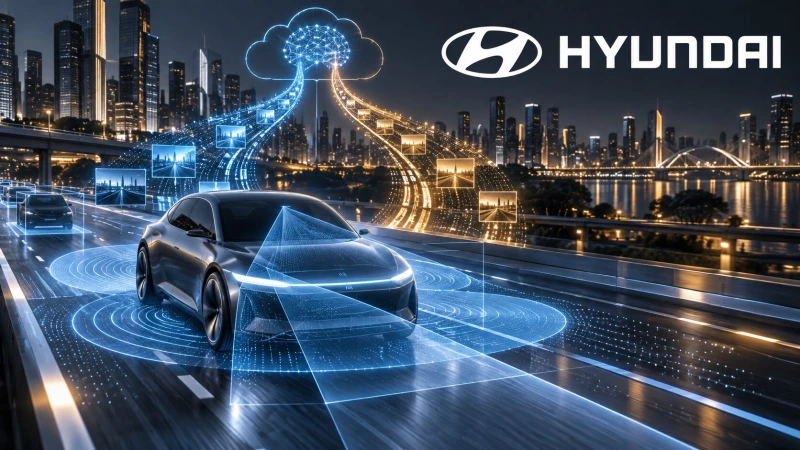
Hyundai Unveils Atria AI Roadmap With Nvidia Systems Due in 2028
-

- by THEFLGHT,
- September 14, 2026
- in Artificial-Intelligence
Hyundai Atria AI is scheduled to reach production vehicles in the second half of 2029, while Nvidia-based driver-assistance systems are targeted for 2028. The dual-track roadmap gives Hyundai Motor Group an earlier commercial path as it continues developing its own end-to-end driving model.
The plan was detailed at Hyundai Motor Group’s Autonomous Driving Media Day on September 13. It turns a partnership announced in March into a timetable and introduces a “Data Flywheel” intended to convert real-world fleet data into repeated cycles of model training, validation and deployment.
Hyundai’s roadmap sets four concrete milestones:
- Nvidia-based Level 2+ production vehicles in the first half of 2028.
- Nvidia-based Level 2++ vehicles in the second half of 2028.
- Atria AI Level 2++ production in the second half of 2029.
- A Level 4 Atria test vehicle in South Korea by year-end.
Hyundai Atria AI Moves to a 2029 Production Target
Hyundai’s official announcement identifies Atria AI as a proprietary end-to-end autonomous-driving system jointly developed by the group’s Advanced Vehicle Platform division and 42dot. Hyundai showed footage of an Atria-equipped software-defined vehicle navigating complex urban traffic without driver intervention at a Level 2++ capability.
The demonstration does not make the system driverless. Level 2 systems require the driver to remain responsible and supervise the vehicle, even when software controls steering, acceleration and braking. Hyundai’s labels distinguish increasingly capable assistance from Level 3 conditional automation and Level 4 operation within a defined domain.
Reuters reported that the proprietary system had originally been expected in late 2027, making the second-half 2029 target a two-year delay. Hyundai has not announced which models or markets will receive Atria first, nor has it published pricing or a consumer release date.
The revised schedule separates software independence from near-term deployment. Hyundai can put more capable assistance into production through Nvidia in 2028, collect operational data, then use those lessons to refine Atria instead of waiting for the internal system to be ready before advancing its product lineup.
Nvidia DRIVE Hyperion 10 Anchors the 2028 Rollout
The first track uses Nvidia’s DRIVE Hyperion 10 computing and sensor platform inside Hyundai’s software-defined vehicle architecture. Hyundai targets Level 2+ production in the first half of 2028 and Level 2++ production in the second half, bringing the more complex urban-driving capability forward by about a year relative to Atria.
Reuters reported that initial vehicles will use cameras, radar and ultrasonic sensors rather than expensive lidar. Hyundai is considering lidar for future Level 3 systems because sensor redundancy becomes more important when a vehicle is allowed to handle the driving task under specified conditions.
The two companies first expanded their autonomous-driving partnership in March. That agreement covered Level 2-and-above systems for selected vehicles and possible Level 4 robotaxi work through Motional, but it did not provide the detailed 2028–2029 production sequence disclosed this weekend.
Hyundai says it will co-design the technology rather than purchase a sealed system. The Nvidia deployment is supposed to produce data and engineering experience that can strengthen Hyundai’s own stack. That makes the relationship both a route to market and an input into the automaker’s longer-term effort to control its driving software.
Related Coverage
The Data Flywheel Connects Fleet Scale to Model Training
Hyundai’s Data Flywheel is a closed development loop: vehicles collect driving information, engineers select difficult scenarios, models train against those cases, the results are validated, and improved software returns to vehicles. New deployments then generate more examples for the next training cycle.
Hyundai and Kia sell more than seven million vehicles annually across roughly 190 countries and regions, according to the company. That scale could become an advantage if the group obtains appropriate customer permissions, standardizes sensors and turns varied road conditions into high-quality training data.
The group currently operates about 40 dedicated data-collection vehicles around the clock. Hyundai says its system emphasizes hard examples—including uncommon road layouts, unusual objects and ambiguous behavior—because model quality depends on finding situations that expose weaknesses, not simply accumulating the largest possible volume of ordinary driving footage.
Data scale alone will not establish safety. Hyundai must also show how it protects personal information, labels driving events, tests regional variations and measures system failures. The company’s target to overtake competitors in accumulated driving data by 2033, reported by Reuters, is a strategic ambition rather than evidence of superior performance today.
Level 4 Testing Extends Beyond Consumer Driver Assistance
Hyundai is developing higher automation in parallel with the production roadmap. It plans to deploy an Atria-equipped SDV Pace Car in the Jeonnam-Gwangju Special Metropolitan City area by the end of 2026 through a project with South Korea’s transport ministry.
That vehicle is intended for real-world Level 4 validation, where an automated system performs the full driving task inside a limited operational domain. A test deployment is materially different from a commercial service, and Hyundai has not attached a mass-production date to Level 4 Atria vehicles.
The distinction will matter as Hyundai competes with Tesla, Chinese automakers and robotaxi developers. Consumer systems can add highway and urban assistance quickly, but broader autonomy requires dependable performance across weather, construction, human behavior and rare events, plus regulatory approval in every intended market.
The clearest near-term tests are now measurable. Hyundai must deliver Nvidia-based Level 2+ vehicles in early 2028, advance to Level 2++ later that year and move Atria into production in late 2029. Meeting those dates—and publishing evidence about safety and supervised-use limits—will show whether the dual-track strategy closes the software gap it was designed to address.




0 Comments:
Leave a Reply