X-Humanoid Advances TianGong Robots From Record Sprint to Factory Trials
-

- by THEFLGHT,
- September 11, 2026
- in Artificial-Intelligence
X-Humanoid TianGong robots are moving from record-setting sprints toward factory work, with the Beijing developer now emphasizing reliability, safety and measurable customer returns. Its Ultra humanoid completed 100 metres in 8.64 seconds at the World Humanoid Robot Games, a time numerically below Usain Bolt’s 9.58-second human record.
The company’s new disclosures connect the track result to four commercial priorities:
- Stable motion over long operating periods.
- Autonomous handling of real industrial tasks.
- Safer braking and lighter future hardware.
- Lower costs that improve customer returns.
X-Humanoid TianGong Robots Pivot Toward Reliability
X-Humanoid’s latest update shifts attention from individual performance records to the full system required for deployment. The company says buyers are increasingly evaluating research, production, delivery, support and return on investment together, rather than judging robots mainly by speed, payload or joint counts.
The Beijing Humanoid Robot Innovation Centre, commonly known as X-Humanoid, was established in 2023. It develops humanoid bodies, motion-control software and embodied-AI systems, while offering parts of its technology and data ecosystem to universities, developers and industrial partners.
Its product stack includes the TianGong 3.0 general platform, the smaller TianGong Omni and the Tianyi 2.0 industrial robot. X-Humanoid also promotes HuiSi KaiWu, a general embodied-intelligence platform designed to coordinate perception, planning and action across different machines and tasks.
The company’s official September 9 account says 49 partner teams using TianGong platforms competed at the Games. They represented 31 universities and several industry participants, showing how X-Humanoid is using competition as a development environment rather than treating medals as the product.
Motion Control Behind the 8.64-Second TianGong Run
TianGong Ultra carried three running strategies trained in simulation, according to Reuters. Each motion-control system continually adjusted the robot’s joints and balance without an operator directing every step, allowing engineers to trade proven stability against higher but less-tested speed.
The team changed programs across the competition. Ultra ran 9.39 seconds in a preliminary round, improved to 8.86 seconds in the semifinal and reached 8.64 seconds in the final. Engineers tested faster strategies between races and repaired machines damaged by falls during the compressed schedule.
That progression demonstrates rapid optimization under controlled conditions, but it does not establish that the robot is faster than a human in an equivalent contest. Robot-specific rules, starting procedures and hardware constraints differ from sanctioned human athletics, so the useful comparison is engineering progress over repeated trials.
The track also exposed an unresolved safety problem. Ultra weighs about 75 kilograms and can exceed 17 metres per second, yet it relied on a padded barrier to stop after the finish. X-Humanoid’s engineers are considering lighter designs, stronger braking and safer postures for later versions.
Background Reading
Factory Trials Put ROI Ahead of Spectacle
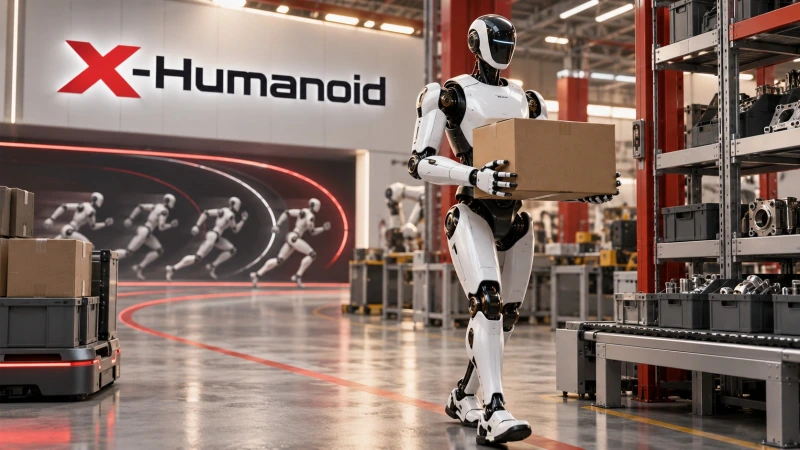
X-Humanoid has begun testing robots in practical settings, but the evidence remains early. Reuters reported that Tianyi 2.0 units have moved boxes at a Foton Cummins engine factory in Beijing, lifting loads of 8 to 12 kilograms onto shelves during an exploratory trial.
The company’s official site lists autonomous parts sorting, electrical-cabinet inspection and material transport among its application scenarios. Those tasks require visual recognition, navigation, task planning and manipulation to work together, which is materially harder than repeating a rehearsed movement on a clear track.
TianGong Omni offers another indicator of mobility beyond racing. In an internal test this year, the smaller robot climbed from the first floor to the 17th floor of X-Humanoid’s headquarters. The result suggests useful terrain handling, although it is not yet a measure of sustained commercial reliability.
Chief executive Xiong Youjun says industrial customers have started calculating return on investment as proof-of-concept projects move into factories. Humanoids still trail established industrial robots on that measure, but customer scrutiny can force developers to reduce costs, raise uptime and shorten deployment cycles.
The near-term market is likely to favor structured jobs where a human-shaped machine can use existing aisles, shelves and tools. Smaller TianGong robots could enter service and light-industry roles first, while Ultra’s mobility may eventually support outdoor inspection or emergency response.
Safety and Standards Will Determine TianGong’s Scale
A fast biped is not automatically a useful worker. Commercial systems must recover from disturbances, stop predictably, protect nearby people and perform for hours without constant engineering attention. They also need models that can adapt to changing objects and environments instead of executing only narrow routines.
X-Humanoid says it is participating in dozens of standards projects, including work on safety and interfaces. Common interfaces could reduce duplicated engineering between robot bodies, sensors and software, while safety requirements will be essential before humanoids operate regularly beside employees or customers.
The company has not disclosed how many of its robots it has sold or commercially deployed. That omission matters because medals, demonstrations and pilot programs do not reveal manufacturing yield, field maintenance costs or the proportion of working hours completed autonomously.
The next credible milestones are operational rather than theatrical: longer factory trials, repeatable task completion, accident data, deployment counts and customer economics. TianGong Ultra’s sprint proved that X-Humanoid can push dynamic motion quickly; turning that capability into dependable work will test the rest of its technology and business.





0 Comments:
Leave a Reply