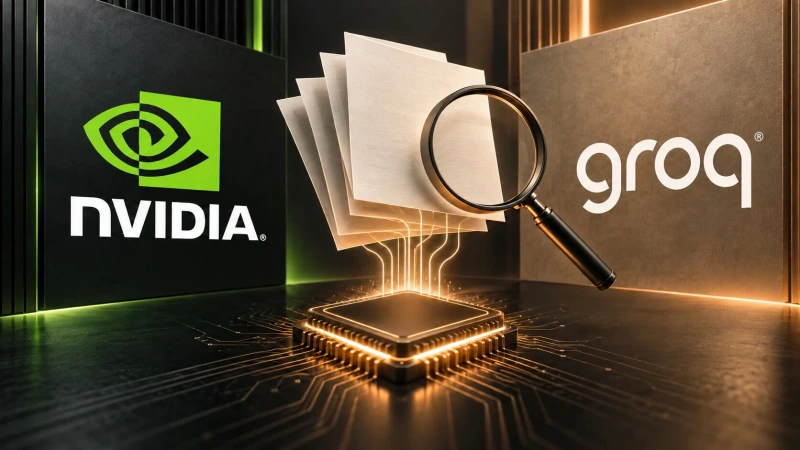
DOJ Probes Nvidia’s $17 Billion Groq Licensing Deal
-

- by THEFLGHT,
- September 10, 2026
- in Artificial-Intelligence
DOJ probes Nvidia’s Groq deal as U.S. antitrust officials examine whether the $17 billion AI-chip licensing arrangement was structured to avoid the scrutiny normally applied to an acquisition. The investigation adds a concrete regulatory test to a deal format that has spread across the artificial-intelligence industry.
The inquiry centers on three elements:
- A non-exclusive license for Groq’s inference-chip technology
- The transfer of founder Jonathan Ross and other senior engineers to Nvidia
- Whether the structure sidestepped federal merger review
DOJ Probes Nvidia’s Groq Deal After a Formal Information Request
The Justice Department opened its investigation soon after the transaction was announced in December 2025 and sent Nvidia a formal request for information, according to a Reuters report published September 10, citing The New York Times.
Investigators are examining whether Nvidia designed the arrangement to escape antitrust review rather than pursuing a conventional takeover. The inquiry is not a finding that Nvidia or Groq violated the law, and neither the Justice Department nor Groq had commented publicly on the investigation when Reuters published its account.
Nvidia defended the arrangement, saying it promoted innovation, rewarded entrepreneurs and benefited consumers. Reuters reported that the department could impose a fine if it concludes the deal was mishandled, although the agency is considered unlikely to seek an unwinding of the transaction.
The $17 Billion License Combined Technology With Talent
The unusual structure matters because Nvidia did not buy Groq outright. In its December 24 announcement, Groq described a non-exclusive license covering its inference technology while confirming that Ross, president Sunny Madra and other engineering employees would join Nvidia.
Groq said it would continue as an independent company under chief executive Simon Edwards and that GroqCloud would keep operating. That separation preserved a corporate shell and an active service even as Nvidia obtained technology rights and recruited the people most closely associated with the hardware.
The current report values the deal at $17 billion. Financial terms were not disclosed in the original company announcement; contemporaneous reporting had placed the arrangement as high as $20 billion. The updated figure should therefore be understood as reported transaction value, not a public line-by-line contract disclosure.
For regulators, the central question is economic substance. A licensing agreement can be non-exclusive on paper while still weakening an independent competitor if the buyer gains critical intellectual property, leadership and engineering expertise together. The department can investigate that competitive effect even when a transaction did not follow the standard merger-notification path.
Groq’s Inference Architecture Addresses Nvidia’s Competitive Gap
Groq focuses on inference, the stage when a trained AI model generates answers for users. Nvidia dominates model training through its GPUs, but inference gives challengers more room to compete on response speed, energy use, memory design and the cost of serving each token.
Groq’s processors use substantial on-chip SRAM rather than depending on external high-bandwidth memory in the same way as many accelerators. That design can reduce data movement and deliver predictable, low-latency output, though the limited on-chip capacity creates trade-offs for very large models.
Those capabilities make the license strategically important. The market is shifting from a narrow emphasis on training ever-larger models toward the recurring expense of running models for search, coding, voice and enterprise software. Faster inference can improve user experience while lowering the infrastructure required for high-volume services.
The agreement also arrived as memory supply became a bottleneck across the AI-chip industry. Groq’s different architecture offered Nvidia another route to serve inference workloads and defend its platform against AMD, Cerebras and custom chips developed by major cloud companies.
The Groq Investigation Could Shape Future AI Acquihires
Technology groups have increasingly paired licensing payments with the recruitment of founders and core teams. The structure can deliver many benefits of an acquisition without buying the startup’s legal entity, taking on all its liabilities or automatically entering the usual pre-merger process.
In March, the Justice Department’s acting antitrust chief called attempts to sidestep scrutiny through acquihires a regulatory “red flag,” according to Reuters. He did not identify a specific active matter, but cited deals that combine technology licenses with senior hires as a category deserving attention.
The Nvidia inquiry will test how aggressively enforcers look beyond labels such as “license” or “partnership.” A formal request for information lets officials examine contracts, internal communications, personnel moves and the practical limits on Groq’s ability to compete after the deal.
Any enforcement outcome could influence how AI companies document future licenses, retain startup independence and decide when to notify regulators. For now, the most important fact is narrower: the government is investigating the structure, while the companies maintain that Groq remains independent and the license is non-exclusive.
Background Reading


0 Comments:
Leave a Reply