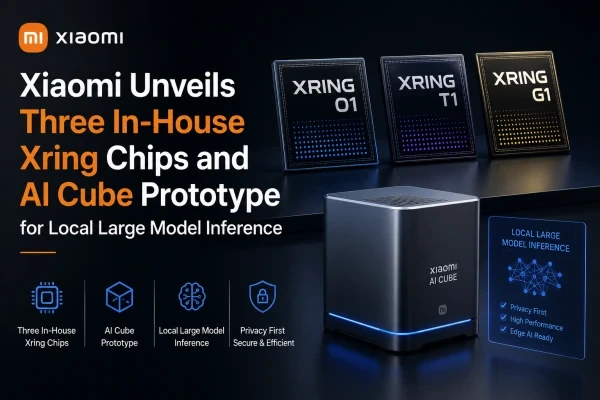
Xiaomi Unveils Three In-House Xring Chips and AI Cube Prototype for Local Large Model Inference
-

- by THEFLGHT,
- August 24, 2026
- in Artificial-Intelligence
Xiaomi has taken a significant step in its semiconductor strategy, unveiling three new in-house chips and an engineering prototype designed for local large-language-model inference.
At a technical briefing on August 24, 2026, the company introduced the Xring O3 flagship system-on-chip, the Xring O100 high-bandwidth AI accelerator, and the Xring D100 3-nanometer smart-driving AI chip, together with the AI Cube Prototype mini-PC that integrates all three.
The announcements mark Xiaomi’s expansion beyond smartphone silicon into dedicated AI acceleration and automotive computing. The company said it has invested more than 21 billion yuan (approximately $3.1 billion) in its chip program and now employs nearly 3,000 engineers in the effort.
Xring O3: Flagship Mobile SoC
The Xring O3 is positioned as Xiaomi’s next-generation AI flagship system-on-chip. Built on a 3-nanometer process with roughly 24 billion transistors, it features a 10-core all-large-core CPU architecture and a new 16-core G2-Ultra NX GPU.
Xiaomi reported Geekbench 6 multi-core scores around 15,221 (about 60 percent higher than the prior generation) and AnTuTu overall scores of approximately 5.228 million.
The chip includes a 200 TOPS low-power NPU optimized for Xiaomi’s MiMo on-device models and is the first Xiaomi SoC to support LPDDR6 memory. Graphical performance is claimed to improve by 85 percent, with ray-tracing performance up 182 percent. The O3 is scheduled to debut in the Xiaomi 18 Fold later in 2026.
Xring O100: High-Bandwidth AI Accelerator
The O100 is a specialized 6-nanometer AI acceleration chip focused on large-model inference rather than general computing. It uses advanced 3D wafer-on-wafer stacking and hybrid bonding to place two layers of high-speed DRAM directly above the NPU compute die.
The design delivers 1.22 TB/s of near-memory bandwidth—roughly 16 times that of mainstream smartphone LPDDR5X—through more than 28,000 data lines and extremely dense bonding (258 million nodes at 1.4 μm pitch).
Xiaomi said the architecture enables peak on-device inference speeds of up to 330 tokens per second. The chip contains 14 dedicated large-model NPU cores and uses a custom high-bandwidth matrix bus (XRING HB-Matrix) that switches between ring and all-to-all topologies depending on the prefill or decode phase of generation. Commercial availability is planned for 2027.
Xring D100: 3 nm Smart-Driving Chip
The D100 is described as China’s first high-compute smart-driving AI chip fabricated on a 3-nanometer process. It integrates a 20-core high-performance CPU and a 16-core NPU, with support for up to 160 GB of unified memory. Xiaomi stated the chip can run models with as many as 200 billion parameters locally.
The company has not yet disclosed TOPS ratings, foundry partner, or the first vehicle that will use the D100. Current Xiaomi electric vehicles rely primarily on Nvidia Thor chips (previously Orin). The D100 has completed validation and is targeted for commercial use in 2027. It joins a growing field of Chinese automaker-developed driving chips from Nio, Li Auto, Xpeng and BYD.
AI Cube Prototype: Desktop Local Inference
The most visible demonstration of the new silicon is the AI Cube Prototype, an engineering-sample mini-PC that combines the O3, O100 and D100. The device is designed for local deployment of large models and can run configurations up to 120 billion parameters alongside a smaller 3-billion-parameter model, with dynamic switching between “fast” and “slow” systems according to task load.
The chassis is machined from aerospace aluminum with more than 33,000 precision CNC openings for cooling and sustains continuous performance at 150 W. Xiaomi compared the concept to high-end desktop AI systems, positioning it as a compact platform for on-device agentic workloads without constant cloud connectivity.
No pricing or commercial launch timeline for the AI Cube has been announced; it remains an engineering prototype.
Strategic Context and Industry Implications
Xiaomi’s move reflects broader industry pressure to reduce reliance on external GPU suppliers for both consumer devices and vehicles while improving latency, privacy and cost for on-device AI.
High memory bandwidth has become a critical bottleneck for local inference of larger models; the O100’s stacked-DRAM approach directly targets that constraint.
For Xiaomi’s “human-car-home” ecosystem, the three chips provide a common AI compute foundation across smartphones, edge devices and vehicles.
Success will depend on manufacturing yields, software optimization of the MiMo models, actual performance versus power efficiency, and the ability to scale production—particularly for the more advanced D100.
The announcements arrive as Chinese technology companies continue to accelerate domestic semiconductor development amid export controls and intense competition in generative AI.
Whether these chips deliver competitive real-world tokens-per-watt and agent performance against established NVIDIA and other platforms will determine their impact beyond Xiaomi’s own product lines.
Xiaomi has not released detailed independent benchmarks beyond the claimed scores and token rates. Further technical papers, third-party testing and commercial product launches in 2026–2027 will provide clearer evidence of the chips’ capabilities.






0 Comments:
Leave a Reply