Roblox Unveils AI Scene Generator for Functional Game Layouts
-

- by THEFLGHT,
- September 12, 2026
- in Artificial-Intelligence
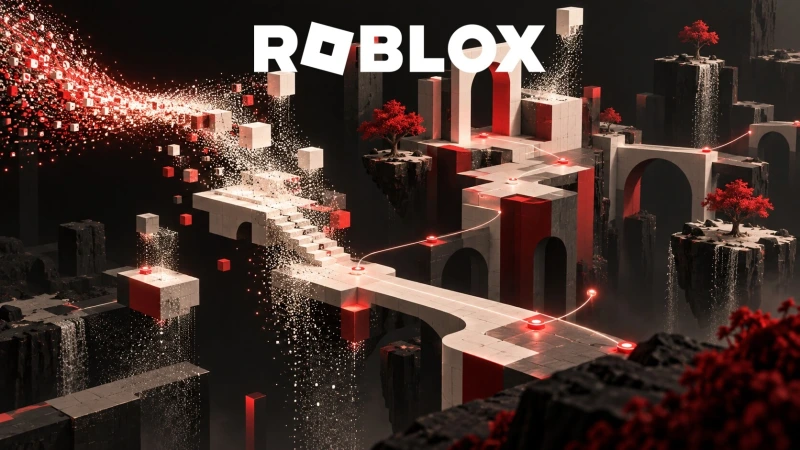
Roblox AI Scene Generator will turn text prompts and reference images into functional game layouts that creators can refine inside Roblox Studio. Announced at the Roblox Developers Conference on September 11, the tool is scheduled to reach both the Build app and Studio later in 2026.
Roblox’s creator roadmap adds four significant capabilities:
- Prompt-to-scene generation with editable layouts
- AI agents that playtest games and surface bugs
- Standalone distribution on mobile, PC and consoles
- Browser access and future offline play
Background Reading
Roblox AI Scene Generator Builds Functional Layouts
Roblox’s official RDC 2026 announcement says Scene Generator will accept a written prompt and a reference image. Its output will be a working scene layout rather than a flat illustration, giving creators geometry and objects they can continue editing in Studio.
The company has not published a precise release date, pricing or performance benchmark. It says the feature is coming later this year, with greater creator control available in Studio than in Build. That staged description makes Scene Generator a roadmap commitment, not a generally available product.
The functional-output claim is the important technical distinction. Image generators can suggest how a game world might look, but a usable scene must preserve spatial relationships, asset properties and engine compatibility. Creators need to move objects, change behaviors and connect the result to gameplay without rebuilding everything from scratch.
Roblox is positioning the model as one layer in a larger creation system. Build handles rapid prompt-driven iteration, while Studio supplies the deeper scripting, asset and production controls required for a finished game. Shared models and project history are intended to let creators move between those surfaces.
Build Has Already Produced About 9,000 Games
Scene Generator extends the Build product Roblox introduced in July. Build lets a person describe a game in natural language, receive a playable starting point, test it and publish from the Roblox app. The system combines proprietary Roblox technology with open-source models across mechanics, environments, characters, visual style and sound.
Roblox says creators had published approximately 9,000 games with Build by September 1. More notably, 71% of people who created a game through the product had never used Roblox Studio. Those company-reported figures suggest prompt-based creation is reaching users beyond the platform’s established developer community.
The Build public alpha began in New Zealand and is expanding to Serbia and Singapore. Roblox also gave conference attendees access and announced an asset library, desktop support and more iterative control. Availability still varies by age and region, so the early adoption numbers do not represent a worldwide release.
Lowering the entry barrier can produce more experiments, but it can also increase repetitive or unfinished submissions. Roblox says Build-created games enter its extended safety review and the same retention-based discovery pool used for other experiences. Games that fail to hold players should therefore receive less distribution, regardless of how quickly they were generated.
Playtesting NPCs Target the Quality-Control Bottleneck
Reuters independently reported that Roblox is developing non-player characters capable of playtesting games. The company’s July roadmap described a playtesting agent that surfaces bugs before players encounter them, alongside analytics and experiment agents for established creators.
An automated player could repeatedly navigate a level, test objectives and expose broken paths that a small team might miss. Unlike a static code check, the agent would interact with a running experience. Roblox has not disclosed the system’s launch date, test coverage or accuracy, leaving its practical value to be demonstrated.
Game testing is a strong target for agents because the work is repetitive and measurable. A useful system can document the steps that produced a failure and run the same route after a developer makes a fix. It still cannot determine whether a game is enjoyable, balanced or culturally appropriate without human judgment.
The combination of scene generation and automated testing creates a faster loop: generate a layout, run simulated players through it, repair failures and test again. That could help independent creators prototype more ambitious ideas, but it also makes audit trails and clear human approval important before a generated game reaches children or a large audience.
Standalone Apps and Browser Play Expand Distribution
The RDC announcements go beyond AI creation. Roblox plans to let creators distribute games as standalone apps across mobile devices, PCs and consoles while the company supplies underlying technology and services. This could give successful experiences a distinct identity outside the main Roblox application.
By the end of 2026, players are also expected to launch games through Chrome from an Experience Details page without installing the Roblox app. Support for additional browsers will follow. Fewer installation steps could make links shared through search, video platforms and social networks more effective acquisition channels.
Roblox says creators will eventually be able to combine online multiplayer with offline solo play. Early access is coming, with broader offline availability targeted for mid-2027. That change requires games to handle saved progress, device limits and later synchronization without depending continuously on Roblox’s servers.
The wider distribution plan raises the standard for AI-generated projects. A scene that works inside a controlled demo must remain stable across devices, input methods and network conditions. Automated playtesters could become more valuable as the number of supported environments grows, provided their reports are specific enough for developers to reproduce.
Roblox’s strategy links creation and reach: more people can build through prompts, while finished games can appear in browsers and standalone apps. The next evidence will be operational—how editable Scene Generator outputs are, whether testing agents catch meaningful defects and whether prompt-created games retain players after the novelty fades.






0 Comments:
Leave a Reply