Apple Launches Reference Image to Authenticate iPhone Photos
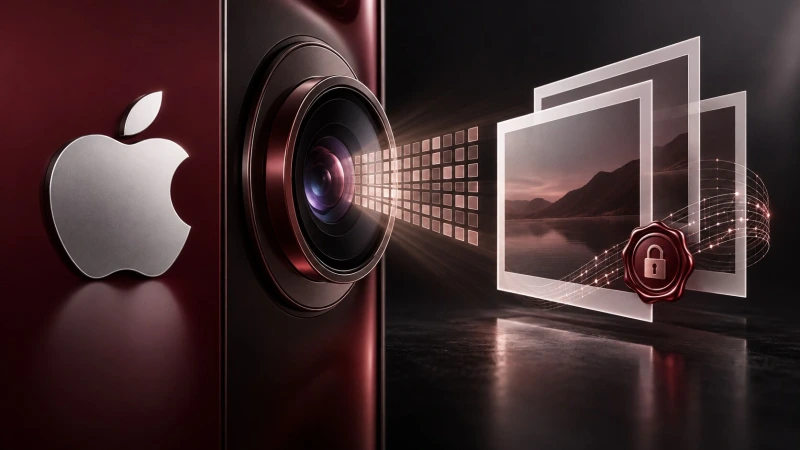
Apple Reference Image launches on the iPhone 18 Pro and Pro Max as an opt-in camera system designed to prove what a device’s sensor captured. Apple says the feature securely signs photo data at pixel level when the shutter is pressed, creating evidence that can be checked after an image is edited or redistributed.
The authenticity system adds four connected components:
- Pixel-level signing at the moment of capture
- An unalterable reference developed through Private Cloud Compute
- Side-by-side verification in the Photos app
- APIs for third-party apps across Apple platforms
Further Reading
Apple Reference Image Signs Sensor Data at Capture
The feature is part of the new iPhone 18 Pro camera system unveiled at Apple’s September event. On its official product page, Apple describes secure pixel-level signing that occurs during capture and is intended to verify exactly what the camera sensor saw.
That timing is the central technical distinction. Conventional metadata can describe a file after processing, but capture-time signing ties authenticity evidence to data produced by the camera hardware. If the signature remains valid, a verifier gains stronger evidence that the reference originated on a supported device.
Reference mode is optional rather than active for every photograph. According to MacRumors’ account of Apple’s announcement, a new main-camera sensor signs the data when a user deliberately takes a photo in that mode.
The signed sensor data is then sent to Apple’s Private Cloud Compute system, which develops it into what Apple calls an unalterable reference image. The reference appears beside the ordinary photo in the Photos app, allowing viewers to compare the captured scene with a version that may have been cropped, retouched or generated from it.
The Digital Negative Verifies Origin, Not Meaning
Apple’s approach addresses one part of the synthetic-media problem: establishing a trustworthy record of what a compatible camera registered. It does not prove that the scene was staged honestly, that the photographer’s caption is accurate or that important events occurred outside the frame.
The distinction matters for journalism, insurance, investigations and online marketplaces. A verified reference could help establish that pixels originated from a physical capture, while editors and investigators would still need location, time, witnesses and contextual evidence before drawing conclusions from the image.
Edits also require careful interpretation. A crop or exposure correction does not necessarily make a photograph deceptive, while an untouched image can still mislead through framing. Reference Image offers a comparison point rather than a universal truth label for the claims attached to a picture.
Apple is separating this mechanism from labels for synthetic material. The company also plans support for Google’s SynthID technology later in a software update, according to launch coverage, helping identify some media generated or edited with AI. Capture provenance and generative-watermark detection solve related but different problems.
Reference Image APIs Extend Verification Beyond Photos
Apple plans APIs in iOS 27, iPadOS 27 and macOS 27 so third-party software can display reference images. That could let newsrooms, verification services, evidence-management tools and social platforms check the reference without requiring every recipient to repeat the process manually inside Apple’s Photos app.
The usefulness of those APIs will depend on implementation details Apple has not fully disclosed publicly. Developers will need clear rules for accessing the reference, validating its signature, showing edits, handling exports and preserving the chain of evidence when files move between devices or services.
Interoperability will be especially important. A provenance system has limited value if verification works only within one manufacturer’s applications. Broad adoption would require other platforms to read the evidence reliably and present understandable results without converting a nuanced comparison into a misleading binary badge.
Privacy is another trade-off because the development process uses Private Cloud Compute. Apple designed that infrastructure so protected requests can run on server hardware without ordinary operator access, but users and independent researchers will want documentation explaining what sensor data leaves the phone, how long it exists and what auditing is available.
Regional Limits Narrow the Initial iPhone 18 Pro Rollout
Reference Image will debut only on the iPhone 18 Pro and Pro Max, which Apple will release on September 18 after preorders begin September 12. Restricting capture to new premium hardware means the pool of authenticated images will start small compared with the billions of photos produced by existing phones.
The launch also has geographic limits. Apple said Reference Image will not be available initially in China because of regulatory requirements. In the European Union, capture will not be available at launch, although devices running Apple’s new operating systems will be able to develop and view reference images.
Those exclusions complicate global verification. An image may circulate internationally even when the person receiving it lives in a region where capture support is unavailable. Consistent viewing tools and explicit status messages will be necessary to prevent absence of a reference from being misread as proof of manipulation.
The next tests are practical: whether creators choose Reference mode before important events, whether third-party apps adopt the APIs, and whether independent security researchers can validate the promised chain from sensor data to reference. The feature’s impact will depend less on one launch demonstration than on reliable use across real evidence workflows.






0 Comments:
Leave a Reply