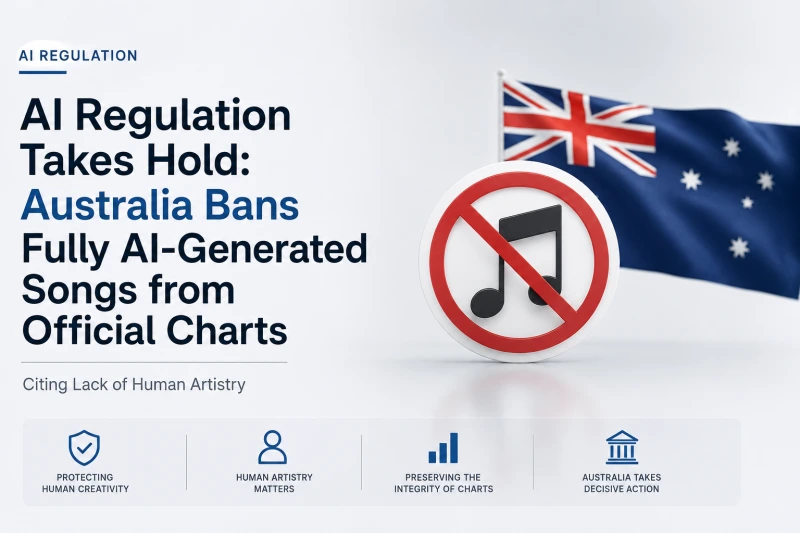
AI Regulation Takes Hold: Australia Bans Fully AI-Generated Songs from Official Charts, Citing Lack of Human Artistry
-

- by THEFLGHT,
- August 25, 2026
- in Artificial-Intelligence
Global AI Governance Advances with Targeted Industry Rules
The music industry in Australia has drawn a clear line in the sand on generative artificial intelligence. On August 25, 2026, the Australian Recording Industry Association (ARIA) announced updated eligibility rules for its official charts, effective with the release dated August 31, 2026.
Tracks that are substantially or entirely created by generative AI will no longer qualify for charting, while those using AI as a supporting tool remain eligible if they meet the standard criteria for human performance and creativity.
This marks the first major regulatory move by a national charting body to distinguish AI-generated content from AI-assisted content. ARIA CEO Annabelle Herd stated the changes reflect an intent to “promote the human nature of artistry” in a market described as the “most crowded market in history.”
The decision follows intense industry debate triggered by a viral Australian cover of Madonna’s “Like a Prayer” that topped radio playlists and reached the ARIA dance charts, only for the artist to later disclose heavy AI use.
How the New Rules Work
Under the updated ARIA Charts Code of Practice, a recording qualifies for charting only if it is “substantially human made” and complies with copyright and stream-manipulation rules. ARIA defines AI-generated tracks as those where generative AI produced “the entirety or the primary portion of the creative elements,” including lead vocals or key instruments created by AI.
AI-assisted recordings—where humans write the song, perform the lead vocal and primary instruments, and use AI only for mastering, drum machines, or autotune—remain fully eligible.
Artists must now declare AI use when submitting releases to the ARIA survey.
If an AI-generated track is later found to have topped the charts, ARIA may adjust positions, withdraw accreditations, or request the return of any #1 award. The rules align with global IFPI principles published in July 2026 and apply uniformly to physical, digital, and streaming releases.
Industry Backlash and Precedent-Setting Context
The policy comes amid broader global conversations about AI’s role in creative industries. It follows similar discussions in Europe and the United States, where regulators and rights holders have debated transparency and authorship standards for generative tools. ARIA’s move is notable because the Australian market ranks among the most competitive, with fierce competition for radio airplay, streaming visibility, and awards recognition.
Industry observers note that while AI tools are already widely used for tasks such as mastering or production, the ban targets cases where AI effectively replaces human artistic contribution. This distinction could influence how future generative models are developed and deployed in music, potentially encouraging more transparent workflows and hybrid human-AI creative processes.
Technical and Ethical Considerations for AI in Creative Fields
Generative AI systems trained on vast datasets of existing music raise questions about copyright, originality, and the definition of “authorship.” ARIA’s approach underscores a growing consensus that human performance and creative input remain essential for cultural recognition. The policy also highlights the need for clear labeling standards, as the industry has adopted an open standard from the global music community to help distinguish AI-generated from AI-assisted works.
Critics of the ban argue it may stifle innovation in music production, where AI can democratize access to professional-grade tools. Supporters, however, maintain that celebrating purely synthetic content risks undervaluing the human skills that have defined music for centuries. The ruling provides a practical test case for how regulatory bodies can balance rapid technological advancement with cultural preservation.
Broader Implications for AI Regulation and Creative Industries
Australia’s action adds to a growing body of AI governance efforts, including data-privacy rules and safety frameworks in other sectors. In the music space, it signals that regulators are beginning to codify boundaries around generative tools rather than waiting for full technological maturity. Similar debates are likely to emerge in film, literature, and visual arts, where AI-generated content increasingly competes for attention and credit.
For developers and studios, the policy underscores the importance of maintaining human creative oversight. Tools that require substantial AI intervention may need hybrid workflows or certifications to remain competitive in markets with strict charting rules. As AI models continue to evolve, such industry-specific regulations could help shape ethical development paths while fostering trust among audiences and creators.
The ARIA update serves as a timely reminder that AI regulation is no longer confined to abstract policy papers or research labs. It is now reaching the creative industries that depend on public perception, cultural value, and economic viability. As more jurisdictions consider similar measures, the coming months are expected to see further clarification on what constitutes authentic human creativity in an AI-augmented world.
This development highlights the maturing relationship between technology and society: innovation continues at breakneck speed, but boundaries—defined by artists, consumers, and regulators—are being drawn to ensure the human element remains central. The Australian charts will serve as a benchmark for how the music world navigates AI’s integration, offering lessons for other creative and knowledge-based sectors worldwide.






0 Comments:
Leave a Reply