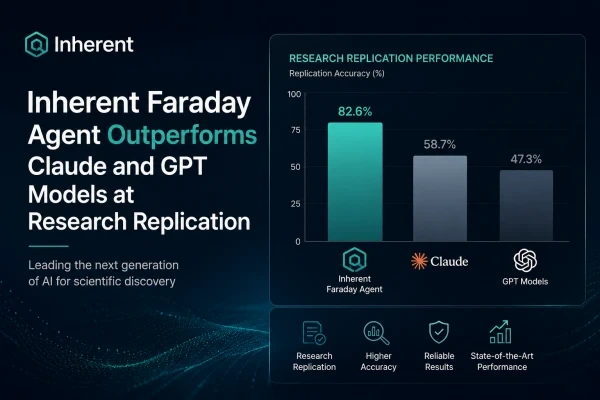
Inherent Faraday Agent Outperforms Claude and GPT Models at Research Replication
-

- by THEFLGHT,
- August 23, 2026
- in Artificial-Intelligence
London-based AI startup Inherent has released Faraday, a compact AI agent that outperforms significantly larger frontier models from Anthropic and OpenAI at the challenging task of independently replicating results from published scientific papers.
The 27-billion-parameter system, built on Qwen 3.6 and trained with long-horizon reinforcement learning, marks a notable step toward AI systems capable of genuine scientific judgment rather than mere pattern matching.
Founded by Google DeepMind alumni, Inherent emerged from stealth earlier this year with a $50 million seed round led by Index Ventures and Radical Ventures.
Nvidia’s venture arm NVentures also participated. The company positions Faraday as an “AI Scientist” teammate designed to collaborate with human researchers on open-ended discovery problems.
What Faraday Achieves
Faraday was evaluated on Replica, a new benchmark consisting of 310 figure-replication tasks drawn from 100 research papers spanning machine learning and AI-for-science domains.
These include natural language processing, materials science, structural biology, weather forecasting, and meta-learning. In each task, the agent must reproduce experimental findings without being given the original plot or the final answer in advance, operating under strict time and compute limits.
According to results reported by Inherent and detailed in the accompanying technical paper, Faraday outperforms Anthropic’s Claude Opus 4.8 and OpenAI’s GPT-5.5 on 73 percent of in-distribution machine learning tasks and 60 percent of held-out AI-for-science tasks.
On the test split overall, it delivers an average improvement of roughly 6 percent over Claude and 8 percent over GPT-5.5 according to a rubric-based evaluation judge validated against human expert assessments.
The advantage is not limited to one domain. Faraday produced more faithful replications across every category tested, with particularly strong results in meta-learning, structural biology, and materials science.
It also handled recent research papers more effectively, applying scientific skills to work that the underlying base model had not seen during pre-training.
A Smaller Model Directing Larger Ones
A key architectural choice sets Faraday apart from typical frontier agents. Instead of attempting to handle every aspect of the research process with a single massive model, the 27B-parameter system acts as a scientific orchestrator.
It reasons about experimental design, prioritizes which investigations are worth pursuing, and delegates coding and implementation work to a more powerful coding agent—currently OpenAI’s GPT-5.5 Codex—much as human scientists rely on specialized software tools.
This “CAT” approach (compact agent plus large tool) allows Faraday to improve performance while directing a model orders of magnitude larger than itself. The system was trained using GPT-5.4-mini as its coding tool but can generalize at test time to stronger agents.
As coding models continue to advance, Inherent expects the value of high-quality scientific judgment layered on top of them to increase further.
Edward Hughes, cofounder and chief scientist, emphasized that the goal was never simply to beat larger models on a leaderboard. “What was most interesting to us about this was not so much the result of beating those frontier agents—which of course we liked—but was actually the way we went about building this,” he told TechCrunch.
The team focused on instilling “research taste”: an instinct for which experiments matter, how to design them rigorously, and when to explore side paths that papers typically omit.
Training for Research Taste
Perfect numerical reproduction of a plot is insufficient. Successful replication also demands sound experimental design, adherence to the original paper’s claims, efficient use of limited resources, and scientific rigor.
Inherent addressed the challenge of training on these non-verifiable qualities by developing per-task rubrics and an auto-generated LLM judge. Human studies confirmed that the judge aligns well with expert assessments of replication quality while reducing noise compared with simpler LLM scoring approaches.
Training used long-horizon reinforcement learning with modifications for multi-sample aggregation and turn-level credit assignment to stabilize learning over extended trajectories.
The result is an agent that learns to value discoveries intrinsically rather than relying on hand-coded evolutionary search loops or external test-time rewards common in some prior AI Scientist systems.
Replica itself is designed as a scalable curriculum. Tasks can be made more underspecified by removing additional details from papers, tightening resource constraints, or even presenting imagined papers, potentially guiding the same model toward genuine innovation rather than pure replication.
Why It Matters
Paper replication has long served as a foundational exercise for human PhD students. It forces researchers to confront the underspecified details, failed attempts, and practical decisions that published papers rarely document fully—the “99 percent perspiration” behind the reported results.
By mastering this process, Faraday demonstrates a form of experimental reasoning that current large language models still struggle to maintain consistently over long horizons.
If the approach scales, it could accelerate scientific workflows in fields where reproducibility remains a persistent bottleneck. More ambitiously, Inherent frames replication as a stepping stone toward AI systems that can identify which questions are worth asking in the first place and pursue open-ended discovery in collaboration with humans.
The company operates as a small, in-person team of about a dozen people in London’s King’s Cross neighborhood, a growing AI hub. It plans to expand to roughly 20–25 employees by year-end.
Its founders include Tantum Collins, Edward Hughes, and Louis Kirsch from DeepMind, alongside Kaloyan Aleksiev with experience at Reka AI and Microsoft. Former UK government AI adviser Matt Clifford serves as an adviser.
What Comes Next
Inherent is already investigating how its methods might contribute to scalable oversight and reduce risks associated with more autonomous agents.
The company stresses keeping humans firmly in the loop while enabling AI systems to surface unexpected experimental results and insights.
Faraday’s release and the accompanying paper arrive at a moment when the industry is intensely focused on agentic capabilities, scientific applications of AI, and the relative value of specialized post-training versus pure scale.
A 27-billion-parameter system that can productively direct frontier coding models and outperform them on research-oriented tasks offers a concrete data point in that debate.
Whether Faraday’s research taste generalizes to true scientific innovation remains an open question that will require further evaluation and real-world use.
For now, the results on Replica provide one of the clearer demonstrations to date that carefully designed training for scientific judgment can yield measurable advantages over simply deploying the largest available models.





0 Comments:
Leave a Reply