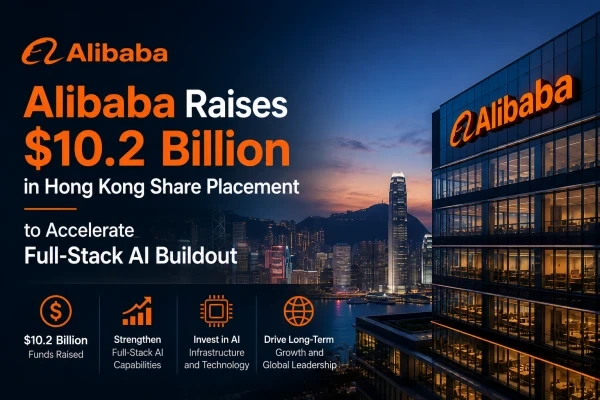
Alibaba Raises $10.2 Billion in Hong Kong Share Placement to Accelerate Full-Stack AI Buildout
-

- by THEFLGHT,
- August 23, 2026
- in Artificial-Intelligence
China's Alibaba Group on Sunday launched a HK$80 billion ($10.2 billion) share placement in Hong Kong, directing 100 percent of the net proceeds toward expanding its full-stack artificial intelligence capabilities.
The offering ranks as the largest primary follow-on share sale by a Hong Kong-listed company and the world's third-largest of its kind this year.
According to a term sheet reviewed by Reuters, Alibaba plans to sell 710 million ordinary shares at HK$112.70 each, a 3.6 percent discount to its most recent closing price.
The placement is structured as an offshore transaction not registered under U.S. securities laws, excluding American investors.
Proceeds Targeted at Chips, Infrastructure and Models
Alibaba stated that the funds will support investment across its "full stack" AI efforts. This encompasses chips, computing infrastructure, and the development and deployment of AI models. The company provided no further breakdown by category in its regulatory disclosure.
The move follows Alibaba's latest quarterly results, in which net profit fell 75 percent year-over-year as the company accelerated AI-related capital expenditures.
CEO Eddie Wu told analysts that the firm had already spent nearly half of its three-year capex plan and expects the payback period on AI investments to shorten to 2.5 years from three years, driven by strong demand.
"In order to be able to capture that future growth, we first need to make these capex investments to build out the necessary compute capacity," Wu said on the earnings call.
Strong Investor Demand and Market Context
Sources familiar with the deal told Reuters that the offering met strong demand, including from sovereign wealth funds, and that Alibaba increased its size after oversubscription. Joint bookrunners include Morgan Stanley, HSBC, UBS and CICC.
The placement comes amid intense global competition in AI infrastructure. U.S. hyperscalers Microsoft, Amazon, Alphabet and Meta are projected to spend roughly $725 billion in capital expenditures in 2026, much of it tied to AI data centers, chips and cloud capacity.
Chinese technology firms have similarly ramped spending to secure compute and model development resources.
Alibaba's free cash outflow reached $6.6 billion in the June quarter as capital spending approached nearly $10 billion quarterly. The company has positioned the raise as necessary to maintain competitiveness in frontier models and supporting infrastructure.
Hong Kong Market Significance
Bloomberg data indicates the deal would be Hong Kong's biggest follow-on offering on record by a company and the city's largest share sale since 2021. It follows a period of elevated Chinese capital-market activity linked to AI investment, with technology valuations rising on sector optimism.
Alibaba has been expanding its AI offerings, including its Qwen series of models. The latest capital injection underscores the scale of resources required to compete at the frontier, where model training, inference capacity and custom silicon all demand sustained multi-billion-dollar outlays.
Industry Implications
The transaction highlights how Chinese technology companies are accessing equity markets to fund AI ambitions at a time of elevated global capital expenditure.
While U.S. firms have relied heavily on free cash flow and partnerships with chipmakers, Alibaba's public placement provides a large, immediate infusion dedicated exclusively to AI.
Market observers will watch how quickly the proceeds translate into additional compute capacity and whether Alibaba can improve the efficiency of its AI investments as projected.
The deal also adds to the growing list of major equity raises this year aimed at underwriting the next phase of AI infrastructure buildout.
Alibaba did not provide a detailed timeline for deployment of the funds beyond its general commitment to full-stack AI capabilities. Further details on specific chip, data-center or model initiatives may emerge in subsequent disclosures.

0 Comments:
Leave a Reply