Anthropic Reports Claude Drug Research Results From Six Partners
-

- by THEFLGHT,
- October 30, 2026
- in Artificial-Intelligence
Claude drug research is moving beyond hypothetical molecule suggestions into laboratory design, quality-document review and clinical-trial planning. In an October 27, 2026 report, Anthropic described early work with six biotechnology and pharmaceutical partners, including tests of shorter CAR-T cell components and antibody designs for food allergies.
The results are promising but largely preclinical. Anthropic has not shown that Claude has produced an approved medicine or shortened the time to one. The clearest evidence so far is narrower: measured lab outcomes at partner companies and a large reduction in one manufacturer's paperwork-review time.
Related Research
Claude Drug Research Spans Six Partners
Anthropic's primary report names BigHat Biosciences, Bristol Myers Squibb, Divergence Labs, Enveda, Generate Biomedicines and The Column Group. Their projects occupy different stages of development, from selecting a biological target and engineering candidate treatments to reviewing manufacturing records and assessing trial plans.
That breadth is the point of the program. Drug development is not a single design problem: a useful molecule must also survive production, pass quality checks and prove itself in people. Anthropic says working on real programs exposes limitations that general demonstrations of AI-driven discovery may miss.
The partner work covers four distinct bottlenecks:
- Generate and BigHat tested engineered cell-therapy or antibody components.
- Divergence screened proposed antibody designs for food-allergy research.
- Enveda used Claude to review manufacturing records and draft documents.
- Bristol Myers Squibb and The Column Group tested planning workflows.
The companies supplied the scientific goals, experimental systems and human review. Claude helped propose or analyze options, but the reported measurements came from laboratory tests or operational evaluations. That distinction matters when evaluating whether an AI model has discovered a treatment, rather than assisted people working toward one.
Generate Tests a Shorter CAR-T Cell Design
At Generate Biomedicines, six scientists used Claude Code while redesigning the intracellular signaling portion of a chimeric antigen receptor, or CAR. Shortening that genetic instruction could free space for other functions in future cell therapies aimed at solid tumors, where today's CAR-T treatments have been harder to apply.
One design was about 70% shorter than the reference. Anthropic says lab tests found roughly ten times as many receptors on the immune-cell surface, stronger tumor-cell killing and longer-lasting activity. Those are cell-level findings, not evidence of a successful solid-tumor treatment in patients.
Generate's technical paper provides the experimental detail behind the summary. It describes several design-and-test rounds, including measurements in primary T cells and target-cell assays. The paper also notes that experimental feedback exposed gains the models had not predicted, limiting any claim that software alone solved the biology.
BigHat Biosciences pursued a different engineering problem: improving two antibody-fragment leads. With Claude connected to its lab-data system, the team made and tested about 1,010 variants over roughly ten weeks. Anthropic reports more than tenfold tighter binding in the best versions, alongside improvements in solubility or reduced clumping for different leads.
These measures can help determine whether a candidate remains usable during manufacturing and storage. They do not establish safety, clinical benefit or commercial manufacturability by themselves. BigHat's work illustrates why the downstream physical properties of a potential medicine matter as much as its apparent biological fit.
Divergence Screens Antibodies; Enveda Reviews Records
Divergence Labs asked Claude to help design a two-part approach to removing allergy-related IgE from immune cells. Anthropic says the system generated about 35,000 antibody designs in roughly a month. Early testing found three candidates that bound IgE and 20 that could dislodge it from cells.
Three of the 20 dislodging candidates appeared to outperform a standard medication in that specific assay. The two arms have not yet been combined into a working drug. A larger design count therefore represents a search process, not 35,000 validated treatments or evidence of benefit in patients with food allergies.
Enveda tested a less glamorous but measurable use: checking pharmaceutical manufacturing paperwork. Across 1,061 pages, its Claude-based system flagged all 11 issues human reviewers had found and seven more that they had missed, according to Enveda's technical report and Anthropic's account.
The reported human review time fell 89%, from more than 25 hours to under three. Claude also prepared first drafts of two regulatory documents. Drafting and flagging possible problems are not the same as regulatory approval; a qualified team still has to verify records, resolve findings and take responsibility for any submission.
Anthropic Extends Work Toward Trials
At Bristol Myers Squibb, Claude is being used to assess plans for an early-stage drug in clinical trials and estimate the chance of success. Anthropic says the companies intend to expand that work in 2027. It did not publish a controlled comparison showing that the model improves trial outcomes.
The Column Group is establishing Pleiades, a company intended to use Claude across scientific and operational drug-program tasks. Its first skill, for assessing target-disease pairs, has been evaluated on 45 pairs. That is an early workflow test, not proof that a small AI-assisted team can routinely bring drugs through trials.
Anthropic also disclosed its acquisition of Mithril Medicine, a one-person venture researching rare childhood muscular dystrophies. Founder Cody Tranbarger used Claude to coordinate 11 external laboratories. One candidate reached promising mouse results in under 18 months. Human trials could begin as soon as late 2028, if the work holds up.
Decisive evidence will require reproducible results beyond initial tests, progress in human studies and proof that AI saves time without raising scientific or regulatory risk. Anthropic calls most of this work preclinical. For now, the report documents useful early tools and experiments, not a new medicine.
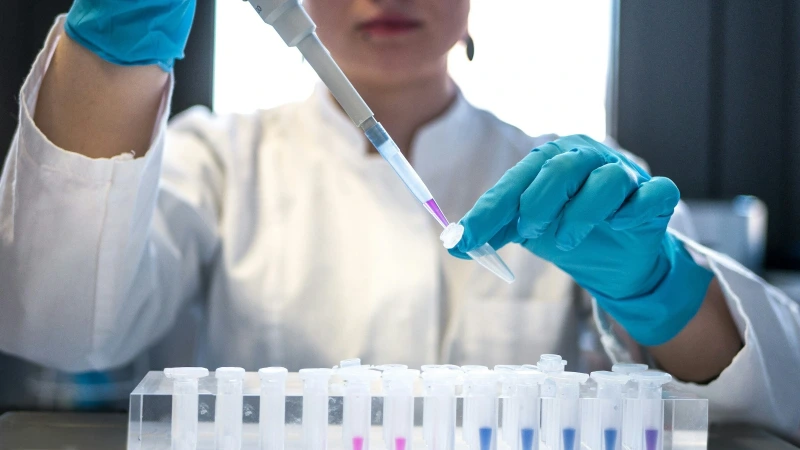
Illustrative stock photo of a laboratory scientist using a pipette: Julia Koblitz, via Unsplash, under the Unsplash License. The photo does not show Anthropic or a partner laboratory.




0 Comments:
Leave a Reply