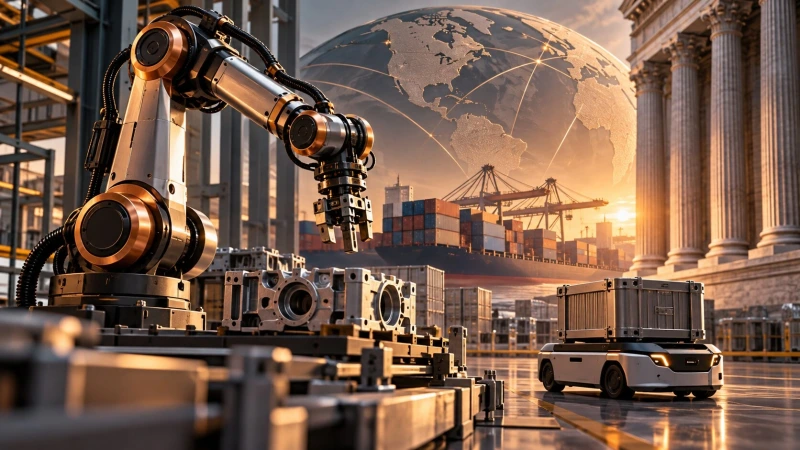
Trump Orders Robotics Import Talks, Holds Off on Tariffs
Robotics import talks are now U.S. policy after President Donald Trump found that foreign-made robots and industrial machinery threaten national security. His October 28 proclamation directs the Commerce secretary and U.S. trade representative to negotiate with trading partners, but imposes no new tariff on these imports today.
The decision affects a wide range of automation equipment, including industrial robots and potentially humanoid and other autonomous systems. It raises the prospect of future trade restrictions while leaving companies that buy imported machines without an immediate new duty under this order.
The proclamation makes four points clear:
- Commerce and USTR must pursue talks with trading partners.
- Officials must update the president within 180 days.
- No new robotics tariff is imposed in this proclamation.
- Tariffs, quotas, fees or domestic-production incentives remain options.
Background Reading
Robotics Import Talks Follow a Section 232 Finding
In the official proclamation, Trump accepted a Commerce Department finding under Section 232 of the Trade Expansion Act of 1962. The department concluded that the quantity and circumstances of robotics and industrial-machinery imports threaten to impair U.S. national security.
Section 232 gives a president authority to adjust imports when they pose such a threat. The new order chooses negotiations as its initial action. Commerce and the U.S. Trade Representative must seek agreements with countries they consider appropriate and report progress within 180 days of October 28.
That timing is a reporting requirement, not a guaranteed date for tariffs or a deadline by which every negotiation must end. The proclamation says the president may consider other remedies depending on the status or result of the talks, including if an agreement is not reached or proves ineffective.
Reuters reported that the decision followed a probe opened in September 2025. The immediate absence of a new duty is significant for American manufacturers that depend on imported machines, even though the finding creates a formal route to later restrictions.
Why the White House Cites Robot Supply and Security
The administration says the United States imports most types of robotics, industrial machinery and their components, while domestic output does not meet demand. It describes that reliance as a risk to defense production, critical infrastructure and the long-term capacity of the American manufacturing base.
The proclamation also argues that connected robots and machines can store or process sensitive data. Equipment integrated into factories or defense systems could introduce cybersecurity exposure if a supplier or remote operator cannot be trusted. The document presents this as a category-level concern; it does not identify a newly discovered flaw in a particular robot.
The White House fact sheet emphasizes the importance of robotics to defense, commercial manufacturing and dual-use equipment. The proclamation cites applications across all 16 U.S. critical-infrastructure sectors, from electronics and automotive production to medical devices and aircraft.
Those arguments do not mean every imported machine carries the same risk. A connected autonomous platform that can receive remote instructions poses a different security profile from a conventional production tool. The order does not publish a product-by-product risk assessment or list the suppliers that would face future measures.
Industrial Machinery Is Included Alongside Humanoid Robots
Although humanoids attract attention, the policy is broader than humanoid robotics or artificial intelligence. It covers robotics, industrial machinery, parts and components. The White House mentions autonomous robots, quadrupeds and ground vehicles among defense-related examples, while also describing machines used throughout manufacturing.
Reuters says the underlying probe examined programmable computer-controlled mechanical systems and industrial stamping and pressing machines. It also covered tools for cutting, welding and handling workpieces, plus autoclaves, industrial ovens and laser or water-cutting equipment. The proclamation itself does not announce product-specific tariff rates or customs classifications.
This distinction matters for AI and robotics companies. A future measure could affect the cost and availability of hardware needed to build or deploy automated systems, but software models, training methods and domestic robot projects are not directly restricted by the October 28 order.
The measure is also separate from earlier federal restrictions on some Chinese robot models. Reuters reported that the Federal Communications Commission barred imports of new models of certain Chinese robots in July while allowing existing models to continue. The new Section 232 process instead concerns a broader category of imports and begins with international negotiations.
The 180-Day Report Will Shape Any Robot Trade Measures
The president has left several possible responses open: tariffs, duties, quotas, fees and incentives for investment in U.S. robotics and machinery production. None is enacted by this proclamation. Any eventual remedy would need its own concrete terms before importers could calculate costs or identify covered products.
For manufacturers, the short-term result is policy uncertainty rather than an immediate tax increase. Buyers may continue planning equipment purchases under existing rules, but suppliers and customers will have to watch the negotiations and any later presidential action that specifies import restrictions.
Domestic robotics developers may see an opening if the government ultimately supports local production. Yet restrictions on imported components could also raise costs for U.S. firms that assemble robots at home. The balance depends on product definitions, exemptions, trading-partner agreements and the availability of domestic alternatives, none of which is settled here.
The next verifiable milestone is the officials' report within 180 days. Until then, the accurate reading is narrow: the administration has made a formal national-security finding and ordered trade talks, while holding off on new robotics tariffs under this particular proclamation.




0 Comments:
Leave a Reply