Danaher Plans Autonomous AI Lab for Antibody Discovery in 2027
-

- by THEFLGHT,
- October 07, 2026
- in Artificial-Intelligence
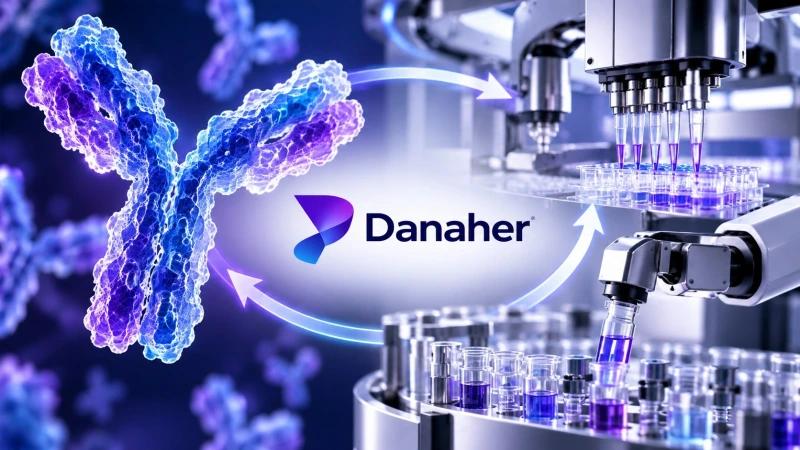
Danaher plans an autonomous AI lab for antibody discovery that it expects to operate at scale in early 2027. In its October 7 announcement, the company said the facility will combine AI design, robotic experiments and laboratory instruments to develop and validate molecules that bind to biological targets.
The first lab will be based at Abcam, a Danaher company. Its central test is whether a connected design, build and measurement cycle can produce useful research reagents faster than conventional processes while keeping scientists responsible for key decisions.
Danaher Plans Autonomous AI Lab at Abcam
Danaher describes the facility as the first step in a broader effort to connect smart instruments, software and laboratory automation. The initial focus is affinity reagents, a class of molecules that bind specific targets and help researchers identify or measure biological material. Antibodies are one example.
The distinction matters because the announcement concerns research tools, rather than a new medicine or a completed drug discovery result. A reagent still has to be made, tested and shown to work reliably in the intended experiment. Faster design alone would not establish that it is useful.
Danaher says the lab will bring together technology from Abcam, Beckman Coulter Life Sciences, Cytiva, Genedata, Integrated DNA Technologies and Molecular Devices. Automata worked on the device orchestration and robotic automation, according to Danaher. The company disclosed that it invested in Automata in January 2026.
The announced workflow has four linked stages:
- AI proposes an affinity reagent design.
- Laboratory systems build the candidate.
- Experiments test whether it performs as intended.
- Results feed into the next design cycle.
That loop gives the system experimental feedback instead of treating a model prediction as a finished answer. It also makes integration a central engineering challenge: designs, instrument instructions, measurements and quality checks must move coherently between different products and teams.
The Eightfold Speed and Tenfold Output Targets
Danaher says the lab is designed to discover affinity reagents up to eight times faster and, as it scales, increase annual reagent generation by as much as tenfold, from tens to hundreds. Reuters also reported the plans. These are company targets, not independently verified results from an operating lab.
The speed claim concerns the path from an idea to a validated reagent. That is more demanding than generating candidate molecules on a computer: the full cycle includes physical production and experimental confirmation. Danaher has not published a detailed benchmark protocol, baseline duration or outside validation for the eightfold comparison.
The output target is likewise tied to scaling. A larger annual count would be meaningful if the reagents meet researchers' standards for binding, specificity and reproducibility. Danaher's announcement does not provide measured error rates or a schedule for releasing those performance data.
Affinity reagents support many experiments that depend on recognizing a particular biological target. A shorter route to validated tools could give research teams more candidates to study, but gains in reagent production would not automatically shorten later stages of drug development.
The company also says this approach could eventually complement traditional immunization-based antibody discovery. That is a prospective role, not a claim that AI-designed reagents can already replace established methods across every target and research setting.
How Danaher Intends to Connect Its Instruments
The planned lab is a practical test of Danaher's wider instrument strategy. It wants devices that can be controlled through software, generate data suitable for AI systems and connect into repeatable workflows. Expert AI agents are intended to help operate instruments and improve the quality of the resulting data.
For laboratories, that architecture could reduce the handoffs that slow iterative experiments. Researchers often need to translate a design into a build plan, run assays, review measurements and decide what to try next. A connected system can shorten those intervals only if each automated step produces trustworthy results.
Human oversight remains part of Danaher's design. The company says scientists will continue to make key decisions while the system handles repeated design and testing cycles. The strongest near-term evidence of value will therefore be measured laboratory output, rather than the number of tasks the software can perform without intervention.
Reproducibility will be a crucial test for any autonomous lab. An attractive result from one experiment must survive repeated measurements and different operating conditions before researchers can trust the underlying reagent. The proposed feedback loop is useful only when it captures those failures as well as its successes.
Danaher has not announced the lab's cost, customer access terms or a broad commercial release date. Early 2027 is its target for operating at scale. Progress will be easier to judge when the company reports reproducible results, the number of validated reagents produced and comparisons against conventional workflows.
Further Reading





0 Comments:
Leave a Reply