DeepSeek Launches V4.1-Flash With Fourfold Smaller KV Cache
-

- by THEFLGHT,
- September 11, 2026
- in Artificial-Intelligence
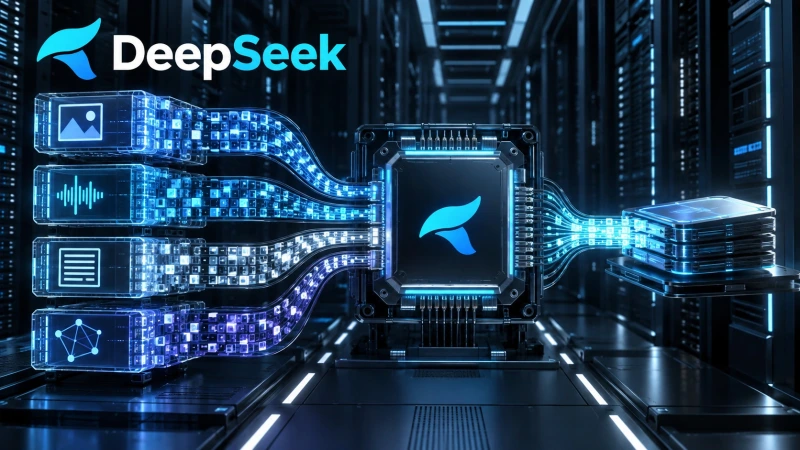
DeepSeek V4.1-Flash has launched as a multimodal open-weight model built to reduce the memory cost of long agent sessions. The company says its new causal encoder-decoder architecture cuts the global key-value cache to 890 bytes per token while supporting text, images and a context window of up to one million tokens.
The September 10 release changes four parts of DeepSeek’s Flash offering:
- A 552-billion-parameter mixture-of-experts backbone.
- Eight billion active parameters for input processing.
- Native image understanding and adjustable reasoning effort.
- Lower peak and off-peak API prices.
DeepSeek V4.1-Flash Launches a New Asymmetric Architecture
DeepSeek describes V4.1-Flash as the smallest model in a new architecture family, not a routine checkpoint of April’s V4 design. Its model card specifies a 40-layer transformer split between a 20-layer causal encoder and a 20-layer decoder.
The separation makes input and output processing asymmetric. Only eight billion parameters activate per token during prefill, when the model reads a prompt, while 16 billion activate during decoding as it generates an answer. That is designed to lower serving costs for agents that repeatedly consume large histories.
The backbone contains 552 billion parameters and uses a mixture-of-experts system with one shared expert and 384 routed experts per layer. Six routed experts activate for each token, allowing the model to hold more specialized capacity than it uses for any individual computation.
DeepSeek also added a 196-billion-parameter conditional-memory component called Engram. A separately trained vision encoder converts images into embeddings that are processed with text, giving V4.1-Flash native visual understanding rather than attaching vision only through an external model.
The company says pretraining used a 45-trillion-token multimodal corpus. Sparse attention was trained at 64,000-token sequences before the context limit was extended to one million tokens. Those figures come from DeepSeek’s technical materials and have not been independently audited.
Fourfold KV Cache Cut Targets Agent Costs
The central engineering claim concerns the key-value cache, which stores attention information from earlier tokens so a model does not recompute the entire conversation for every output. Long contexts can make that cache a major constraint on expensive high-bandwidth memory and storage.
V4.1-Flash projects the decoder’s global cache from the encoder’s final hidden states rather than preserving a separate full cache for every decoder layer. Compressed Sparse Attention 2 then shares cache data and reuses token-selection indexes across layers.
DeepSeek reports a global cache footprint of 890 bytes per token, about one quarter of V4-Flash. A bounded-replay method reconstructs missing sliding-window states from recent tokens, reducing the persistent storage requirement to roughly one eighth of the previous generation.
That reduction matters most when an agent repeatedly sends a long repository, document set or tool history. Smaller cache allocations can increase the number of simultaneous sessions a server handles and reduce the hardware reserved for each request, although real savings depend on deployment software and workload patterns.
The model supports reasoning-effort settings from 1 to 100, giving developers a continuous control for trading compute against accuracy. DeepSeek’s API documentation lists a one-million-token context window and a maximum output of 384,000 tokens, alongside tool calls, JSON output and Responses API compatibility.
DeepSeek Benchmarks Show Gains and Limits
DeepSeek’s evaluations show large gains on several agent and coding tasks. At maximum reasoning effort, V4.1-Flash scored 90.6 on Terminal-Bench 2.1, compared with 82.7 for V4-Flash and 87.9 for V4 Pro under the company’s stated test setup.
On DeepSWE v1.1, the new model resolved 74.2% of tasks using the mini-SWE harness. DeepSeek reports 54.4% for the previous Flash model and 62.7% for V4 Pro. V4.1-Flash also reached 88.1 on CyberGym and 54.8 on AutomationBench.
The results are not a clean sweep. V4 Pro remains higher on GPQA Diamond, scoring 92.4 against V4.1-Flash’s 90.9, and on Humanity’s Last Exam without tools. V4.1-Flash also trails several competing frontier models on harder Terminal-Bench 3.0 and 4.0 tests.
Harness choice changes outcomes substantially. DeepSeek’s table shows its DeepSWE score ranging from 65.5 to 74.2 across agent scaffolds, even with the same model. Developers should therefore treat the published comparisons as reproducible experiments under specified conditions, not universal rankings.
The weights are available on Hugging Face under the MIT license, and DeepSeek provides reference code for prompt encoding and local inference. Running the full system remains an infrastructure project: the company asks organizations considering large deployments to discuss configurations involving at least 2,000 GPUs plus storage.
API Pricing and the V4 Pro Reversal
V4.1-Flash is available through the model name deepseek-flash. Legacy V4-Flash and V4-Flash-Vision-Exp names now route to the new model, preserving compatibility while retiring the prior Flash versions.
Official pricing varies by time. Off-peak rates are $0.15 per million uncached input tokens and $0.60 per million output tokens, while peak rates are $0.30 and $1.20. Cache-hit input costs $0.003 off-peak or $0.006 during peak hours.
The launch announcement initially said DeepSeek would begin routing V4 Pro requests to V4.1-Flash on September 14 because the newer model performed better across cost, speed and total runtime. The company’s current API documentation now says V4 Pro will continue after that date following customer demand.
That reversal gives developers more choice but also shows how quickly model-lifecycle plans can change. Teams should select explicit model identifiers, record the version serving each evaluation and monitor routing notices before treating an API endpoint as a stable benchmark target.
V4.1-Flash’s practical test will be whether its cache compression delivers lower costs without eroding reliability during long, tool-heavy jobs. Independent evaluations of latency, multimodal accuracy and sustained agent performance will matter more than a single leaderboard position as production traffic moves to the new endpoint.
Further Reading

0 Comments:
Leave a Reply