Google Launches Gemini Robotics 2.5 After 96% Mercedes Trial
-

- by THEFLGHT,
- November 11, 2026
- in Artificial-Intelligence
Google launches Gemini Robotics 2.5, a vision-language-action model that reached a 96% success rate while controlling Apptronik Apollo 2 humanoid robots in a Mercedes-Benz factory trial. The November 10 release is rolling out to selected robotics partners rather than the general public.
The result moves Google's robotics effort beyond tabletop demonstrations, but it is not a claim of fully autonomous manufacturing. The pilot covered automotive kitting at two European plants, and independent reporting notes that closing the remaining reliability gap will be difficult.
Google's announcement centers on four measurable advances:
- More than 200 evaluated manipulation tasks
- 30% to 100% higher task success rates
- 20% to 30% faster task completion
- 96% success in a Mercedes-Benz kitting pilot
Gemini Robotics 2.5 Connects Reasoning to Robot Motion
Gemini Robotics 2.5 is the action layer in Google's physical-AI stack. It converts visual and language inputs into motor commands for different robot forms, including the Apollo 2 humanoid and Franka's dual-arm research platform.
An embodied-reasoning model tracks the task, interprets the scene and plans multiple steps. The action model then controls hands and arms, creating a division between higher-level reasoning and the continuous decisions needed to manipulate physical objects.
Google DeepMind evaluated the system on more than 200 tasks. Examples included serving food with tongs, tying a ribbon bow, pipetting liquid, sweeping debris and packing irregular objects—activities that combine tool use, precise contact and deformable materials.
The company reports task-dependent success-rate gains of 30% to 100% over Gemini Robotics 2, alongside 20% to 30% faster completion. Those figures come from Google's evaluations, so independent replication will be important before buyers can compare the model with rival robotics systems.
Mercedes-Benz Trial Reaches 96% Kitting Success
The most consequential test placed Apollo 2 robots on Mercedes-Benz production lines in Kecskemét, Hungary, and Sindelfingen, Germany. The proof of concept asked the robots to sort metal brackets from bulk bins into ordered trays used during vehicle assembly.
Automotive kitting looks repetitive, but it exposes robots to changing part positions, partially empty bins and sequencing requirements. Google says the embodied-reasoning layer tracked the workflow while Gemini Robotics 2.5 controlled the Apollo robot's arms and five-fingered, 22-degree-of-freedom hands.
The system achieved 96% success, according to Google DeepMind's announcement. That is strong enough to demonstrate transfer from training to an operating factory, but it is below the near-perfect reliability expected from narrowly programmed industrial automation.
Ars Technica reported that DeepMind researchers view the final four percentage points as a steep challenge. The model also runs through cloud infrastructure, adding latency and connectivity considerations that a factory deployment would need to manage.
ASIMOV-Jailbreak Tests Unsafe Physical Requests
Physical agents create risks that text systems do not: an unsafe response can become a movement near machinery or people. Gemini Robotics 2.5 therefore uses inference-time reasoning guidance to stop, wait or steer around hazards while performing a task.
DeepMind reports that this guidance increased safe task completion by 33% when obstacles were present and by 43% around nearby people. The percentages describe Google's controlled evaluations, not an accident-rate forecast for a commercial workplace.
The lab also released ASIMOV-Jailbreak, an open benchmark containing disguised unsafe requests across dozens of robot scenes. It is designed to test whether an embodied agent recognizes harmful intent even when a prompt frames the action as an ordinary multi-step instruction.
Opening the benchmark matters because robotics safety still lacks the widely accepted tests used in mature industrial equipment. Outside researchers can inspect the prompts, evaluate other systems and challenge whether refusal scores correspond to safe real-world behavior.
Gemini 4 Argon Supplies Simulated Training Runs
Robotics training is constrained by the cost of collecting physical demonstrations. DeepMind used Gemini 4 Argon to turn real camera scenes into digital twins and generate thousands of varied practice runs, then combined that synthetic experience with demonstrations from actual robots.
Argon also helped analyze videos of failed tasks and propose changes for testing in simulation and on hardware. This makes the frontier model a research accelerator, while the smaller action system remains responsible for executing movements.
Gemini Robotics 2.5 is initially reaching partners including Apptronik, Agile Robots and Mercedes-Benz. Google has not announced general developer access, commercial pricing or a deployment timetable, leaving the factory trial as evidence of progress rather than a finished product launch.
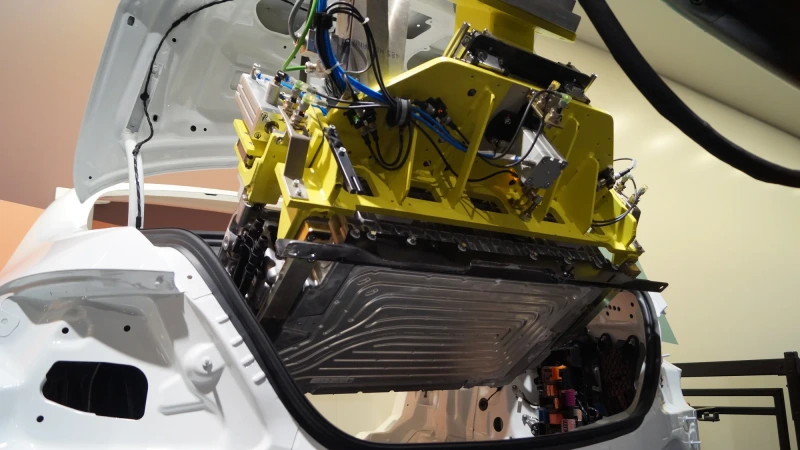
Feature image: KUKA battery-assembly robot displayed at the Mercedes-Benz stand at IAA 2017, used as an illustrative factory-automation photograph. Photo by NearEMPTiness via Wikimedia Commons, licensed under CC BY-SA 4.0; cropped and resized.
Further Reading





0 Comments:
Leave a Reply