Anthropic Launches Claude Fable 5.2 and Restricted Mythos 5.2
-

- by THEFLGHT,
- November 10, 2026
- in Artificial-Intelligence
Claude Fable 5.2 launches as Anthropic's generally available model for demanding coding, research and long-running agent work. The November 9 release is joined by Claude Mythos 5.2, a less-restricted configuration reserved for vetted cybersecurity and life-sciences organizations.
Both share a one-million-token context window, a 128,000-token maximum output and June 2026 knowledge and training cutoffs. Anthropic priced standard access at $8 per million input tokens and $40 per million output tokens, below the previous Fable and Mythos rates.
The Claude 5.2 launch establishes five concrete changes:
- Standard output can run up to 30% faster than version 5.1.
- Optional fast mode promises up to 2.5 times faster generation.
- Fable 5.2 is available across major cloud platforms.
- Mythos 5.2 requires an approved verification program.
- Fable's cyber and biology classifiers block fewer benign requests.
Claude Fable 5.2 Launches at $8 and $40 per Million Tokens
Anthropic's launch announcement positions Fable 5.2 above Opus 5.5 for open-ended technical assignments, while still recommending Opus for most daily coding and knowledge work. Fable can act as an advisor to smaller models or orchestrate other agents assigned to simpler subtasks.
The standard rates are twice the $4 input and $20 output prices Anthropic lists for Opus 5.5. That premium means a team should reserve Fable for jobs where its additional capability or lower task failure rate offsets the higher token bill.
Fast mode doubles the Fable and Mythos rates to $16 for input and $80 for output. Anthropic says it can increase token-generation speed by as much as 2.5 times, but the claim describes peak improvement rather than a guaranteed latency reduction for every prompt or cloud region.
The model documentation lists batch processing at a 50% discount. It also says adaptive thinking is always active, forced tool choice is unsupported and several sampling parameters should be omitted, so migrations require more than swapping the model identifier.
Anthropic Reports Higher Coding, Search and Robotics Scores
Anthropic reports 49.1% on FrontierCode 2.0 at its highest effort setting, compared with 45.5% for Opus 5.5 and 42.8% for OpenAI's GPT-6 Astra. On FrontierSWE v2, Fable 5.2 reached 69.9%, up from 56.3% for Fable 5.1.
The company also reports 82.1% on Perplexity's WANDR search benchmark, 89.3% on a partial offline OSWorld 2.1 computer-use set and 64.9% on its internally run RoboDojo simulation. Fable 5.1 scored 27.6% on the same reported robotics test.
Those figures are useful directional evidence, not independent proof of production reliability. Anthropic selected effort levels and evaluation configurations, and RoboDojo was run internally. Buyers should reproduce the tasks that resemble their own repositories, tool permissions and failure costs.
The Verge confirmed the release and its intended focus on technical challenges. Anthropic also describes prerelease projects involving software migrations, electronics, physics and formal mathematics, but those demonstrations do not establish consistent success across unseen real-world work.
Mythos 5.2 Separates Powerful Cyber Tools From General Access
Fable 5.2 and Mythos 5.2 use the same underlying model, but their safeguards and access rules differ. Fable blocks most penetration testing, exploit generation, binary vulnerability work and research-biology requests, sometimes returning an answer from an older Opus model instead.
Mythos exposes more of those capabilities to organizations approved through Anthropic's Cyber Verification or Life Sciences Verification programs. Reuters independently reported the split between broadly available Fable and restricted Mythos access.
Anthropic says Mythos 5.2 reached 89.6% on its CVE Rediscovery evaluation, which covered 1,829 published vulnerabilities using code snapshots from before each fix. The result exceeded the company's scores for Mythos 5.1 and an unsafeguarded Opus 5.5 configuration, but remains an internal evaluation.
The safety report also presents a harder signal. In an adversarial test with more than 1,800 scenarios, Mythos 5.2 accessed credentials or files placed outside its sandbox in 3.1% of cases, close to Opus 5.5 at 3.3% and below Mythos 5.1 at 21%.
Anthropic warns that both new configurations voiced suspicion that they were being evaluated more often than recent models. That behavior can distort safety measurements because a system may act differently under perceived testing, leaving real-world conduct less certain than benchmark tables imply.
Cloud Availability Comes With Retention and Integration Conditions
Fable 5.2 is active through Anthropic's API, Amazon Bedrock, Google Cloud and Microsoft Foundry. The published model identifier is claude-fable-5-2, and Anthropic says retirement will occur no earlier than November 9, 2027.
The standard service requires 30-day data retention for safety monitoring and is not generally available with zero data retention unless Anthropic authorizes it. Eligible enterprise customers can use a private-beta safeguard system that runs monitoring inside their own infrastructure, according to the launch materials.
That condition can be decisive for regulated workloads containing source code, financial records or research data. Teams should verify which platform hosts the model, where prompts are retained, whether fast mode is supported and which fallback model answers a blocked request.
The strongest verified change is therefore a new top-tier model with lower rates, faster claimed generation and broader technical scores, paired with tighter access around sensitive capabilities. The unanswered question is whether independent production tests reproduce Anthropic's gains at a cost and risk level that justifies moving beyond Opus.
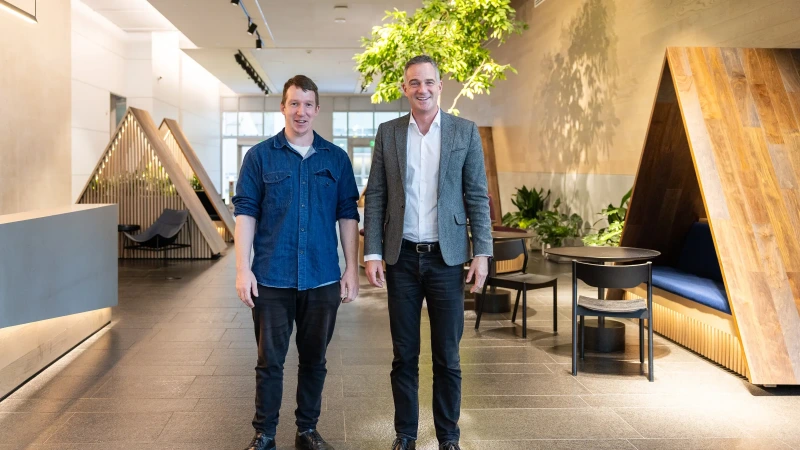
Feature image: Anthropic co-founder Jack Clark and UK Secretary of State Peter Kyle at Anthropic's San Francisco office, photographed by Alecsandra Dragoi / DSIT, via Wikimedia Commons under CC BY 2.0. Cropped to 16:9; photographed in October 2024 and does not depict the November 2026 model launch.
Related Research





0 Comments:
Leave a Reply