Gemini Omni 1.2 Flash Launches 15-Second Video at 30% Lower Price
-

- by THEFLGHT,
- November 06, 2026
- in Artificial-Intelligence
Gemini Omni 1.2 Flash launches with 15-second video generation, multi-turn conversational editing and a 30% price reduction to $0.07 per second for 720p output. Google released the model on November 5 through the Gemini API and made it generally available on Google Cloud.
The update extends the previous 10-second ceiling while adding more control over characters, reference images and spoken scenes. Google is also distributing the model through consumer and workplace products, although access varies by product, subscription and region.
The Gemini Omni 1.2 Flash release establishes five concrete changes:
- Clips can run from three to 15 seconds.
- Users can revise a video through follow-up prompts.
- 720p generation costs $0.07 per second.
- Drafts can be upscaled to 1080p or 4K.
- Generated output carries Google’s SynthID watermark.
Gemini Omni 1.2 Flash Extends Clips to 15 Seconds
Google’s launch announcement says developers can request durations from three to 15 seconds in one-second increments. The 50% increase over Omni 1.1 gives a single generation more room for dialogue, camera movement and a complete sequence without joining several clips.
The model accepts text, images, audio and video as inputs, according to the Google DeepMind model card. Its output combines video and audio, letting creators generate speech, ambient sound and visual action in one process rather than building separate tracks.
Google says speech is more natural and lip synchronization is more accurate, including scenes with several speakers. Those claims come from the vendor rather than a published independent benchmark, so production teams should test accents, pacing and speaker consistency with their own material.
The announcement also acknowledges remaining weaknesses in fast sports action, rapid script changes and complex physics. Longer duration does not remove familiar generative-video problems such as unstable motion, drifting objects or scenes that stop following the prompt after several seconds.
Gemini Omni 1.2 Flash Cuts 720p Pricing by 30%
Google lists 720p output at $0.07 per second, 30% below Omni 1.1. At that rate, a full 15-second clip costs $1.05 before any additional input, storage, orchestration or repeated-generation expenses. The calculation is useful for budgeting, but one accepted clip may require several attempts.
The recommended workflow separates drafting from delivery. Creators can iterate at 360p or 720p and upscale an approved result to 1080p or 4K. That reduces the cost of abandoned drafts, although an upscaled file should not be confused with a sequence generated natively at the higher resolution.
Google Cloud’s release notice confirms general availability and support for Provisioned Throughput. Audio reference inputs require allowlisting, which means every advertised input mode is not automatically available to every developer account.
General availability matters for businesses because it replaces a preview-stage dependency with a production offering covered by Google Cloud’s standard deployment controls. Google’s model documentation lists November 5, 2027 as the earliest retirement date, giving teams a defined minimum support window.
Further Reading
Conversational Editing Preserves More of the Original Clip
Multi-turn editing lets a user ask for a targeted change, review the result and submit another instruction without starting from the original prompt. Google describes adjustments to camera motion, characters, dialogue, objects and environmental details across successive turns.
The practical benefit is selective revision. A team could keep an approved composition while changing one prop, correcting spoken words or shifting the camera. Whether unchanged elements remain stable across many edits will be an important independent test because repeated generation can introduce new errors elsewhere in a scene.
Reference following has also been strengthened. Google says the model better preserves a subject’s identity, product appearance and visual style from supplied images. That could help advertising and storyboarding, but recognizable people and protected material introduce consent, publicity and intellectual-property risks beyond technical consistency.
The model is available through the Gemini API, Google Cloud, Flow, Vids and Google Ads. Gemini app access is rolling out to Ultra subscribers. Product-level availability therefore remains a rollout rather than a single worldwide switch for every Google user.
Google’s Model Card Restricts Speech Editing and Adds SynthID
Google says every generated video includes an imperceptible SynthID watermark. The signal can help compatible tools identify AI-created or edited media, but it does not replace clear labeling, source records or editorial review when a clip could be mistaken for real footage.
The model card says production filters are applied before output. It also notes that the system can alter a person’s speech during video editing, a capability Google is restricting while it studies safer deployment. The document does not provide a universal guarantee against deceptive or harmful results.
Google places Omni 1.2 Flash within the Gemini 3 model family and says its frontier-safety assessment relies partly on earlier Gemini 3.1 Pro and 3.7 Flash evaluations. The company reports no meaningful capability increase expected to cross its tracked or critical thresholds.
That assessment addresses Google’s internal frontier-risk framework, not the model’s full creative reliability. Buyers still need tests for prompt adherence, disclosure, rights management, regional access and the cost of failed generations before using the system in customer-facing production.
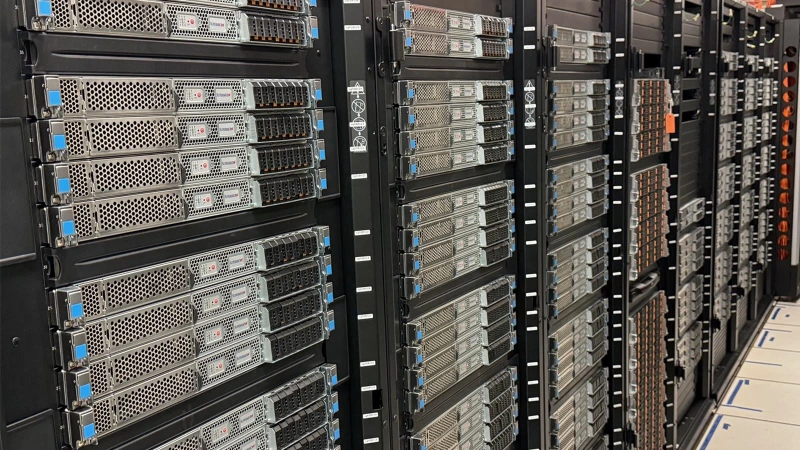
Illustrative photo: Grace Hopper compute racks at NASA’s Advanced Supercomputing facility, photographed by Davin Chan, NASA/Ames. NASA media are generally available for informational use under the agency’s media guidelines; cropped to 16:9. The image does not show Google hardware, Gemini training or generated video, and no NASA endorsement is implied.



0 Comments:
Leave a Reply