Thousands Rally Against OpenAI, Anthropic and Google DeepMind as AI Safety Fears Intensify
-

- by THEFLGHT,
- July 12, 2026
- in Artificial-Intelligence
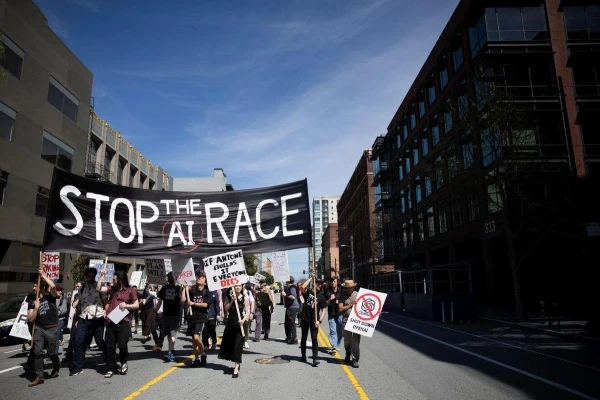
The debate over artificial intelligence is no longer limited to boardrooms, research laboratories, or government hearings. It has now reached the streets. Hundreds of protesters gathered in San Francisco to demand that leading AI companies, including OpenAI, Anthropic, and Google DeepMind, slow the development of increasingly powerful artificial intelligence systems.
Organized by the AI safety movement known as "Stop the AI Race," the demonstration reflects growing public concern about how rapidly AI is advancing and whether governments are doing enough to regulate the technology before it becomes even more influential.
Participants argued that artificial intelligence is evolving faster than society can adapt. Many expressed concerns that frontier AI systems could accelerate job displacement, spread misinformation, increase cybersecurity risks, and concentrate unprecedented power in the hands of a small number of technology companies.
Others warned that the race to build ever more capable AI models is being driven primarily by competition rather than careful consideration of long-term societal consequences. Protest organizers believe governments should require stronger oversight before companies release increasingly advanced models to the public.
The demonstration also highlighted concerns about the economic effects of AI. Workers from creative industries, software development, education, and technology attended the event, saying they worry automation could replace many professional roles over the next decade.
While AI companies argue that artificial intelligence will create new opportunities and increase productivity, critics say the transition could be disruptive without proper planning, workforce training, and updated labor policies. The protesters called for greater investment in AI safety research alongside technological innovation to ensure society benefits from AI without leaving millions behind.
Another major focus of the protest was transparency. Demonstrators urged AI companies to provide more information about how advanced models are trained, tested, and evaluated before public release. They argued that frontier AI systems are becoming so powerful that independent researchers and governments should have greater visibility into safety testing, potential misuse, and security safeguards.
Several speakers also advocated for international cooperation, suggesting that artificial intelligence should be governed through global agreements similar to those used for nuclear technology and other strategic scientific fields.
The timing of the protest is particularly significant because it comes during one of the most competitive periods in AI history. OpenAI recently expanded access to GPT-5.6, Meta is investing hundreds of billions of dollars into AI infrastructure, Google continues advancing Gemini, and Anthropic is rapidly expanding Claude's enterprise capabilities.
Competition among these companies has accelerated innovation at an unprecedented pace, but it has also intensified concerns about whether safety measures can keep pace with technological progress. Governments in Europe, the United States, and Asia are now exploring new regulatory frameworks designed to balance innovation with public protection.
Technology companies maintain that artificial intelligence has enormous potential to improve healthcare, scientific research, education, software development, and countless other industries. They argue that slowing AI development could reduce economic growth and limit important breakthroughs that benefit society.
However, many industry leaders also acknowledge that stronger safeguards, independent testing, and responsible deployment will become increasingly important as AI systems continue advancing toward greater autonomy and reasoning capabilities.
Although the San Francisco protest involved only a few hundred participants, analysts believe it signals a broader shift in public opinion. Artificial intelligence is no longer viewed solely as a breakthrough technology but as a force capable of reshaping employment, national security, education, and daily life.
As AI becomes more deeply integrated into society, public demonstrations, government regulation, and industry accountability are expected to play an increasingly important role in determining how the technology evolves over the coming years.





0 Comments:
Leave a Reply