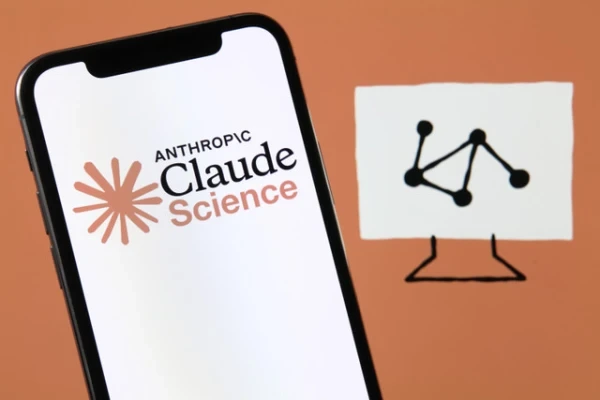
Anthropic Launches Claude Science to Transform AI-Powered Scientific Research
-

- by THEFLGHT,
- July 11, 2026
- in Artificial-Intelligence
Artificial intelligence is steadily moving beyond chatbots and coding assistants into highly specialized industries, and Anthropic is positioning itself at the forefront of that transformation with the launch of Claude Science. The new platform is designed specifically for researchers, scientists, engineers, and research institutions that need an AI system capable of supporting sophisticated scientific workflows rather than simply answering questions.
As research projects become increasingly data-intensive, Claude Science aims to help experts spend less time on repetitive computational tasks and more time making discoveries that could shape medicine, biotechnology, physics, chemistry, and other scientific disciplines.
Unlike traditional AI assistants built for general productivity, Claude Science has been developed as a dedicated scientific workbench. Anthropic says the platform integrates with many of the tools researchers already use every day, allowing scientists to analyze datasets, write and review research code, organize experiments, generate reproducible reports, and create auditable research outputs.
Every stage of the research process can be documented, making it easier for research teams to verify results and collaborate on large multidisciplinary projects. This approach reflects a growing demand for AI systems that can integrate directly into professional workflows instead of operating as standalone chat applications.
One of the biggest challenges facing modern scientific research is the enormous volume of information generated every day. Thousands of new research papers are published daily across medicine, biology, engineering, and computer science, making it nearly impossible for individual researchers to keep up with every important development.
Claude Science is intended to reduce this burden by helping scientists summarize publications, identify relevant findings, compare studies, organize references, and extract valuable insights from large collections of technical literature. By automating these time-consuming activities, researchers can focus more on experimentation and innovation rather than manual information management.
Programming has also become an essential part of modern science, with researchers relying heavily on software for simulations, statistical analysis, machine learning, genomics, climate modeling, and laboratory automation. Claude Science includes advanced coding capabilities that assist scientists in writing Python, R, MATLAB, and other programming languages commonly used in research environments.
Beyond generating code, the AI can explain algorithms, identify programming errors, optimize computational workflows, and help researchers build reproducible analysis pipelines that meet scientific standards. These capabilities have the potential to significantly accelerate research while reducing technical barriers for scientists who may not have extensive software engineering experience.
Anthropic has also emphasized transparency and reproducibility, two principles that are increasingly important within the scientific community. Research generated with AI assistance must remain verifiable, traceable, and open to peer review.
Claude Science therefore produces auditable outputs that allow researchers to understand how results were generated and to document every stage of the analytical process. This feature could prove particularly valuable in regulated industries such as pharmaceuticals, healthcare, biotechnology, and environmental science, where maintaining detailed records is often required for compliance and publication.
The introduction of Claude Science reflects a broader trend in artificial intelligence toward industry-specific solutions. Rather than building one AI model for every possible task, technology companies are increasingly developing specialized platforms tailored to particular professions.
Healthcare, finance, legal services, software engineering, education, and now scientific research are all receiving AI systems optimized for their unique workflows. Analysts believe these specialized AI tools will become increasingly common as organizations seek higher accuracy, deeper domain expertise, and better integration with existing professional software.
Competition in scientific AI is also intensifying. Companies including OpenAI, Google DeepMind, Microsoft, and several biotechnology startups are investing heavily in AI systems capable of accelerating scientific discovery. Applications range from predicting protein structures and designing new medicines to analyzing climate data and discovering advanced materials.
Anthropic's launch of Claude Science signals its intention to become a major player in this rapidly expanding market by providing researchers with a secure, enterprise-ready AI environment built specifically for scientific work rather than general consumer use.
As artificial intelligence continues reshaping research across every scientific discipline, platforms like Claude Science demonstrate that the future of AI extends far beyond conversation. By combining advanced reasoning, coding assistance, data analysis, and research collaboration into a single integrated workbench, Anthropic is helping scientists tackle increasingly complex challenges with greater speed and efficiency.
If widely adopted, specialized AI platforms could significantly shorten the time required for important discoveries, opening new possibilities in medicine, engineering, environmental science, and countless other fields where innovation depends on the ability to analyze enormous amounts of information quickly and accurately.




0 Comments:
Leave a Reply