Agility Robotics Starts Nasdaq Trading With $465 Million in Gross Capital
-

- by THEFLGHT,
- November 05, 2026
- in Artificial-Intelligence
Agility Robotics Nasdaq trading began under the ticker AGLT on November 5 after the humanoid-robot maker completed its business combination with Churchill Capital Corp XI. The transaction and related financings supplied about $465 million in gross capital before expenses.
The listing gives public investors direct exposure to a U.S. humanoid specialist, but it also exposes the sector's difficult economics. Agility reported only $1.8 million in 2025 revenue against a $138.1 million net loss, even as it prepares the next Digit robot for wider commercial use.
The public debut establishes four measurable tests:
- Whether $465 million can finance production scale-up.
- Whether conditional Digit 5 orders convert into revenue.
- Whether deployments expand beyond small customer fleets.
- Whether robot subscriptions can produce sustainable margins.
Agility Robotics Nasdaq Trading Follows a $465 Million Raise
Agility's November 5 announcement says its common stock and warrants started trading as AGLT and AGLTW after the Churchill XI combination closed. The company describes itself as the first U.S.-listed pure-play humanoid robotics business with active commercial deployments.
The financing is composed of roughly $164 million remaining in Churchill XI's trust, about $201 million from a private placement led by Foxconn, and $100 million of equity funding received earlier. Those figures are gross proceeds, so transaction costs will reduce the amount available for operations.
An SEC filing records the $465 million estimate and warns that commercialization, manufacturing capacity, customer conversion and unit economics remain uncertain. The capital gives Agility time to execute; it does not resolve those risks.
Agility entered the deal at a pre-money equity value of about $2.5 billion. That creates a sharp comparison between its valuation and current sales, while public reporting will make cash use, backlog conversion and deployment growth visible each quarter.
Digit 5 Orders Carry Conditions and Concentration Risk
Agility says it has more than $300 million in committed multi-year orders for Digit 5. The company consistently qualifies that figure: the orders depend on contractual milestones, product features and specifications, and should not be treated as current-period revenue.
Business Insider reported that the order represents 1,000 robots for one customer under a three-year usage arrangement. That concentration makes a single deployment program unusually important to the company's near-term manufacturing plan.
Digit 5 is scheduled for early customer access in the first half of 2027, with general availability targeted for the end of that year. Agility says the new model is designed for cooperative safety, broader industrial tasks and closer operation around people than earlier versions.
The financial starting point is demanding. Agility generated $1.8 million in 2025 revenue, posted a $138.1 million net loss and used $99.8 million in operating cash, according to merger disclosures summarized by Business Insider. In the first half of 2026, net sales were $174,000.
Related Research
Commercial Deployments Put Humanoid Claims Under Public Scrutiny
Agility reports more than 65,000 operating hours and Digit deployments with GXO, Schaeffler and Toyota Motor Manufacturing Canada. At GXO's Georgia operation, the robots have moved more than 100,000 totes, and two additional U.S. facilities are scheduled to receive deployments in early 2027.
Those deployments distinguish Agility from developers that remain at the prototype stage, but the fleets are still small relative to conventional warehouse automation. The central commercial question is whether a bipedal form can justify its added complexity in sites already served by conveyors, autonomous mobile robots and fixed industrial arms.
Agility has built infrastructure ahead of that demand. Its 70,000-square-foot RoboFab facility in Salem, Oregon, is designed for annual capacity of up to 10,000 robots. Designed capacity is not production output, and reaching it will require reliable supply chains, repeatable assembly, service coverage and customers ready to absorb the machines.
The company is also selling software and service around the hardware. Agility Arc manages robot fleets and connects them to customer operations, while the business model emphasizes recurring robot usage rather than only one-time equipment sales. Investors will need evidence that subscription revenue can cover manufacturing, maintenance and support.
AGLT Becomes a Quarterly Test for Physical AI
MarketWatch's debut-day report framed the listing as a first-mover opportunity paired with steep losses. That tension is likely to define AGLT: the company can set reporting benchmarks for humanoids, but public investors will demand progress on revenue and cash consumption rather than demonstrations alone.
The most useful indicators will be units deployed, productive hours, customer renewals, revenue per robot, gross margin and service costs. Agility should also disclose how much of its conditional backlog reaches acceptance milestones and how quickly RoboFab moves from designed capacity to actual deliveries.
Technical performance will remain inseparable from finance. A robot that works safely beside people but requires frequent intervention may be difficult to price profitably. Conversely, dependable operation across multiple tasks could spread hardware and support costs across more productive hours.
Agility's Nasdaq debut therefore matters beyond one ticker. It creates a public record for a sector dominated by private valuations and selective deployment announcements. The next year will show whether committed orders, factory investment and real-world operating experience can become repeatable revenue before the new capital is consumed.
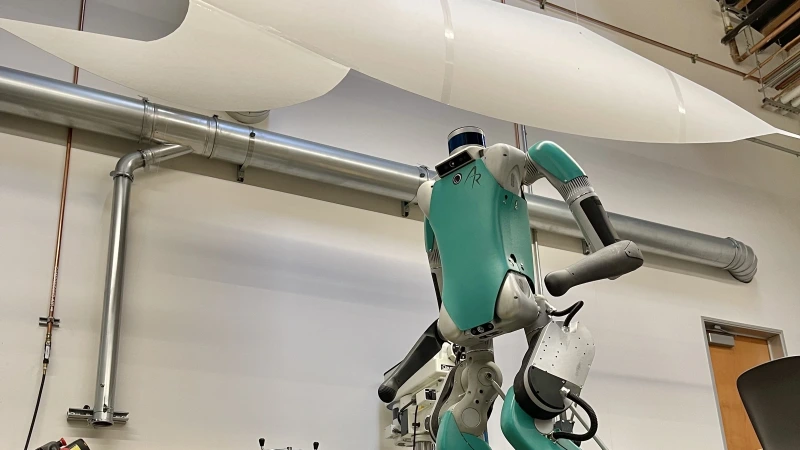
Photo: an earlier-generation Agility Robotics Digit robot photographed by Steve Jurvetson, via Flickr. Licensed under CC BY 2.0. Cropped and resized to 16:9; the image does not show Digit 5 or the Nasdaq listing.





0 Comments:
Leave a Reply