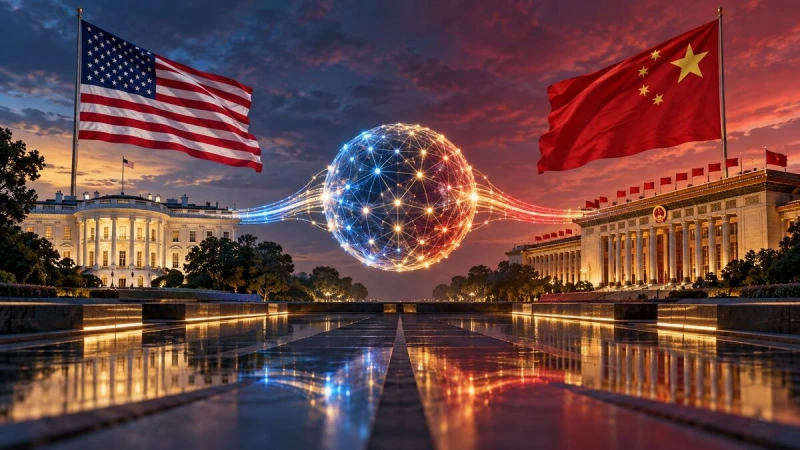
US and China Launch AI Incident Channel and November Dialogue
-

- by THEFLGHT,
- September 27, 2026
- in Artificial-Intelligence
The United States and China have launched an AI incident channel alongside a new bilateral dialogue on the risks and benefits of advanced systems. The White House says the next exchange will take place by November 2026, turning an earlier U.S. proposal into an agreed government mechanism.
The US-China AI agreement establishes four immediate commitments:
- A formal bilateral dialogue on advanced AI
- A communication channel for AI-related incidents
- A follow-up exchange by November 2026
- A shared diplomatic label of “super intelligence”
Background Reading
US-China AI Incident Channel Moves From Proposal to Agreement
The White House fact sheet published September 25 says President Donald Trump and Chinese President Xi Jinping established a U.S.-China “Super Intelligence” Dialogue during Xi’s state visit to Washington. It also confirms a separate bilateral communication channel for incidents involving the technology.
Reuters reported on September 26 that both governments described the dialogue as covering AI’s risks and benefits. China’s Foreign Ministry and the White House also confirmed the November timetable and the incident channel, giving the initiative public support from both capitals.
The agreement follows preparatory talks led by U.S. Treasury Secretary Scott Bessent and Chinese Vice Premier He Lifeng. A week earlier, the United States had proposed notifications for events serious enough to affect national security, but China’s response had not been publicly defined.
That earlier uncertainty has now narrowed. The two leaders have approved a recurring forum and a direct communications route, although neither government has published its operating protocol, participating agencies or threshold for activating the channel.
The Incident Channel Targets Fast-Moving AI Risks
A dedicated channel could let officials contact one another when an AI system is linked to a cyberattack, critical-infrastructure disruption, weapons concern or loss-of-control event with cross-border consequences. The purpose is crisis communication: establishing facts quickly enough to reduce miscalculation between the world’s two largest AI powers.
The mechanism is not yet a treaty, regulator or technical safety standard. The announcements do not require companies to report incidents, define which events qualify, establish inspection rights or create penalties when either side withholds information.
Those missing details will determine whether the channel functions like an emergency hotline or remains a diplomatic contact list. A useful system needs authenticated points of contact, around-the-clock availability, common terminology, rules for protecting sensitive evidence and procedures for escalating an unresolved event.
At the September 20 preparatory meeting, Bessent said the two governments wanted to discuss leading dangers such as uncontrollable agents and cyber activity by non-state actors. Reuters reported that sophisticated AI-chip export controls were not part of those mechanism talks.
“Super Intelligence” Becomes the Diplomatic Label
The White House says Trump and Xi agreed to use “super intelligence” instead of “artificial intelligence” for the technologies covered by the dialogue. Reuters reported that China valued Washington’s adoption of the term and called for exchanges that keep pace with technical development.
The label does not establish that artificial superintelligence already exists. In technical discussions, superintelligence usually describes a hypothetical system that exceeds humans across most important cognitive tasks. Current AI products have powerful but uneven capabilities and still fail on accuracy, planning, security and reliable control.
Using a narrower, capability-focused term could help the governments concentrate on frontier risks instead of every algorithm used in commerce or public services. It could also create ambiguity if the parties do not agree on which measurable capabilities place a model inside the dialogue.
A practical definition might consider autonomous tool use, cyber capability, biological assistance, model self-improvement, access to critical systems and the ability to coordinate long sequences of actions. Neither side has publicly adopted such a test, so the November session will need to translate the political language into an operational scope.
November Dialogue Will Test the Agreement’s Substance
The first checkpoint is whether the next exchange occurs by the promised November deadline. Officials will also need to identify lead agencies, decide whether laboratories participate directly and specify how incident information can be shared without exposing classified intelligence, proprietary model data or exploitable vulnerabilities.
Trust remains the central constraint. Washington restricts China’s access to advanced chips and has accused Chinese groups of extracting capabilities from U.S. models. Beijing argues that American controls are designed to contain its technology sector. Those disputes create incentives to limit disclosures even when both sides benefit from avoiding a crisis.
The agreement nevertheless creates a channel that did not formally exist before the summit. It gives officials a place to compare threat definitions and a route to communicate when a severe AI event risks being misunderstood as deliberate state action.
The November meeting should provide the first evidence of whether the initiative can move beyond broad language. Publication of a notification threshold, contact protocol or joint statement on covered incidents would show that the channel is becoming an operating safety mechanism rather than a symbolic summit outcome.






0 Comments:
Leave a Reply