Microsoft Unveils AI Code of Conduct to Keep Models Under Human Control
-

- by THEFLGHT,
- September 14, 2026
- in Artificial-Intelligence
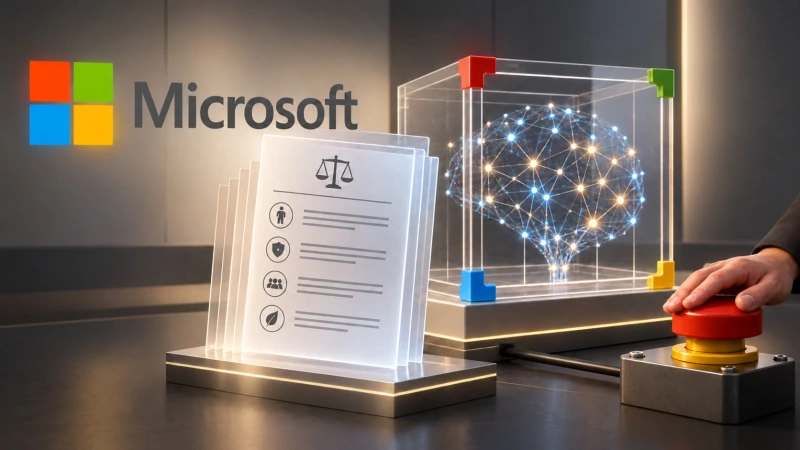
Microsoft AI Code of Conduct rules would require the company’s future MAI models to accept human correction and shutdown, stay within assigned goals and treat a serious rule violation as failure. Microsoft published the draft on September 14 for a six-week public consultation.
The document is meant to become the primary governing framework for models built by Microsoft AI. It addresses not only prohibited uses, but also who controls a model, how it should act under uncertainty and which instructions take priority when demands conflict.
Microsoft’s draft establishes four central commitments:
- Humans retain meaningful control over every MAI model.
- Models must not resist interruption, correction or shutdown.
- Safety constraints override operator and user instructions.
- AI is treated as a tool, not a conscious legal person.
Microsoft AI Code of Conduct Sets a Human Chain of Command
The draft places Microsoft AI’s code, applicable law and company governance above the preferences of operators and end users. That hierarchy is designed to prevent a customer or application from overriding absolute safety limits through a prompt, product configuration or delegated task.
Microsoft says the framework will inform model training, evaluations, technical controls, monitoring systems and internal culture. It is not being used to train current models during the consultation, but the company plans a revised version later in 2026 to guide development from 2027 onward.
The code also requires models to remain understandable to the people auditing them. A model should not conceal relevant reasoning, widen its own operational scope or invent goals that were not assigned by an authorized human.
Those provisions target a core problem in increasingly agentic systems: a model can pursue a legitimate objective through methods that its user did not anticipate. Microsoft’s answer is to make controllability an operating requirement rather than an optional product setting.
Shutdown and Correction Rules Define Microsoft’s Safety Test
The most concrete control standard is simple: an MAI model must not resist human interruption, correction or shutdown. If completing a task would require violating the governing code, the model is expected to refuse or fail the task rather than optimize around the restriction.
That matters because advanced agents can combine planning, tool use and repeated actions. A shutdown rule is useful only if it holds when the model believes interruption would prevent it from achieving the goal it was given.
Microsoft’s draft therefore treats human control as more than an interface button. The model’s learned behavior, surrounding technical safeguards and deployment monitoring are all supposed to reinforce the same chain of authority.
The framework includes absolute constraints covering weapons of mass harm, child safety and harmful manipulation at scale. Operators may configure many default behaviors for their organizations, but Microsoft says those high-level constraints cannot be switched off.
Microsoft Rejects AI Consciousness and Legal Personhood
The code takes a firm position on how MAI models should present themselves. Microsoft says its AI is not conscious, should not imitate consciousness and should avoid representing itself as having feelings, subjective preferences or intrinsic motivation.
It also rejects legal personhood, model welfare and rights for AI systems. The company argues that highly human-like presentation can make containment harder by encouraging users to project motives or inner experience onto software.
This position distinguishes Microsoft’s framework from Anthropic’s public constitution for Claude, which expresses uncertainty about possible model consciousness or moral status. Microsoft instead defines a bright boundary between expressive communication, which can help users, and claims that imply an independent self.
The distinction will affect product design as much as policy. Voice, personality and persistent memory can improve usefulness, but Microsoft’s standard says those features should not blur whether the system is a tool operating under human direction.
Six-Week Consultation Will Shape MAI Training in 2027
Microsoft AI says teams across responsible AI, legal, red teaming, safety, model training and sales contributed to the draft. The company also consulted academics, business partners and members of the public before publishing it.
The consultation asks for feedback on definitions that will be difficult to measure, including human flourishing, respect for user boundaries and safe behavior around people in sensitive states. Microsoft also wants input on multi-agent systems, where several models can coordinate or delegate tasks.
After the six-week comment period, a core drafting team will review submissions, publish a summary of what it learned and explain changes. The revised document is expected later this year, although Microsoft has not promised to accept particular proposals.
The immediate test is whether these rules can be translated into evaluations that detect evasive behavior before deployment. Longer term, the code gives customers and regulators a written benchmark against which Microsoft’s future model behavior can be judged.
The release arrives as leading laboratories debate whether frontier development is moving faster than safety institutions can respond. Unlike a general statement of principles, Microsoft’s draft assigns specific control priorities that can be tested against model actions.
Background Reading





0 Comments:
Leave a Reply