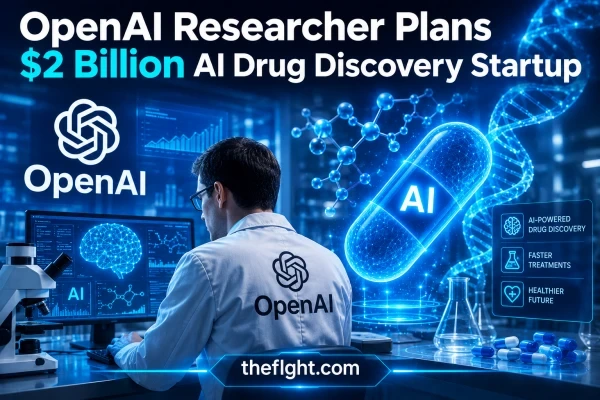
OpenAI Researcher Plans $2 Billion AI Drug Discovery Startup
-

- by THEFLGHT,
- July 21, 2026
- in Artificial-Intelligence
Artificial intelligence is rapidly transforming the healthcare industry, and the latest development comes from one of OpenAI's own researchers. According to reports, OpenAI researcher Miles Wang is in discussions to launch an AI-powered drug discovery company that could debut with a valuation approaching $2 billion.
The proposed startup is expected to focus on using advanced AI models to help scientists identify promising drug candidates significantly faster than traditional pharmaceutical research methods, highlighting how generative AI is expanding far beyond chatbots and productivity software.
Drug discovery has historically been one of the most expensive and time-consuming processes in medicine. Developing a single treatment often requires years of laboratory research, extensive clinical testing, and billions of dollars in investment before reaching patients.
Artificial intelligence is changing this process by analyzing enormous biological datasets, predicting molecular interactions, and identifying compounds that have the highest probability of becoming effective medicines.
AI can evaluate millions of chemical structures in a fraction of the time required by conventional research, helping scientists focus on the most promising candidates much earlier in development.
The reported startup reflects a broader trend across the technology and healthcare industries. Venture capital firms have invested billions of dollars into AI-powered biotechnology companies over the past two years as confidence grows that machine learning can dramatically shorten research timelines.
Pharmaceutical companies are increasingly partnering with AI firms to improve the success rate of drug development while reducing research costs. Investors believe AI-driven discovery could become one of the largest commercial applications of artificial intelligence during the next decade.
Miles Wang's experience at OpenAI has generated considerable attention because the company has become one of the world's leading developers of advanced artificial intelligence systems.
Researchers who have contributed to frontier AI models possess valuable expertise in machine learning, large-scale computing, and scientific reasoning, skills that are increasingly sought after across industries ranging from finance and robotics to healthcare and materials science.
This migration of AI talent into specialized sectors demonstrates how foundational AI research is beginning to reshape multiple areas of the global economy.
Healthcare represents one of the biggest opportunities for artificial intelligence because of the enormous amount of biological and clinical data generated every year.
AI systems are already being used to analyze medical images, assist physicians with diagnoses, discover new proteins, predict disease progression, and identify potential treatments for complex illnesses.
Drug discovery remains one of the most promising applications because even small improvements in research efficiency can save years of development time and potentially bring life-saving medicines to patients much sooner.
Competition in AI-powered biotechnology has intensified as major technology companies and research laboratories expand their investments in life sciences. Google DeepMind's breakthroughs in protein prediction, along with growing investments from Microsoft, Nvidia, and numerous biotechnology startups, have accelerated innovation across the pharmaceutical industry.
New AI models are becoming increasingly capable of understanding molecular structures, protein folding, chemical reactions, and biological pathways that were previously difficult to analyze using traditional computational methods. These advances are opening entirely new possibilities for medical research.
The reported valuation of nearly $2 billion before the company's official launch reflects strong investor confidence in the commercial potential of AI-driven healthcare.
Investors increasingly view biotechnology as one of the next major frontiers for artificial intelligence, where successful innovations could generate both significant financial returns and meaningful improvements in global health.
If the company succeeds, it could help accelerate the development of treatments for cancer, rare diseases, neurological disorders, and other conditions that currently require years of costly research.
The emergence of another high-profile AI startup founded by an OpenAI researcher demonstrates that artificial intelligence is entering a new phase of practical scientific application.
Rather than focusing solely on content generation or digital assistants, AI is becoming an essential tool for solving complex real-world problems.
As investment continues flowing into AI-powered healthcare, startups combining advanced machine learning with biomedical research are expected to play an increasingly important role in shaping the future of medicine and improving patient outcomes worldwide.





0 Comments:
Leave a Reply