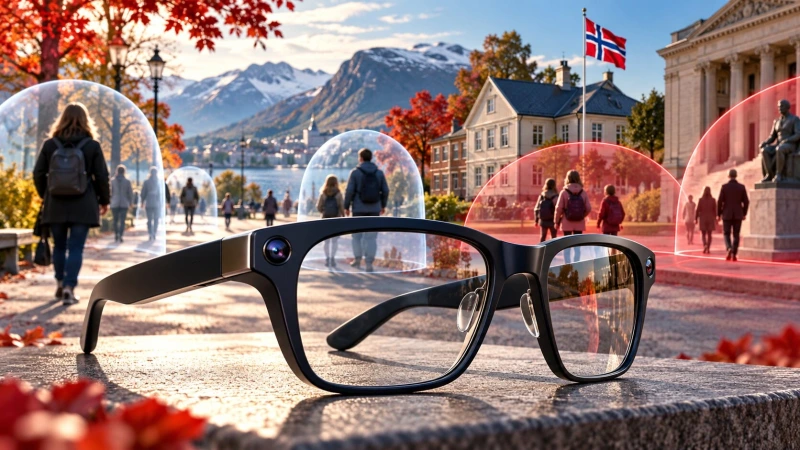
Norway Proposes Temporary AI Glasses Ban in Public Spaces
-

- by THEFLGHT,
- October 06, 2026
- in Artificial-Intelligence
Norway’s AI glasses ban proposal would temporarily prohibit use of the devices in selected public and privacy-sensitive places while the government develops longer-term rules. The government announced the plan on October 5, 2026, and says it will submit a bill to parliament as soon as possible.
No nationwide ban has taken effect. The proposal responds to the prospect of people being photographed, filmed or recorded without knowing it as cameras, microphones and AI features move into ordinary eyewear.
The government’s plan has four main elements:
- A temporary restriction on using AI glasses in selected places.
- Special consideration for children and sensitive settings.
- Possible exceptions for vulnerable groups and socially beneficial uses.
- An expert group to advise on lasting rules for wearable technology.
Further Reading
Norway’s AI Glasses Ban Proposal Targets Selected Places
The Ministry of Digitalisation and Public Governance identified parks, beaches, museums, shopping centers and public events as possible locations. Schools, kindergartens, playgrounds and youth clubs are also under consideration because children warrant particular protection.
Other potential locations include doctors’ offices, healthcare institutions, swimming pools, gyms and spaces with changing rooms or showers. The ministry says universities and other higher-education institutions could be included, but the final list has not been set out in legislation.
The plan concerns use of AI glasses in designated settings, not ownership of the devices or a blanket prohibition across Norway. The government says private use and use where others are not at risk of nonconsensual recording should remain possible.
That distinction matters for anyone who already owns camera-equipped glasses. A proposed restriction is not an enforceable rule today, and the bill still needs to define the places, covered devices, exceptions, enforcement and date of effect before users or venues can know the precise obligations.
Which Glasses and Wearables Could Be Covered
The government has deliberately left the device definition open for further study. It will assess whether the measure should cover glasses with cameras and audio recording, glasses combining cameras with AI functions, or other body-worn technology with recording or AI capabilities.
This is a consequential design choice. A narrow definition may be easier to understand but could miss devices that perform similar recording through a different form factor. An overly broad one could interfere with accessibility tools or legitimate uses that do not create the same privacy risk.
The ministry therefore anticipates exemptions for vulnerable groups and limited public-benefit uses. It has not published eligibility criteria, application procedures or a technical standard for distinguishing assistive devices from general-purpose recording eyewear.
Digitalisation and Public Governance Minister Torgeir Micaelsen said the government wants time for a thorough study and informed public debate before adopting permanent rules. The planned expert group will examine challenges across body-worn technology, extending the inquiry beyond one generation of smart glasses.
Privacy Concerns Have Moved Beyond Venue Policies
The core concern is that a bystander may not notice when a pair of glasses captures images, video or sound. AI can make the resulting material searchable, transcribable or easier to analyze, magnifying the effect of an apparently casual recording.
In August, the Norwegian ministry urged public and private organizations to consider their own rules for smart glasses in workplaces and premises. The October announcement advances that earlier position toward a proposed national law, although the text has yet to reach the Storting.
Reuters confirmed that the government is seeking a temporary, place-specific measure rather than a total ban. The Associated Press reported that privacy advocates welcomed the proposal, while its potential effect on useful applications remains part of the debate.
The policy is relevant to companies making AI-enabled eyewear, including firms that combine cameras and microphones with on-device or cloud AI. A venue-based restriction can influence product design, recording indicators and user guidance even before a final law specifies exactly which products are covered.
Parliament and the Expert Group Set the Next Milestones
Norway’s minority government says it will return to parliament with a bill as quickly as practical. Passage is not guaranteed, and lawmakers could narrow, expand or reject the scope once they examine the proposal and hear from affected groups.
The expert group’s separate assignment is to recommend a durable national approach to wearable technology. That work could address devices beyond glasses and help determine how privacy protections coexist with accessibility, work, education and other legitimate applications.
The next verifiable developments are the bill’s actual wording, parliamentary timetable, definition of covered devices and rules for exceptions. Until then, describing the measure as a ban already in force would misstate Norway’s October 5 announcement.






0 Comments:
Leave a Reply