Wix Launches AI Workforce That Can Run Business Tasks Without Constant Human Instructions
-

- by THEFLGHT,
- August 11, 2026
- in Artificial-Intelligence
The idea of having an AI assistant that answers questions is already becoming familiar. The more interesting shift is happening now, with companies beginning to build AI systems that do not simply wait for a person to ask what should happen next.
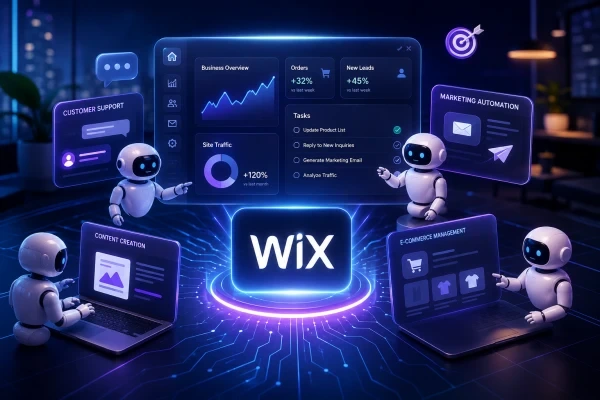
Wix has launched Symphony, a new multi-agent AI platform designed around the idea of giving businesses a coordinated team of AI agents that can understand how a company operates, identify work that needs attention and carry out tasks across approved workflows. The launch points toward a future in which a business may not use one AI assistant but an entire digital workforce.
At the center of Symphony is an AI orchestrator called Maestro. Instead of requiring a business owner to decide which AI tool should handle every individual task, Maestro is designed to understand what is happening across the business and coordinate specialized agents for different jobs. Wix says the system can work across areas of business operations and connect with tools that companies already use.
That distinction is important because most AI products people use today still operate like individual tools. A person opens an AI application, writes a prompt and waits for a response. If the person wants another task completed, another instruction is usually required. A multi-agent system changes the model by allowing different AI agents to take responsibility for different parts of a workflow while another system coordinates their work.
Imagine a small online store that receives hundreds of customer messages every day. One AI agent could identify customer questions, another could prepare responses, another could analyze sales information and another could monitor products or business activity. Instead of the business owner opening separate AI tools and telling each one what to do, the agents could work together under a central system.
That is the bigger idea behind Symphony.
Wix says its platform is designed to learn the specific needs, practices and goals of a business rather than treating every company exactly the same. The company is drawing on knowledge accumulated through its work with hundreds of millions of businesses and using that experience to build industry-specific AI capabilities.
The change may sound small, but it could represent an important step in the development of AI agents.
For years, businesses have used software to automate individual tasks. An accounting program handles finances. A customer relationship platform manages customers. An email platform handles communication. An analytics system monitors performance. Humans have traditionally been responsible for moving information between these systems and deciding what should happen next.
AI agents could increasingly become the layer connecting those systems.
Instead of asking a person to monitor everything, an AI system could continuously examine business activity and identify what needs attention. If a customer has not received a response, an agent could flag it.
If sales suddenly fall, another agent could investigate. If a product is running low, another could identify the issue. If a report needs to be prepared, another could produce it.
The human would still make important decisions, but the AI could increasingly handle the work surrounding those decisions.
This is where the phrase AI workforce becomes more meaningful.
An AI workforce does not necessarily mean replacing every human employee with a machine. It can mean creating a group of digital workers that handle repetitive, analytical and operational tasks while humans focus on decisions that require judgment, relationships and accountability.
That distinction could be particularly important for small businesses.
Large companies can afford specialized employees for marketing, finance, customer support, analytics and operations. A small business owner often has to perform many of those jobs personally. A coordinated group of AI agents could potentially give a small company access to capabilities that would otherwise require several employees or expensive software services.
Wix is specifically targeting this opportunity with Symphony. The company describes the platform as a coordinated team of AI agents designed around business goals, with built-in, custom and external agents working through a unified orchestrator.
The system is also designed to report back to the business owner rather than simply disappearing into the background. According to Wix, Symphony can provide updates, analytics and alerts about actions that need approval. TechRadar reports that the platform includes a daily summary in which the agents report completed work, unfinished tasks and potential opportunities.
That may become one of the most important features of future AI agents.
People do not necessarily want an AI that makes every decision for them. They want an AI that handles the work they do not want to spend time doing and brings important decisions back to them.
A business owner might therefore tell an AI system to monitor customer activity, prepare marketing material and identify potential opportunities. The AI could perform those tasks independently but ask for approval before spending money, contacting an important customer or making a significant business change.
This creates a model of controlled autonomy.
The AI works independently inside boundaries defined by the business.
That could be much more practical than giving an AI unlimited control.
The technology also raises an important question: how many AI agents will a business eventually need?
The answer may not be one.
A business could eventually have dozens of specialized agents. One could handle customer support. Another could monitor inventory. Another could analyze financial information. Another could create content. Another could manage advertising campaigns. Another could monitor competitors. Another could watch for security problems.
The central AI would coordinate them.
This resembles the structure of a human company more than the structure of traditional software.
A manager does not personally perform every task. The manager assigns work to people with different skills and monitors the results. A multi-agent AI system can follow a similar structure, with specialized digital workers operating under a central coordinator.
That is why the launch of Symphony is more interesting than another AI chatbot announcement.
It reflects a shift from AI that answers to AI that operates.
The difference could become increasingly important as AI models improve. A smarter chatbot gives better answers. A smarter agent can potentially complete more complicated tasks.
That means improvements in reasoning could have a direct effect on business automation.
An AI agent that can understand a simple request might schedule an appointment. A more capable agent could organize an entire event.
A still more capable system could manage the research, communication, scheduling and follow-up required to complete a complicated project.
The amount of work delegated to AI could therefore increase as the models become more reliable.
But there is a major challenge.
Businesses cannot simply connect powerful AI agents to every system and allow them unlimited access.
An agent that can send emails, change financial records, edit websites or make purchases needs clearly defined permissions. A mistake by one agent could otherwise affect the entire business.
This is why multi-agent AI will probably develop alongside stronger identity, authentication and permission systems.
Every agent may eventually need to have a defined role and a defined level of authority.
A marketing agent should not automatically have access to banking information. A customer service agent should not be able to change financial records. An inventory agent should not be allowed to make large purchases without approval.
The more autonomous AI becomes, the more important these boundaries will become.
There is also the problem of trust.
A business owner needs to know whether an AI actually completed a task correctly. An AI workforce cannot simply report that something was done. Businesses will increasingly need systems that can verify results and flag uncertainty.
Symphony includes a quality layer in which another agent reviews work before it is presented, according to TechRadar. That reflects a broader direction in AI development: one AI agent performs the work while another checks the result.
This could become a standard pattern.
Instead of asking one AI to perform everything, businesses could use multiple agents with different responsibilities. One agent generates the work. Another checks it. A third evaluates whether it meets the business objective. A human then approves important actions.
The result could be more reliable than relying on a single AI system.
But it could also create a new challenge: complexity.
If a company has dozens of AI agents working together, it may eventually become difficult for humans to understand exactly why a particular decision was made. The more agents involved in a workflow, the more important activity logs, explanations and monitoring systems become.
Businesses will need to know which agent performed which action, what information it used and who authorized it.
That is where the future of AI workforce technology connects with the question of digital identity.
An AI agent that performs meaningful business work may eventually need its own identifiable credentials. The company may need to distinguish between actions performed by a human employee and actions performed by an AI agent acting on that employee's authority.
The concept may sound futuristic, but the underlying problem is already appearing as AI systems become more capable of taking actions rather than simply generating information.
Wix's launch is therefore part of a much larger movement.
Microsoft, Google, OpenAI, Anthropic and numerous startups are all developing increasingly capable AI agents and agent platforms. The competition is gradually moving away from who can build the best chatbot and toward who can build systems that can reliably complete useful work.
That could change the way people think about software.
Instead of buying another application, a business may eventually hire another AI agent.
Instead of learning how to operate every business application, the owner may explain what needs to happen and allow the AI workforce to coordinate the software.
Instead of spending an hour checking several dashboards, the owner may receive a short report from an AI system explaining what changed and what requires attention.
That is a very different future from simply asking ChatGPT a question.
The AI becomes part of the business's operating system.
For Wix, this could also represent a significant change in the company's identity. The company is widely known as a website-building platform, but Symphony pushes Wix further into business operations by attempting to make AI agents part of the day-to-day running of a company. Wix says the platform is designed to connect with existing business tools rather than forcing businesses to abandon their current workflows.
If the idea works, the website itself may become only one part of the platform.
The more valuable product could be the intelligence operating behind the business.
A website attracts customers. AI agents could help manage what happens after those customers arrive.
That is potentially a much larger opportunity.
The most interesting part of this development is therefore not the name Symphony or the number of agents included in the platform. It is the direction it represents.
AI is moving toward a world where software does not simply wait for humans to operate it.
It watches.
It analyzes.
It plans.
It coordinates.
And increasingly, it acts.
The businesses that adapt early could gain an advantage because they will be able to automate work that previously required constant human attention. But the businesses that deploy AI carelessly could discover that autonomy creates new risks alongside its productivity benefits.
The future business may therefore not be human versus AI.
It may be humans working with teams of AI agents.
The owner sets the objectives. The AI workforce handles the routine work. Specialized agents collaborate with each other. A central system coordinates their activities, while humans remain responsible for the decisions that matter most.
That model is still developing, and Symphony is only one example of where the technology is heading. But today's launch offers a useful glimpse of a future in which having an AI assistant may no longer be enough.
Businesses may soon want an entire AI team.






0 Comments:
Leave a Reply