Will AI Agents Need Their Own Digital Identity?
-

- by THEFLGHT,
- August 08, 2026
- in Artificial-Intelligence
For years, digital identity has been built around one basic assumption: there is a human sitting behind the computer. A person creates an account, chooses a password, verifies their identity and receives permission to access a service. But artificial intelligence is beginning to challenge that assumption.
AI agents are being developed to browse websites, use software, send messages, write code, access information and complete tasks on behalf of people. If an AI agent can eventually perform work without a human controlling every action, an important question follows: will AI agents need their own digital identities?
At first, the idea may sound unnecessary. An AI agent is software, so why would software need an identity separate from the person using it? The answer becomes clearer when an AI starts interacting with dozens of different services. Imagine telling an AI agent to manage your business expenses.
It may need to access your accounting software, read invoices, communicate with suppliers, check bank information and prepare payments. If every action is performed using the owner's personal identity, it becomes difficult to determine which actions were performed directly by the human and which were performed by the AI.
That distinction could become extremely important.
Today, when a person logs into a website, the website generally assumes that the person is the one performing the actions. If an AI agent logs in using that same person's account, the system may have no reliable way to distinguish between the human and the machine. This could work when AI is simply assisting with a single task, but it becomes much harder to manage when agents begin operating continuously and independently.
Consider a future where you give an AI agent permission to manage your online shopping. You tell it to purchase household products whenever supplies are running low. The agent monitors your inventory, searches for products, compares prices and places orders. Eventually, hundreds of purchases could be made without you manually logging into any store.
Who actually made those purchases?
You authorized the AI, but the AI selected the products and completed the transactions. If something goes wrong, the company needs to know whether the purchase was made by you, by an AI acting on your behalf or by someone who gained unauthorized access to your account.
This is where the idea of an AI digital identity becomes useful.
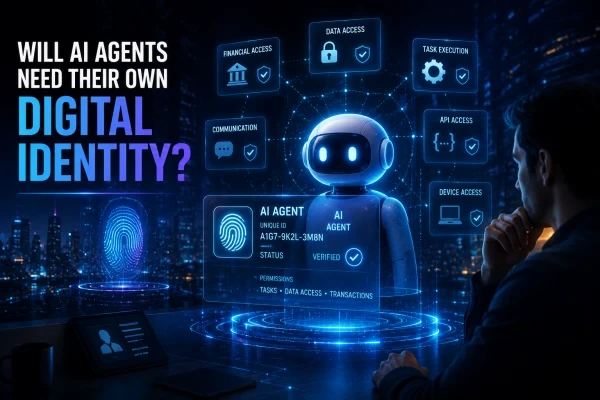
An AI agent could potentially receive a unique identity that tells other systems who or what is making a request. That identity could be connected to its owner, company or organization while remaining separate from the owner's personal account. Every action performed by the agent could then be associated with that identity.
Instead of a website seeing “John's account purchased this product,” it could eventually see something closer to “John's authorized AI agent purchased this product.”
That may sound like a small technical change, but it could become extremely important when millions or billions of AI agents begin interacting with online services.
The internet was largely designed for humans. Websites display buttons for people to click. Forms expect people to complete them. Authentication systems expect people to log in. Businesses communicate with customers through interfaces designed around human behavior.
AI agents introduce another type of internet user.
They can operate much faster than humans. An agent could potentially visit hundreds of websites, compare thousands of products, monitor prices continuously and communicate with other software systems without getting tired. If every one of those actions appears to come from a human account, existing identity and security systems could become difficult to manage.
An AI-specific identity could provide a solution.
The identity could contain information about the agent, the person or organization responsible for it, the permissions it has and possibly the actions it is authorized to perform. A service could then decide whether to accept or reject a request based not only on who owns the account but also on what the AI is allowed to do.
This could create something similar to a digital passport for AI agents.
An agent might have a unique identifier, a cryptographic credential and a list of permissions. One agent could be allowed to read information but not change it. Another could create documents but not send them. Another could make purchases below a certain amount but require human approval for larger transactions.
The concept becomes even more interesting when AI agents begin interacting with each other.
Imagine an AI agent representing a company negotiating with another AI agent representing a supplier. One agent is trying to purchase equipment at the lowest possible price. The other is trying to maximize revenue. They exchange information, negotiate terms and eventually agree on a contract.
Neither human may be involved in the conversation.
If that becomes common, both sides will need to know who the agents represent and what authority they possess.
The supplier's AI agent might need to know that the purchasing agent is authorized to negotiate prices but cannot sign a contract above a certain value. The purchasing agent might need to know that the supplier's AI is authorized to offer discounts but cannot change delivery conditions.
Without clear identities and permissions, automated negotiations could become extremely difficult to trust.
This is why identity could become one of the hidden infrastructure problems of the agentic AI era.
The public conversation around AI often focuses on intelligence. People ask which model is smartest, which company has the best AI and which system can reason most effectively. But once AI agents begin performing real-world tasks, another question becomes equally important: who is this agent?
A powerful AI without a reliable identity could become difficult to control.
If an agent sends an email, a recipient should eventually be able to determine whether the message came directly from a human or was generated and sent by an authorized AI system. If an AI changes a document, the organization may need to know which agent performed the change. If an automated system makes a purchase, the merchant may need to know which agent initiated the transaction.
This could eventually lead to a new layer of internet infrastructure built specifically for machine-to-machine activity.
Instead of the internet being primarily a network connecting humans to websites, it could become a network where humans, software agents and businesses continuously interact.
The difference in speed could be enormous.
A human might compare three products before making a purchase. An AI agent could compare hundreds.
A human might contact five suppliers. Ten AI agents could contact hundreds simultaneously.
A human might negotiate one contract at a time. Thousands of AI agents could negotiate simultaneously.
This creates an enormous efficiency opportunity, but it also creates a security problem.
If an AI agent is compromised, the attacker could potentially use its identity and permissions to perform actions at machine speed.
A stolen human account might be used to make fraudulent purchases. A compromised AI agent could potentially make hundreds of purchases, send thousands of messages or interact with thousands of systems before anyone notices.
That means AI identity cannot simply be another username and password.
Security systems would likely need to determine not only whether an agent is authentic but also whether the action it is attempting is consistent with its permissions.
An AI agent authorized to manage a company's calendar should not suddenly have the ability to access its financial accounts. An agent authorized to order office supplies should not be able to transfer company funds. An agent authorized to analyze customer information should not automatically be allowed to delete customer records.
Identity and authorization would therefore become closely connected.
The agent's identity would answer who is acting, while its permissions would answer what it is allowed to do.
A third question would then become important: who is responsible?
Suppose an AI agent makes a decision that causes a financial loss. The agent itself cannot simply be treated like a human employee. It does not have a bank account, legal identity or personal responsibility in the ordinary sense.
The company or individual controlling the system would ultimately remain responsible for how the agent was deployed.
This means an AI identity would probably need to remain connected to a human or organization that owns or controls it.
The identity might therefore look less like a completely independent person and more like a traceable digital representative.
A company could operate thousands of AI agents, each with a unique identity but all connected to the company's larger organizational identity. An individual could have several AI agents, each responsible for different tasks. One could manage finances, another could organize travel and another could handle research.
Each agent would have its own permissions and activity history.
This could make AI systems easier to audit.
If an unusual transaction occurs, investigators could determine which agent initiated it. If confidential information is accessed, security teams could identify the specific agent involved. If an automated system makes an error, developers could examine the agent's activity history and understand what happened.
That level of accountability could become essential as AI systems become more autonomous.
There is also a possible economic reason for giving AI agents their own identities.
If agents eventually become capable of negotiating prices, purchasing services and managing business operations, they may become participants in digital marketplaces.
A company could have an AI procurement agent constantly searching for cheaper suppliers. Another company's AI could respond with offers. The two systems could negotiate automatically.
For such a marketplace to function safely, businesses would need to know which agents are legitimate and what authority they possess.
This could eventually create something resembling an AI economy.
Human beings would still own the businesses and money, but software agents could perform much of the routine interaction between them.
That possibility raises another fascinating question: could an AI agent eventually have its own money?
Technically, a system could be given access to a financial account or controlled spending balance. But that does not necessarily mean the AI would legally own the money. More likely, the agent would operate a controlled account on behalf of a person or organization.
The account could have strict limits.
For example, an AI travel agent might be given a spending allowance for hotels and transportation. It could make purchases within those limits without asking for approval every time. If it needed to spend more than the authorized amount, it would stop and request permission.
That would make the AI more autonomous without making it financially uncontrolled.
The same principle could eventually apply to digital contracts, subscriptions, advertising purchases and business services.
An AI agent could be authorized to negotiate and complete transactions within predefined limits.
The result would be a world where software increasingly acts on behalf of humans.
But before that world becomes normal, the internet will need a way to distinguish trusted agents from unknown automated systems.
This could become particularly important for websites.
If millions of AI agents start browsing the internet continuously, websites could receive enormous amounts of automated traffic. Some of that traffic could be useful, while some could be malicious or wasteful. Websites may eventually need to know whether a request is coming from a human, a trusted AI agent or an unknown automated program.
AI identity could become part of that solution.
A website might choose to provide a special interface for verified AI agents. Instead of forcing an agent to behave like a human clicking buttons, the website could expose structured information that an authorized agent can understand more efficiently.
This could lead to a major change in web design.
Today's websites are designed around human vision and interaction.
Future websites may increasingly be designed for both humans and machines.
Humans could see a normal interface while AI agents use structured data and specialized interfaces underneath it. The two systems could access the same services but interact with them in completely different ways.
That possibility makes AI identity even more important.
The website would need to know which agents are allowed to access its machine-readable services and what those agents are permitted to do.
There will also be a privacy question.
Giving AI agents their own identities could make activity easier to track. That is useful for security, but excessive tracking could create new privacy concerns. People may not want every action performed by their personal AI assistant to become permanently associated with a unique identifier.
The future system would therefore need to balance accountability with privacy.
An AI identity should make unauthorized activity easier to detect without turning every action a person takes through an AI into an unrestricted surveillance record.
There is no guarantee that the internet will adopt one universal AI identity system. Different companies, governments and technology platforms may create competing standards. Some agents may use enterprise identity systems, while others could rely on cryptographic credentials or decentralized technologies.
The important point is that the problem is unlikely to disappear.
Once software starts acting independently on behalf of humans, other software will need a way to recognize it.
The question may eventually become as normal as asking whether a website supports human login.
Instead of seeing only “Sign in,” users could see options such as “Sign in as a person” or “Connect an authorized AI agent.”
That future may sound distant, but the underlying transition is already beginning. AI systems are moving beyond simple question-and-answer interactions toward agents that can use tools and complete multi-step tasks.
The more independence these systems receive, the more important identity becomes.
An AI agent that only generates text does not necessarily need its own identity. An AI agent that can access your email, purchase products, modify software, communicate with businesses and make decisions on your behalf is different.
At that point, simply saying “this belongs to Bryan” or “this belongs to Company X” may not be enough.
The system will need to know which agent is acting, who authorized it, what it is allowed to do and what happened during the interaction.
That is why AI identity could become one of the most important technologies nobody is talking about yet.
The AI revolution is often described as a race toward smarter models. But intelligence is only one part of what will make autonomous AI useful. Agents will also need memory, tools, permissions, security and a reliable way to establish who they are.
The companies that solve those problems could end up building some of the most important infrastructure of the next generation of the internet.
And if AI agents really do become the digital workers many companies expect them to become, the question “Who are you?” may no longer be something only humans have to answer.
AI agents may need an answer too.





0 Comments:
Leave a Reply