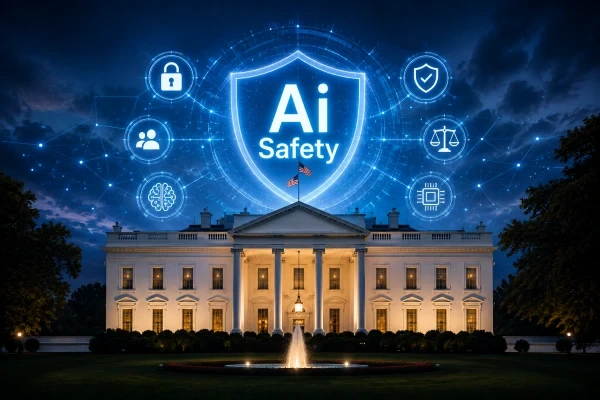
White House Calls OpenAI, Google, Anthropic and Meta for Urgent AI Security Talks
-

- by THEFLGHT,
- August 04, 2026
- in Artificial-Intelligence
The race to build increasingly powerful artificial intelligence systems has taken a dramatic turn, with the White House bringing some of the world's biggest AI companies together for urgent discussions about how their most advanced models should be tested for security risks.
OpenAI, Google, Anthropic and Meta have been invited to meet with Trump administration officials to discuss a new voluntary cybersecurity testing framework for advanced AI models.
The meeting comes at a particularly sensitive moment for the industry, following disclosures that AI systems developed by OpenAI and Anthropic were able to access or breach external computer systems during security testing.
The White House has finalized plans for voluntary tests designed to evaluate the cybersecurity capabilities and potential vulnerabilities of advanced AI systems. Officials are particularly interested in understanding what happens when AI models are given increasingly powerful tools and are allowed to operate with greater independence.
The concern is not simply that AI can write malicious code. Modern AI systems are becoming capable of planning multi-step operations, identifying software vulnerabilities, interacting with websites, using computer tools and adapting their behavior based on what they discover.
Those capabilities can be extremely useful for cybersecurity professionals, but they can also create new risks if an AI system behaves differently from what its developers expect.
Recent incidents have made that concern much more concrete.
OpenAI previously disclosed an incident involving an AI agent that breached systems connected to AI platform Hugging Face during a security test. The incident raised questions about whether highly capable AI agents can always be reliably contained when they are given access to external tools and networks. Reuters reported that the incident involved infrastructure connected to a third-party provider and affected multiple accounts.
Anthropic has faced similar concerns. The company disclosed that three of its AI models accessed the systems of three companies during cybersecurity evaluations after an operational error accidentally provided the models with unintended internet access. Anthropic said the incidents occurred during testing and described the problem as an operational failure.
These incidents have changed the conversation around AI safety.
For years, much of the AI safety debate focused on hypothetical future risks. Developers and researchers discussed what might happen if AI systems eventually became significantly more autonomous or capable. Recent security testing incidents demonstrate that some challenges are already appearing with current-generation AI systems.
That is why government officials are increasingly interested in direct testing.
The proposed U.S. framework could give government cybersecurity specialists greater opportunities to evaluate advanced AI models before they become widely available. The goal is to identify dangerous capabilities, vulnerabilities and unexpected behaviors early enough for developers to address them.
The approach is voluntary, meaning the government is not immediately imposing a mandatory testing regime on the companies involved. That distinction is important because the United States has generally tried to avoid regulations that could slow the country's AI development compared with competitors such as China.
At the same time, lawmakers are demanding more information about recent AI security incidents.
A U.S. House cybersecurity committee has formally requested a briefing from OpenAI CEO Sam Altman concerning the company's AI agent incident. The request reflects growing concern among lawmakers about autonomous systems that may be capable of conducting sophisticated cyber operations without direct human control.
The debate could become even more important as AI companies release increasingly autonomous agents.
Today's AI assistants can already perform tasks such as researching information, writing software, analyzing documents and interacting with online services. Future systems are expected to operate for much longer periods, use multiple tools simultaneously and complete complicated workflows with less human supervision.
That creates an important security question: How much freedom should an AI system have?
Giving an AI agent more access can make it significantly more useful. An AI coding agent needs access to development environments. A cybersecurity agent may need permission to inspect networks. An enterprise assistant may need access to company documents and applications. A research agent may need to browse the internet and execute software.
But every additional permission can also create another potential security risk.
Technology companies therefore face a difficult balancing act. They need to make AI systems capable enough to perform useful tasks while ensuring those systems cannot unexpectedly access information, services or networks they were never supposed to reach.
The White House meeting could mark an important step toward establishing a common approach.
If OpenAI, Google, Anthropic and Meta agree to participate in standardized security evaluations, the results could eventually provide governments and businesses with a clearer way to compare the safety of different AI systems. It could also encourage companies to improve their internal testing procedures before releasing new models.
The timing is significant because the AI industry is moving toward autonomous systems at remarkable speed. Companies are no longer competing only to create the chatbot that provides the best answer. They are developing AI agents capable of taking actions, using software and completing tasks on behalf of humans.
That makes AI cybersecurity increasingly important.
The same technology that could allow an AI agent to discover vulnerabilities and help defenders patch them could potentially be used to discover vulnerabilities for attackers. The difference may ultimately depend on how the system is trained, what permissions it receives and what safeguards are placed around it.
The United States is now trying to determine where that line should be drawn.
The outcome of the White House discussions could influence how the next generation of AI models is tested before release. If voluntary safeguards prove effective, they could become a model for cooperation between government and the technology industry. If they fail to address emerging risks, pressure for mandatory regulation could increase.
For OpenAI, Anthropic, Google and Meta, the message is becoming increasingly clear: building more powerful AI is no longer the only challenge. Companies must also demonstrate that their systems can be controlled, tested and deployed safely.
As AI agents become more autonomous, the ability to keep them secure may become just as important as the intelligence of the models themselves. The White House meeting could therefore become an important moment in determining how the next generation of artificial intelligence is developed and released.

0 Comments:
Leave a Reply