WhatsApp Is Testing AI That Can Warn You About Scam Messages
-

- by THEFLGHT,
- August 16, 2026
- in Artificial-Intelligence
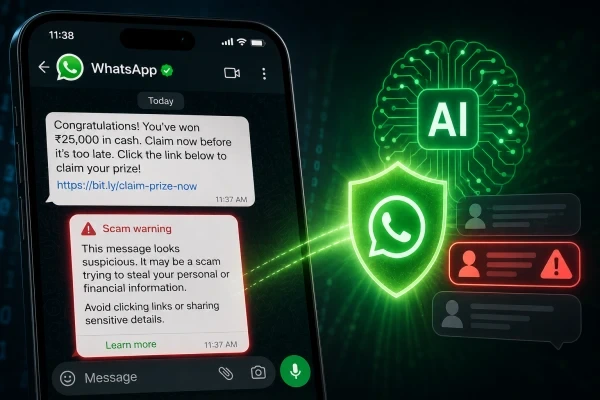
WhatsApp is testing a new artificial intelligence feature that could change how users deal with scam messages. Called Scam Alert, the feature uses an on-device machine-learning model to identify conversations that may contain signs of fraud and warn the person before they continue interacting with the suspected scammer. The feature is currently being tested with a limited group of users.
The timing is important because scammers are becoming increasingly sophisticated. Fraudsters can impersonate friends, businesses, employers, banks and even government organizations, while AI tools are making it easier to create convincing messages. WhatsApp, which has more than 3 billion users, has consequently become an important target for online fraud.
The new Scam Alert feature is designed to work differently from traditional server-side message scanning. WhatsApp says the machine-learning model can analyze certain messages directly on the user's device, meaning the message content does not have to be sent to Meta's servers simply for the AI to determine whether it looks suspicious. This allows WhatsApp to add another security layer while maintaining its end-to-end encryption approach.
When the system believes a conversation could be a scam, WhatsApp can display a warning to the recipient. The user can then decide whether to block the person, report the conversation or continue chatting. If the warning is incorrect, the user can also mark the conversation as trusted.
The feature is particularly interesting because WhatsApp is not automatically taking control of the conversation. The AI is being used as a warning system rather than making the final decision for the user. This means a suspicious message can be flagged without WhatsApp automatically deleting the conversation or reporting the sender.
There is also an important limitation. The initial Scam Alert system is focused on messages from people who are not already in the user's contacts. That makes sense because unexpected conversations from unknown numbers are frequently associated with phishing attempts, fake investment opportunities, fraudulent job offers and impersonation scams.
WhatsApp is also giving users control over the feature. Scam Alert is optional during the current testing phase, and users can turn it off. In some situations, users can voluntarily share a small amount of message information with WhatsApp to help improve detection, rather than having their conversations automatically sent to Meta.
The bigger development is the use of AI directly on smartphones to detect scams. Instead of waiting for users to report fraudulent accounts after they have already lost money, AI can potentially identify suspicious patterns earlier and give people a warning before they respond.
This approach could become increasingly important as AI-generated scams become more convincing. A scam message with perfect grammar, realistic business language or a believable personal story may be much harder for an ordinary user to recognize. An AI system can instead look for patterns across the conversation that may indicate manipulation or fraud.
However, Scam Alert should not be treated as a guarantee that every scam will be detected. Scammers constantly change their techniques, and an AI system can make mistakes or miss new forms of fraud. Users will still need to be careful with unexpected requests for money, passwords, verification codes, banking information and suspicious links.
The feature also raises an interesting question about privacy. WhatsApp is trying to use AI to analyze potentially dangerous messages without abandoning its encryption model. Running the detection locally on the device provides one possible way to achieve that balance because the analysis can happen without sending the full conversation to a remote server.
If testing goes well, WhatsApp could eventually make Scam Alert available to a much larger number of users. That would give billions of people another layer of protection against one of the most common forms of online fraud.
For Meta, the feature also demonstrates how AI is moving beyond chatbots and image generation. Artificial intelligence is increasingly being placed quietly inside everyday applications to detect threats, protect accounts and make decisions that users may never see.
The most interesting part is that you may not need to ask an AI whether a message is a scam.
Your phone could eventually warn you before you even realize something is wrong.






0 Comments:
Leave a Reply