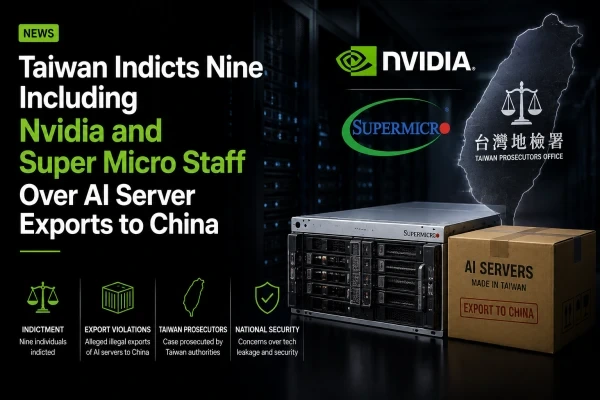
Taiwan Indicts Nine Including Nvidia and Super Micro Staff Over AI Server Exports to China
-

- by THEFLGHT,
- August 24, 2026
- in Artificial-Intelligence
Taiwanese prosecutors have formally indicted nine individuals, including employees of Nvidia and Super Micro Computer, in connection with the alleged illegal export of high-end artificial intelligence servers to China.
The charges, announced Monday by the Keelung District Prosecutors’ Office, mark a significant escalation in Taiwan’s efforts to police the diversion of advanced AI hardware subject to U.S. export controls.
According to the prosecutors’ statement, eight of the defendants face charges of breach of trust and document forgery linked to the illegal movement of Super Micro servers equipped with Nvidia chips. A ninth defendant is charged in a related case involving the alleged diversion of funds from a distributor company.
The group includes one employee from Nvidia’s Taiwan unit and two from Super Micro’s Taiwan operations. Full names of the defendants were not released.
The case centers on a scheme involving 130 B300 servers ordered from Super Micro. Prosecutors said the defendants arranged false end-user documentation stating that the systems would be installed and used at a rented server facility in Taiwan. In reality, 74 of the servers were exported and delivered to Chinese customers.
Routes included direct shipments as well as transshipments through Indonesia, Japan and Hong Kong. Taiwan customs officials detected irregularities and blocked the remaining 56 servers that were intended for export to a company in Japan.
Awareness of Controls and Alleged Collusion
Keelung prosecutors stated that the defendants were “fully aware” that both Nvidia and Super Micro maintain rigorous internal control procedures governing exports. Despite this knowledge, the individuals “colluded with one another at various levels for enormous profit, illegally exporting high-end servers, increasing corporate compliance costs, and severely damaging our nation’s international image,” the office said.
Neither Nvidia nor Super Micro immediately responded to requests for comment on the indictments. The companies have previously emphasized their commitment to complying with U.S. export regulations and cooperating with investigations.
Taiwan is the world’s leading producer of advanced semiconductors used in AI applications. The island has steadily tightened its own export controls in recent years to prevent sensitive technology and know-how from reaching China, which claims Taiwan as its territory despite the island’s democratic government and strong objections.
Context of U.S. Restrictions and Parallel Cases
Washington has restricted the export and sale of advanced AI semiconductors to China without a license since 2022. The rules aim to limit Beijing’s access to high-performance computing capabilities that could support military applications and broader technological advancement. Servers built around Nvidia’s latest-generation chips fall squarely under these controls.
The Taiwanese indictment builds on earlier phases of the same investigation. In May 2026, prosecutors detained three suspects and seized approximately 50 Super Micro AI servers along with cash after intercepting a suspected shipment.
Subsequent raids in late June and early July targeted Super Micro’s Taiwan office, distributor Albatron Technology, data-center operator Chief Telecom, and residences of additional individuals. Several employees were questioned or detained during those operations.
The local probe also runs parallel to U.S. federal charges unsealed in March 2026. American prosecutors charged Super Micro co-founder Yih-Shyan “Wally” Liaw and two associates with conspiring to divert roughly $2.5 billion worth of Nvidia-equipped servers to Chinese customers through a Southeast Asian front company. Those U.S. allegations involved techniques such as serial-number swaps and dummy servers to evade detection.
Why the Case Matters for AI Infrastructure and Geopolitics
The indictment underscores the practical challenges of enforcing export controls in a globalized semiconductor supply chain. High-end AI servers are assembled and often staged in Taiwan, the epicenter of advanced chip manufacturing.
Once systems leave controlled facilities, secondary markets and transshipment routes can obscure final destinations. Document forgery and false end-user certificates remain common alleged methods for circumventing both corporate compliance systems and customs checks.
For Nvidia and Super Micro, the case raises ongoing compliance costs and reputational considerations even when the companies themselves are not charged. Super Micro has previously stated that it is not a target of the Taiwanese investigation and has placed involved employees on administrative leave while cooperating with authorities.
The presence of employees from both firms among the indicted defendants highlights how internal actors can undermine formal control frameworks.
From a broader industry perspective, the action reinforces that Taiwanese authorities are prepared to pursue criminal charges under existing statutes—primarily document forgery and breach of trust—while the island continues to debate stronger domestic legislation specifically targeting strategic technology exports to China.
Enforcement pressure from both Taipei and Washington increases the operational risk for any intermediary seeking to arbitrage price differences or meet demand in restricted markets.
The successful diversion of 74 servers demonstrates that demand for cutting-edge AI compute remains strong enough in China to incentivize high-risk schemes.
At the same time, the interception of 56 additional units shows that customs scrutiny and inter-agency coordination can disrupt larger volumes. Prosecutors have not publicly quantified the total value of the 130-server order, but earlier seizures in the same probe involved systems valued in the tens of millions of dollars.
What Comes Next
The nine defendants now face formal trial proceedings in Taiwan. Prosecutors have sought prison terms of up to five years for several of the primary figures. Outcomes will depend on evidence of knowledge, intent, and the precise roles each individual played in document preparation, logistics, and profit distribution.
Companies throughout the AI hardware ecosystem are likely to review end-user verification processes, reseller agreements, and internal audit protocols. Heightened scrutiny may slow certain gray-market flows but is unlikely to eliminate them entirely while performance gaps between unrestricted and controlled hardware remain large.
The case also arrives amid intensifying global competition over AI infrastructure. Data-center buildouts, sovereign AI initiatives, and military modernization programs continue to drive demand for the same classes of accelerators and servers that feature in export-control regimes.
Taiwan’s decision to pursue criminal indictments rather than limit itself to administrative measures signals a willingness to treat diversion of these systems as a serious national interest issue.
As the proceedings advance, further details on the logistics networks, financial flows, and any additional unindicted participants may emerge.
For now, the Keelung indictment stands as one of the clearest public demonstrations that Taiwanese prosecutors are actively policing the AI hardware supply chain at the point where advanced systems leave the island.






0 Comments:
Leave a Reply