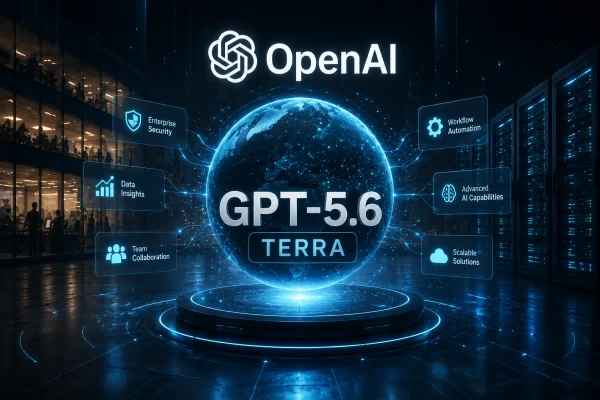
OpenAI Expands GPT-5.6 Family With Terra to Bring Enterprise AI to More Businesses
-

- by THEFLGHT,
- July 27, 2026
- in Artificial-Intelligence
OpenAI is continuing its rapid expansion of frontier artificial intelligence with the introduction of GPT-5.6 Terra, a new model developed to make advanced AI more practical and affordable for businesses. While flagship AI models continue pushing the limits of reasoning and scientific problem-solving, Terra focuses on delivering high performance for everyday enterprise workloads without requiring the same level of computing resources. The release reflects a growing industry trend toward specialized AI systems that balance intelligence, speed, and operational efficiency for commercial deployments.
GPT-5.6 Terra has been built for organizations that rely on artificial intelligence throughout their daily operations. Businesses increasingly use AI to automate customer support, analyze large collections of documents, generate software code, summarize meetings, prepare reports, assist employees, and manage internal knowledge bases.
Rather than paying premium costs for the most advanced reasoning model on every request, companies can use Terra to handle the majority of routine business tasks while maintaining impressive speed and reliability. This approach allows organizations to expand AI adoption without significantly increasing infrastructure expenses.
One of Terra's strongest advantages is its ability to support enterprise automation at scale.
Companies deploying AI across thousands of employees require systems capable of responding quickly while maintaining consistent accuracy.
Terra has been optimized for these environments, making it suitable for integration into help desks, customer relationship management platforms, productivity software, financial systems, and internal business applications. By reducing response times and operating costs, OpenAI aims to make artificial intelligence accessible to a broader range of organizations, including medium-sized businesses that previously found large AI deployments too expensive.
Software developers are also expected to benefit from the new model. GPT-5.6 Terra can assist with writing code, reviewing applications, explaining programming concepts, identifying software bugs, generating technical documentation, and accelerating development workflows.
Many businesses now integrate AI directly into software engineering teams to reduce repetitive tasks and improve productivity. With organizations shipping software faster than ever before, efficient coding assistants have become one of the fastest-growing applications of enterprise artificial intelligence.
Security and reliability remain key priorities for enterprise customers adopting AI technologies.
Businesses expect AI systems to protect confidential information while complying with internal governance policies and industry regulations.
OpenAI continues strengthening safeguards designed to improve the handling of sensitive requests, reduce inaccurate outputs, and provide organizations with greater confidence when deploying AI across critical business operations. These improvements are particularly important in industries such as finance, healthcare, legal services, education, and government, where accuracy and trust are essential.
The introduction of Terra also highlights how the artificial intelligence market is becoming increasingly segmented. Instead of building one universal model for every task, AI companies are developing families of models optimized for different workloads.
Premium models remain available for advanced reasoning, scientific research, and complex engineering challenges, while more efficient systems like Terra focus on everyday productivity, customer engagement, and enterprise automation. This strategy gives organizations greater flexibility to select the right AI model based on performance requirements and budget.
Competition within enterprise AI continues to intensify as OpenAI, Anthropic, Google, Microsoft, Meta, Amazon, and other technology leaders invest billions of dollars in cloud infrastructure, AI chips, and next-generation language models.
Businesses evaluating AI platforms increasingly compare factors such as operating cost, response speed, security, integration capabilities, and long-term scalability rather than benchmark scores alone. The demand for practical, cost-effective AI solutions is expected to grow significantly as organizations continue expanding digital transformation initiatives across every industry.
The launch of GPT-5.6 Terra demonstrates that the future of artificial intelligence will not depend solely on creating the most powerful models, but also on making advanced AI economically viable for everyday business use.
As enterprises continue integrating intelligent software into customer service, software development, operations, and decision-making, efficient AI platforms like Terra are likely to play a central role in the next phase of global AI adoption, helping organizations unlock greater productivity while controlling operational costs.




0 Comments:
Leave a Reply