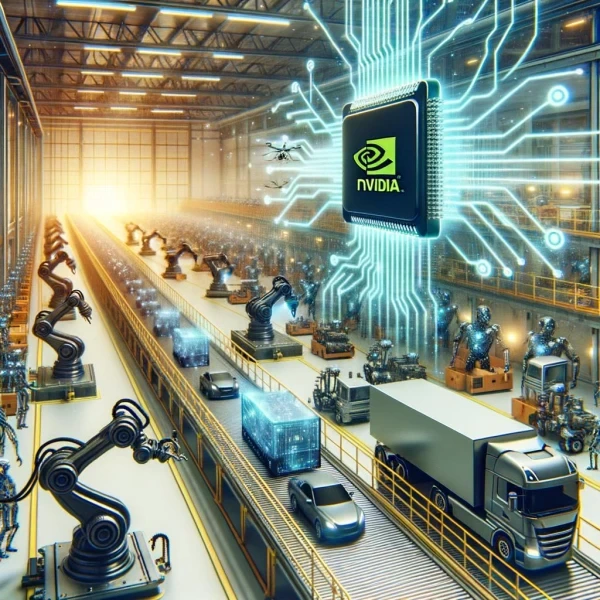
Nvidia Joins Forces With Japan's Biggest Robotics Companies to Build the Next Generation of AI Robots
-

- by THEFLGHT,
- July 16, 2026
- in Artificial-Intelligence
Nvidia has taken another major step in expanding beyond AI chatbots and data centers by announcing a strategic partnership with some of Japan's largest robotics companies. The collaboration brings together Nvidia, Fujitsu, Fanuc, Yaskawa Electric, and other industrial leaders to develop a new generation of intelligent robots capable of performing increasingly complex tasks in factories, warehouses, hospitals, and other real-world environments.
The announcement was made during events in Tokyo attended by Nvidia CEO Jensen Huang, who described robotics as one of the biggest opportunities for artificial intelligence over the next decade.
Unlike traditional industrial robots that repeatedly perform pre-programmed movements, the new generation of AI-powered machines is designed to understand their surroundings, adapt to changing environments, and make decisions in real time. Nvidia refers to this technology as "physical AI" because it extends artificial intelligence beyond digital assistants and into machines that interact directly with the physical world.
These robots can identify objects, navigate unpredictable spaces, work safely alongside humans, and improve their performance through continuous learning. Industry experts believe this represents one of the most important frontiers in artificial intelligence.
Japan is considered one of the world's most important robotics markets, making the partnership particularly significant. The country has long been a global leader in industrial automation through companies such as Fanuc and Yaskawa Electric.
At the same time, Japan faces a rapidly aging population and growing labor shortages, creating strong demand for intelligent machines capable of supporting manufacturing, healthcare, logistics, and essential public services. AI-powered robotics could help businesses maintain productivity while addressing workforce challenges that are becoming increasingly difficult to solve through traditional hiring alone.
Nvidia will provide the advanced AI computing platform that powers these next-generation robotic systems. Its processors are already widely used for training large language models, but the company is now investing heavily in technologies that enable autonomous machines to understand vision, speech, motion, and spatial awareness simultaneously.
By combining powerful AI chips with robotics expertise from Japanese manufacturers, the partnership aims to accelerate commercial deployment of intelligent robots capable of operating in complex environments without constant human supervision.
The initiative also highlights Nvidia's broader strategy to diversify beyond cloud computing. While demand for AI chips from companies such as Microsoft, Meta, Amazon, Google, and OpenAI continues to drive record revenue, Nvidia sees robotics as another trillion-dollar opportunity.
During the Tokyo event, Jensen Huang emphasized that factories of the future will increasingly rely on autonomous machines powered by AI rather than conventional industrial automation. Analysts believe robotics could become one of Nvidia's fastest-growing business segments over the coming decade.
Beyond manufacturing, physical AI has applications across numerous industries. Hospitals are exploring autonomous delivery robots, logistics companies are developing AI-powered warehouse systems, retailers are testing inventory robots, and agriculture is adopting autonomous equipment for planting and harvesting.
Advances in computer vision, sensor technology, and AI reasoning are allowing robots to perform tasks that previously required direct human control. This shift could dramatically improve productivity while opening entirely new markets for AI hardware and software providers.
Japan's government has also identified artificial intelligence and robotics as national priorities, committing major long-term investments in semiconductors, AI infrastructure, and advanced manufacturing.
Officials believe stronger collaboration between government, universities, and technology companies will help the country regain competitiveness in emerging technologies while supporting economic growth. Nvidia's partnership aligns closely with these national objectives and strengthens Japan's position in the rapidly expanding global AI ecosystem.
The partnership demonstrates that the future of artificial intelligence extends well beyond chatbots and virtual assistants. As AI becomes integrated into physical machines capable of moving, observing, and making decisions independently, robotics is emerging as one of the industry's fastest-growing sectors.
With Nvidia supplying the intelligence and Japan contributing decades of robotics expertise, the collaboration could accelerate the arrival of a new generation of AI-powered machines that transform manufacturing, healthcare, logistics, and everyday life around the world.





0 Comments:
Leave a Reply