Nvidia CEO Says the AI Boom Is Far From Over as Global Chip Demand Surges
-

- by THEFLGHT,
- July 24, 2026
- in Artificial-Intelligence
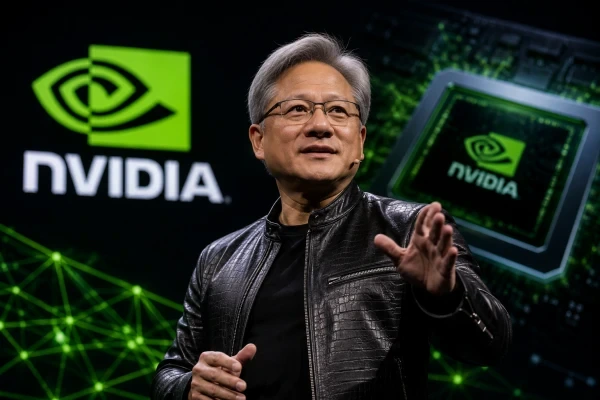
Nvidia Chief Executive Officer Jensen Huang has delivered one of his strongest statements yet about the future of artificial intelligence, declaring that the current AI boom is nowhere near its peak.
Speaking about the rapid expansion of AI infrastructure across industries, Huang dismissed concerns that the semiconductor market is approaching another boom-and-bust cycle, arguing instead that artificial intelligence has fundamentally changed the long-term demand for advanced computing.
His remarks come as Nvidia continues to dominate the global AI chip market, supplying processors that power many of the world's leading AI models and cloud platforms.
According to Huang, the explosive growth of generative AI has created a new era in computing where demand is driven not only by training massive AI models but also by the enormous computing resources required to run them every day. Unlike previous technology cycles that experienced sharp declines after periods of rapid expansion, he believes artificial intelligence represents a permanent shift in how businesses operate.
As companies deploy AI across customer service, software development, healthcare, finance, manufacturing, education, and scientific research, the need for AI computing infrastructure continues to grow at an unprecedented pace.
The increasing popularity of AI assistants, intelligent software agents, and enterprise automation has dramatically increased demand for high-performance processors.
Every AI-generated response requires powerful graphics processors capable of processing billions of mathematical calculations in fractions of a second. Nvidia's latest Blackwell architecture has become one of the industry's most sought-after platforms because it delivers significantly higher performance for AI training and inference while improving energy efficiency. Cloud providers and AI companies continue placing large orders as they race to expand data center capacity around the world.
Technology companies including OpenAI, Microsoft, Google, Meta, Amazon, Anthropic, and xAI are investing hundreds of billions of dollars in new AI infrastructure to support the growing demand for intelligent applications. Massive hyperscale data centers are being constructed across North America, Europe, Asia, and the Middle East, each containing thousands of AI accelerators working together to train increasingly capable foundation models. Analysts believe these investments will continue for years as organizations integrate artificial intelligence into nearly every aspect of their operations.
The competition among chip manufacturers has also intensified. AMD, Intel, and several emerging AI hardware companies are introducing new processors designed to challenge Nvidia's leadership, while cloud providers continue developing their own custom AI chips. Despite growing competition, Nvidia remains the industry's dominant supplier, benefiting from its mature software ecosystem, advanced networking technologies, and powerful GPU architecture that have become the preferred platform for training and deploying frontier AI models.
Industry experts note that the AI market is evolving beyond simple chatbot applications. Businesses are increasingly deploying autonomous AI agents capable of writing software, analyzing documents, conducting research, detecting cyber threats, managing customer interactions, and automating complex business processes. These more sophisticated workloads require significantly greater computing power than earlier generations of AI, further increasing demand for high-performance infrastructure capable of supporting continuous inference and long-running reasoning tasks.
Beyond commercial applications, governments and research institutions are also expanding investments in AI supercomputing. National laboratories, universities, healthcare organizations, and defense agencies are deploying advanced AI systems for scientific discovery, climate research, drug development, cybersecurity, and national security initiatives. This broad adoption across both public and private sectors reinforces Huang's belief that demand for AI computing will remain strong well into the next decade.
Jensen Huang's latest comments highlight a growing consensus within the technology industry that artificial intelligence is becoming a foundational technology comparable to the rise of the internet and cloud computing.
Rather than slowing down, investment in AI infrastructure continues to accelerate as organizations compete to build smarter applications and more capable AI systems. If current trends continue, the global race for AI leadership will depend not only on developing better models but also on building the powerful computing platforms that make those models possible.






0 Comments:
Leave a Reply