NVIDIA AVO Agent Scores Perfect 100 on ARC-AGI-3 Benchmark
-

- by THEFLGHT,
- August 22, 2026
- in Artificial-Intelligence
NVIDIA researchers have demonstrated that carefully designed agent architecture can dramatically outperform raw model capability on long-horizon reasoning tasks. On August 21, 2026, the company announced that its Agentic Variation Operators system, known as AVO, achieved a perfect 100.00 Relative Human Action Efficiency score on the public ARC-AGI-3 benchmark.
AVO completed all 183 levels across the benchmark’s 25 game environments while requiring roughly 12 percent fewer environment actions than the previous leading comparable system.
The underlying language model was Anthropic’s Claude Opus 5, which scores only about 30.2 percent when evaluated on its own under high-reasoning settings. The gap between 30 percent and 100 percent is attributed almost entirely to the surrounding agent system rather than any change in the model weights.
What ARC-AGI-3 Actually Tests
ARC-AGI-3 is an interactive successor to earlier Abstraction and Reasoning Corpus benchmarks. Agents are dropped into unfamiliar environments with no instructions, explicit rules, or stated goals. They must discover the effects of available actions, infer objectives, and make efficient progress solely through trial, observation, and memory.
Success is measured by Relative Human Action Efficiency, which compares the number of actions an agent needs against the number a human typically requires on the same level.
When the public set launched, humans cleared every environment while the best standalone models managed fractions of a percent. Claude Opus 5 later set a model-only record near 30 percent. NVIDIA’s result therefore represents a qualitative leap in how effectively frontier models can be harnessed for sustained autonomous work.
How AVO Works
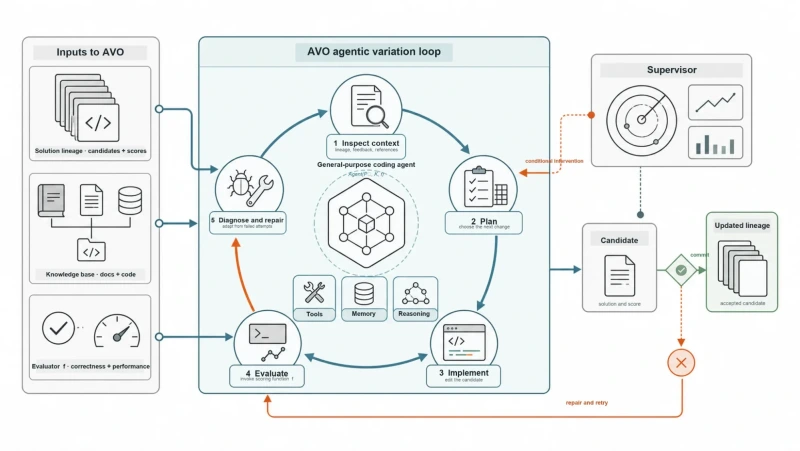
AVO is a general-purpose coding agent originally developed for software engineering and GPU-kernel optimization. Its core loop consists of inspecting context, planning, implementing changes, evaluating results, and updating persistent state. Two mechanisms enable long-horizon performance that exceeds a single model context window: persistent memory and a supervisor agent.
Persistent memory stores prior implementations, evaluation outcomes, compiler and profiler outputs, and accumulated reasoning so the agent can resume from the current state rather than reconstructing everything from scratch.
The supervisor monitors the overall search trajectory for stagnation or repeated unproductive cycles and can redirect the main agent toward alternative strategies when progress stalls.
For the ARC-AGI-3 experiments, the same underlying agent architecture was connected to a different task interface. Environments were presented as text-only 64-by-64 grids. No domain-specific redesign of the agent loop was required. Only the environment-specific tools and evaluation functions changed.
Transfer from Kernel Optimization
Before tackling ARC-AGI-3, AVO spent seven continuous days optimizing multi-head attention kernels on NVIDIA DGX B200 systems. It explored more than 500 optimization directions and committed 40 kernel versions.
The best results outperformed cuDNN by up to 3.5 percent and FlashAttention-4 by up to 10.5 percent across evaluated configurations. The same agent later adapted the evolved kernel to grouped-query attention in roughly 30 minutes of additional autonomous work.
NVIDIA researchers emphasize that the computational pattern underlying both tasks is similar: form hypotheses from incomplete evidence, act through an external interface, observe consequences, preserve useful state, revise the internal model of the problem, recover from incorrect assumptions, and continue over a long horizon. The domain changes; the core machinery does not.
Important Caveats
The 100.00 score applies only to the public ARC-AGI-3 set. NVIDIA did not submit results on the semi-private or fully private competition sets used for official leaderboard rankings. The comparison with VISTA, which required 7,542 environment actions versus AVO’s 6,624 on the same 183 levels, is also not a controlled ablation.
The two systems differ in agent backend, observation representation, memory design, and context management, so the efficiency difference cannot be attributed to any single component.
Preliminary experiments pairing AVO with OpenAI’s GPT-5.6 Sol on a challenging subset of games produced complementary operating profiles: Sol sometimes reached matched levels faster in wall-clock time, while Opus used fewer environment actions. Broader systematic comparisons remain for future work.
Why the Result Matters
The announcement arrives amid intense industry focus on agentic systems capable of multi-step software engineering, scientific discovery, and real-world tool use. It provides concrete evidence that substantial performance gains on hard interactive benchmarks can come from system-level design rather than waiting for the next larger or more heavily trained model.
For developers and researchers building autonomous agents, the takeaway is clear. Memory that survives across context windows, recovery mechanisms that prevent stagnation, and tools that ground the agent in external feedback are not optional polish. They can determine whether a frontier model delivers 30 percent of its potential or nearly all of it.
NVIDIA has released a technical blog post detailing the architecture and results, along with an accompanying paper on arXiv. The work underscores a growing consensus across labs that the next major advances in useful AI may depend as much on how models are orchestrated as on the models themselves.
As agent systems move from research demonstrations into production coding assistants, enterprise automation, and scientific workflows, results like AVO’s perfect public-set score offer both a performance target and a practical blueprint for turning strong language models into reliable long-horizon problem solvers.






0 Comments:
Leave a Reply