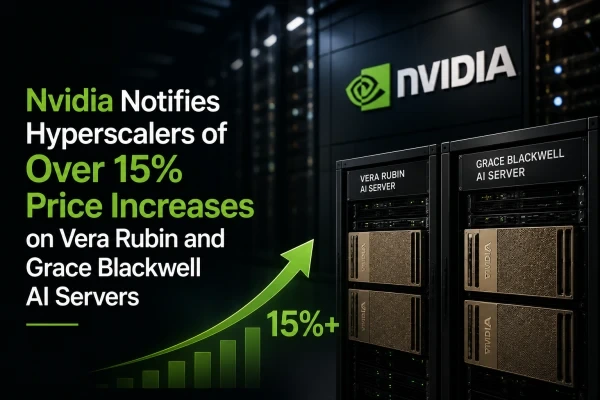
Nvidia Notifies Hyperscalers of Over 15% Price Increases on Vera Rubin and Grace Blackwell AI Servers
-

- by THEFLGHT,
- August 23, 2026
- in Artificial-Intelligence
Nvidia has notified some of its largest customers that prices for servers containing its artificial intelligence chips will rise by more than 15 percent in many cases, according to reports from Bloomberg and confirmed across multiple outlets.
The increases, driven by soaring memory chip costs, will take effect on systems shipped early next year and will affect configurations built around the flagship Vera Rubin and Grace Blackwell platforms.
Contract server manufacturers that assemble systems for major data center operators including Microsoft, Google, and Oracle have already informed those customers of the forthcoming changes.
Nvidia itself has not publicly commented on the notifications. The company is scheduled to report its second-quarter results on August 26.
Memory Costs Drive the Increases
The price adjustments stem primarily from sharp rises in the cost of high-bandwidth memory and related DRAM components essential to modern AI accelerators.
Samsung, SK Hynix, and Micron, the dominant suppliers of the specialized memory used in AI systems, have seen demand outpace supply as hyperscalers race to expand training and inference capacity.
Analyst estimates earlier in the year already pointed to substantial memory cost inflation for next-generation racks. Reports indicated that memory alone could account for a significantly higher share of the bill of materials on Vera Rubin systems compared with previous Blackwell-generation racks. Those earlier projections are now translating into concrete price notifications for customers.
The size of the increase will vary depending on the specific Nvidia chip generation and the memory configuration chosen. Systems using the newest Vera Rubin architecture and Grace Blackwell combinations are explicitly included in the notifications.
Impact on Hyperscalers and the Broader AI Buildout
Microsoft, Alphabet’s Google, and Oracle are among the operators whose contract manufacturers have received the notices.
These companies form the core of the global AI infrastructure expansion, committing tens of billions of dollars annually to GPU clusters. Higher server prices will raise the capital expenditure required to reach planned capacity targets.
The timing is notable. Nvidia has maintained gross margins near 75 percent while becoming the world’s most valuable public company, largely on the strength of AI chip demand. Even so, the company is passing through the elevated memory costs rather than absorbing them. This underscores the leverage currently held by memory makers amid constrained supply.
Downstream effects are already visible. Amazon Web Services previously raised certain GPU instance prices. Nvidia itself increased gaming card prices earlier this month, with AMD following shortly afterward. Consumer electronics firms including Apple and Qualcomm have also cited component cost pressure.
European AI Projects Face Higher Costs
Public-sector AI initiatives in Europe are also exposed. The European Union has committed approximately €20 billion to a network of AI gigafactories. A French consortium has bid around $10 billion for one such facility.
Those plans were developed using earlier hardware pricing assumptions. A sustained 15 percent or greater increase on server systems would require material budget revisions.
Commercial European operators expanding Nvidia capacity, such as Nebius at its Finnish data center, face the same revised economics.
Why This Matters for the AI Industry
The notifications highlight a structural shift in AI infrastructure economics. For years the primary constraint was access to Nvidia GPUs themselves. Memory supply has now emerged as a parallel bottleneck capable of moving system-level pricing.
Analysts have previously estimated that memory could represent roughly a quarter of the cost of a Vera Rubin NVL72-class rack under elevated pricing scenarios.
Higher server costs arrive as hyperscalers continue to report multi-year capital expenditure plans measured in the hundreds of billions of dollars.
The combination of elevated hardware prices, power availability challenges, construction delays, and local opposition to new data centers is raising the overall cost of scaling AI compute.
Nvidia’s earnings report later this week will provide the next data point on demand durability. Investors and operators will be watching not only for order trends but for any commentary on how the company and its customers are navigating the memory cost environment.
In the near term, the price increases reinforce the centrality of the memory supply chain to the next phase of AI infrastructure growth.
They also illustrate that even the industry’s most dominant hardware supplier cannot fully insulate its customers from component inflation when specialized memory remains scarce.
The developments leave hyperscalers, cloud providers, and national AI programs recalculating the true cost of the compute capacity required to train and serve the next generation of frontier models.






0 Comments:
Leave a Reply