Nvidia's AI Chip Demand Shows No Signs of Slowing as Global Data Center Spending Soars
-

- by THEFLGHT,
- July 28, 2026
- in Artificial-Intelligence
The global race to build more powerful artificial intelligence systems is fueling unprecedented demand for Nvidia's AI chips, reinforcing the company's position at the center of one of the fastest-growing technology markets in history.
As businesses accelerate investments in generative AI, autonomous agents, robotics, and enterprise automation, the need for advanced graphics processing units (GPUs) has reached record levels.
Technology giants, cloud providers, research institutions, and AI startups are all competing for access to the computing power required to train and deploy increasingly sophisticated AI models.
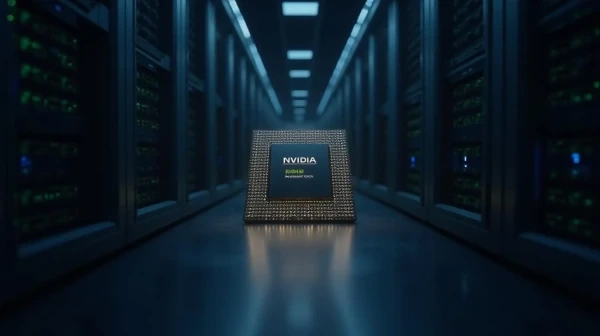
Nvidia's latest Blackwell-based AI platforms have become a critical part of modern data centers. These processors are designed to handle massive AI workloads, enabling organizations to train large language models, process complex scientific simulations, accelerate software development, and support real-time AI applications.
Compared with previous generations, the new hardware delivers significantly greater performance while improving energy efficiency, allowing companies to scale their AI operations more effectively.
The rapid expansion of AI infrastructure is being driven by some of the world's largest technology companies. Microsoft, Amazon, Google, Meta, Oracle, and other cloud providers continue investing billions of dollars in new AI data centers capable of supporting growing customer demand.
These facilities require thousands of high-performance GPUs working together, making Nvidia one of the biggest beneficiaries of the ongoing AI boom. Industry analysts expect global spending on AI infrastructure to continue rising over the next several years as organizations integrate artificial intelligence into more products and services.
Demand is not limited to major technology companies. Financial institutions, healthcare organizations, manufacturers, universities, and government agencies are increasingly deploying AI systems that require specialized computing hardware.
From medical research and cybersecurity to autonomous vehicles and financial forecasting, advanced GPUs have become essential for processing enormous datasets and running sophisticated machine learning models. This diversification of customers is helping expand Nvidia's market beyond traditional cloud computing.
AI startups are also contributing to record chip demand. Companies developing foundation models, enterprise AI platforms, robotics software, and scientific research tools require access to large numbers of GPUs to train and refine their models.
Many startups rent computing resources through cloud providers, while others invest directly in dedicated AI clusters. As venture capital continues flowing into artificial intelligence, infrastructure providers are racing to expand capacity to meet growing demand.
One of the biggest challenges facing the industry is balancing performance with energy consumption. Modern AI data centers require enormous amounts of electricity, prompting hardware manufacturers to improve power efficiency while delivering greater computational performance.
Nvidia has invested heavily in advanced chip architectures, networking technology, and software optimization to help organizations maximize AI performance without proportionally increasing operational costs. Energy-efficient computing is becoming increasingly important as governments and businesses seek more sustainable technology solutions.
Competition in the AI hardware market continues intensifying. AMD, Intel, and several specialized chipmakers are introducing new processors designed to challenge Nvidia's leadership. Major cloud providers are also developing custom AI chips tailored to their own infrastructure.
Despite growing competition, Nvidia maintains a significant advantage through its mature software ecosystem, developer tools, networking technologies, and long-standing relationships with enterprise customers. These strengths have helped the company remain the preferred platform for many of the world's largest AI deployments.
Industry experts believe demand for AI computing power will continue increasing as artificial intelligence becomes more deeply integrated into everyday life. Applications such as autonomous AI agents, advanced robotics, personalized healthcare, intelligent manufacturing, scientific discovery, and next-generation digital assistants all require substantial computational resources.
Every new breakthrough in AI creates additional demand for faster processors and larger data centers, reinforcing the importance of companies capable of delivering high-performance computing infrastructure.
Nvidia's continued success illustrates that the artificial intelligence revolution extends far beyond software models and chatbots. Behind every advanced AI application lies an enormous network of powerful computing systems capable of processing trillions of calculations every second.
As organizations worldwide continue investing in AI innovation, Nvidia's chips are expected to remain one of the most essential building blocks powering the future of artificial intelligence.






0 Comments:
Leave a Reply