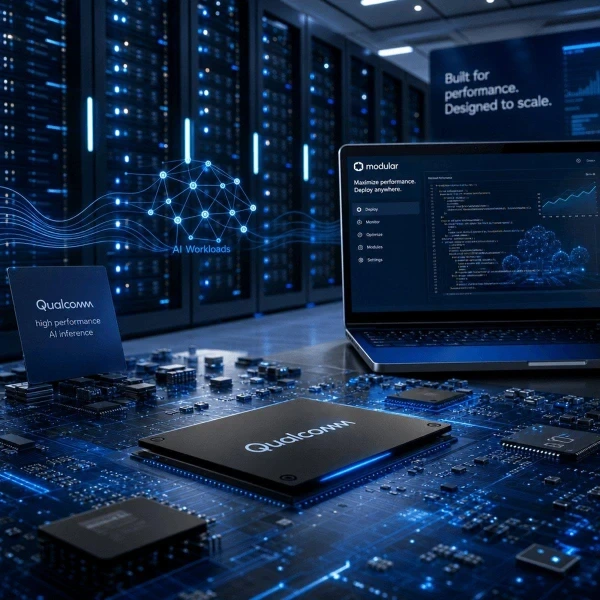
Microsoft and Meta Choose Qualcomm's New AI Chips in Surprise Challenge to Nvidia
-

- by THEFLGHT,
- July 17, 2026
- in Artificial-Intelligence
Qualcomm has made one of its biggest announcements in years by revealing that Microsoft and Meta will use its next-generation artificial intelligence chips inside their growing AI infrastructure. The decision marks a major breakthrough for Qualcomm as it expands beyond smartphones and enters one of the fastest-growing markets in technology.
Until now, Nvidia has dominated AI computing inside data centers, but Qualcomm believes its new processors can offer an efficient alternative for companies building the massive computing systems required to power modern AI applications.
The announcement represents a significant shift in Qualcomm's long-term strategy. For decades the company has been best known for supplying processors used in Android smartphones, but slowing growth in the mobile industry has encouraged Qualcomm to diversify into automotive technology, industrial computing, PCs, and now artificial intelligence infrastructure.
Company executives say AI data centers could become one of Qualcomm's largest business opportunities over the next several years, with revenue from the segment expected to reach billions of dollars before the end of the decade.
Microsoft plans to use Qualcomm's High Bandwidth Compute processors for AI workloads, while Meta intends to deploy Qualcomm's Dragonfly C1000 CPUs in its expanding network of AI data centers.
Qualcomm also revealed that two additional hyperscale cloud providers have committed to purchasing custom AI chips, although their identities have not yet been disclosed. Winning customers of this size demonstrates growing confidence in Qualcomm's ability to compete in a market that has largely been controlled by Nvidia.
The timing of Qualcomm's expansion reflects the enormous global demand for artificial intelligence computing. Technology companies are investing hundreds of billions of dollars in new data centers capable of training and operating advanced AI models.
Every new chatbot, AI assistant, image generator, coding platform, and autonomous system depends on increasingly powerful processors capable of handling complex machine learning workloads. This surge in demand has transformed AI chips into one of the world's most valuable technology markets.
Competition is also becoming far more intense. Nvidia remains the dominant supplier of AI accelerators, while AMD, Intel, Google, Amazon, Microsoft, and several startups continue developing their own custom processors.
Rather than relying on a single supplier, many cloud providers now want multiple hardware options that offer different combinations of performance, efficiency, and cost. Qualcomm believes its experience designing low-power, high-performance chips gives it an opportunity to win market share as AI infrastructure continues expanding worldwide.
Industry analysts believe the semiconductor market is entering a new phase where AI hardware becomes as strategically important as AI software. Companies developing advanced language models need enormous amounts of computing power, making access to reliable processors a competitive advantage.
As more businesses adopt generative AI across healthcare, finance, manufacturing, education, cybersecurity, and software development, demand for specialized AI chips is expected to remain strong for years. This environment creates new opportunities for companies capable of delivering powerful and energy-efficient processors at scale.
Investors responded positively to Qualcomm's strategy because it reduces the company's dependence on smartphones while positioning it inside one of the technology industry's fastest-growing sectors.
Executives forecast that AI infrastructure, automotive computing, industrial systems, and connected devices will contribute a growing share of future revenue as artificial intelligence becomes embedded across virtually every industry. The company believes this diversification strategy will strengthen long-term growth while opening new partnerships with the world's largest cloud providers.
Qualcomm's partnership with Microsoft and Meta demonstrates that the race to power artificial intelligence is no longer limited to software companies. The next stage of AI competition will increasingly depend on the processors inside data centers that make advanced AI services possible.
As more technology giants search for alternatives to Nvidia, Qualcomm has positioned itself as a serious new contender in one of the most important markets shaping the future of artificial intelligence.





0 Comments:
Leave a Reply