Microsoft Expands Copilot AI Agents to Automate Everyday Office Work
-

- by THEFLGHT,
- July 24, 2026
- in Artificial-Intelligence
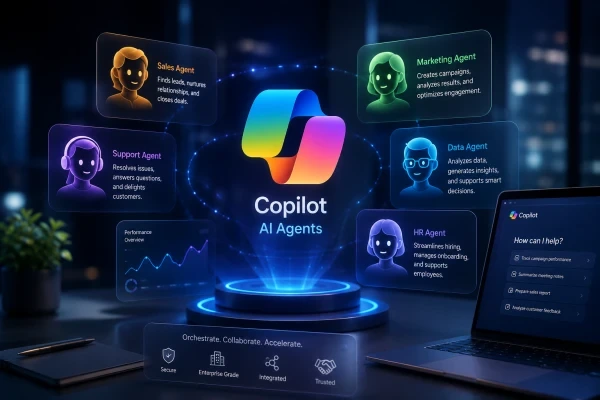
Microsoft is accelerating its artificial intelligence strategy by introducing a new generation of Copilot AI agents designed to perform increasingly complex workplace tasks with minimal human intervention.
Instead of acting solely as assistants that answer questions or generate content, these AI agents are being developed to carry out complete workflows, analyze business data, prepare reports, organize documents, coordinate projects, and automate repetitive administrative tasks. The expansion reflects Microsoft's vision of transforming AI from a productivity tool into an active digital coworker capable of helping organizations operate more efficiently.
The latest Copilot capabilities allow businesses to create AI agents tailored to their specific operations. Companies can deploy intelligent assistants that monitor emails, summarize meetings, update spreadsheets, prepare presentations, manage customer requests, and retrieve information from internal knowledge bases without requiring employees to manually switch between multiple applications.
By integrating deeply with Microsoft 365, Teams, Outlook, Excel, Word, SharePoint, and Dynamics 365, Copilot can work across an organization's existing digital environment while maintaining awareness of business context.
Microsoft believes AI agents represent the next major phase of enterprise software. Rather than employees completing every individual task themselves, organizations will increasingly assign work to intelligent AI systems capable of planning, executing, and monitoring multi-step processes.
These systems can draft documents, analyze financial reports, track project milestones, identify potential risks, and recommend actions based on real-time business data. As AI becomes more autonomous, businesses are expected to experience significant improvements in productivity while reducing the time spent on routine operational work.
Security remains a central focus of Microsoft's AI strategy. Enterprise customers require strong protections when AI systems access confidential emails, financial information, legal documents, customer records, and corporate databases.
Microsoft continues strengthening permission controls, compliance features, encryption, and governance tools to ensure organizations retain control over how AI agents access and process sensitive information. These safeguards have become increasingly important as AI moves deeper into critical business operations.
The announcement comes during an intense period of competition among the world's leading artificial intelligence companies. Microsoft continues investing billions of dollars in AI infrastructure while expanding Copilot across nearly every product in its ecosystem.
Google is integrating Gemini into Workspace, OpenAI is advancing ChatGPT Enterprise, Anthropic is expanding Claude for business customers, and Salesforce continues developing Agentforce for enterprise automation. The competition has shifted beyond chatbots toward intelligent agents capable of performing real work on behalf of users.
Analysts believe enterprise AI will become one of the largest technology markets of the decade. Organizations across finance, healthcare, education, manufacturing, retail, and government are increasingly adopting AI to automate business processes, improve customer service, strengthen cybersecurity, accelerate software development, and support data-driven decision-making.
Companies capable of delivering reliable AI platforms integrated into everyday business software are expected to gain a significant competitive advantage as adoption accelerates worldwide.
Microsoft's broader AI investment also extends to cloud infrastructure. Demand for AI services continues driving rapid growth for Azure as organizations require more computing power to train, deploy, and operate advanced language models.
The combination of cloud computing, enterprise software, and intelligent AI agents positions Microsoft as one of the key companies shaping the future of workplace technology. As more organizations build AI-first workflows, scalable cloud infrastructure will remain essential to supporting increasingly sophisticated business automation.
The expansion of Copilot AI agents demonstrates that artificial intelligence is entering a new era where software no longer simply responds to user requests but actively completes meaningful work. As businesses continue embracing AI-driven productivity, Microsoft's latest innovations could redefine how millions of employees collaborate with technology, transforming everyday office work through intelligent automation and autonomous digital assistants.






0 Comments:
Leave a Reply