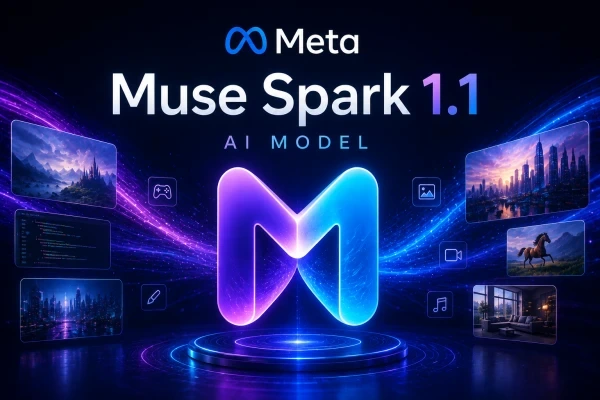
Meta Targets OpenAI and Anthropic With Powerful Muse Spark 1.1 AI Model
-

- by THEFLGHT,
- July 30, 2026
- in Artificial-Intelligence
Meta has intensified the artificial intelligence race with the introduction of Muse Spark 1.1, an upgraded AI model designed to compete directly with OpenAI's GPT-5.6 and Anthropic's Claude Opus 5.
The release marks another major step in Meta's strategy to become a leading provider of enterprise AI by focusing on software development, intelligent agents, and business automation. Rather than simply improving conversational AI, Muse Spark 1.1 has been built to solve practical business problems where speed, reasoning, and coding accuracy are becoming increasingly important.
One of the biggest improvements in Muse Spark 1.1 is its performance on programming tasks. The model is capable of writing code, debugging applications, explaining complex software architecture, reviewing pull requests, and helping developers work more efficiently across large projects.
Meta believes software engineering will remain one of the most valuable applications of artificial intelligence, making coding capabilities a key battleground among frontier AI companies.
Meta is also positioning Muse Spark 1.1 as the foundation for more capable AI agents.
These systems are designed to perform multi-step tasks such as researching information, managing calendars, organizing documents, planning schedules, and interacting with external applications.
Unlike traditional chatbots that answer one question at a time, AI agents can work through complete workflows while maintaining context across longer sessions. Meta has begun integrating these capabilities with services such as Gmail and Google Calendar as part of its broader AI assistant strategy.
The launch reflects Meta's growing investment in enterprise artificial intelligence. Businesses increasingly want AI systems that improve productivity instead of simply generating text. Organizations are deploying AI to automate customer support, accelerate software development, summarize meetings, analyze financial reports, and improve internal knowledge management.
By offering stronger coding tools and intelligent automation, Meta hopes to attract developers and enterprise customers that might otherwise choose competing platforms.
Pricing could become another important advantage. Industry observers believe Meta is using aggressive pricing to encourage developers to experiment with Muse Spark 1.1, increasing pressure on rivals that charge higher rates for similar AI capabilities. Lower operating costs could make advanced AI accessible to startups, independent developers, and medium-sized businesses that previously found enterprise AI too expensive.
Competition among AI companies has never been more intense. OpenAI continues expanding ChatGPT and GPT-5.6, Anthropic is advancing Claude Opus 5, Google DeepMind is integrating Gemini across its ecosystem, and xAI continues developing Grok. Instead of competing solely on benchmark scores, companies are now racing to deliver practical AI systems that can write production-ready code, automate business operations, and assist employees with complex daily work.
Meta's broader strategy extends beyond software. The company continues investing heavily in AI infrastructure, custom silicon, and next-generation data centers to support increasingly powerful AI models. Building its own hardware ecosystem could reduce long-term costs while giving Meta greater control over how future AI systems are trained and deployed.
The release of Muse Spark 1.1 highlights how quickly artificial intelligence is evolving from experimental technology into an essential business platform. As organizations continue integrating AI into software development, customer service, and enterprise operations, competition between Meta, OpenAI, Anthropic, and Google is expected to accelerate even further.
For businesses and developers, this rivalry is likely to produce faster innovation, more capable AI tools, and lower costs, making advanced artificial intelligence more accessible than ever before.



0 Comments:
Leave a Reply