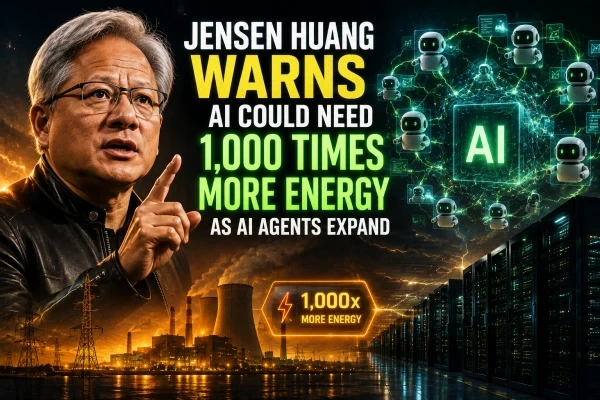
Jensen Huang Warns AI Could Need 1,000 Times More Energy as AI Agents Expand
-

- by THEFLGHT,
- August 05, 2026
- in Artificial-Intelligence
Nvidia CEO Jensen Huang has issued one of the starkest warnings yet about the infrastructure required to support the next phase of artificial intelligence, saying the world could need dramatically more energy as computing shifts toward always-on AI systems and autonomous agents.
Huang's warning has put electricity and data-center capacity back at the center of the AI debate, highlighting a problem that could become just as important as chips, software and model performance as companies race to build increasingly capable artificial intelligence systems.
The Nvidia chief has previously argued that the transition from conventional computing to AI-driven computing will create an enormous increase in demand for processing power. In discussions about the future of AI, Huang has pointed to the emergence of systems that do not simply wait for a user to type a question but can continuously reason, plan, use tools and perform tasks.
Those systems require significantly more computation than traditional search and software applications, potentially turning AI data centers into one of the largest new sources of electricity demand.
Huang's warning matters because Nvidia sits at the center of this transformation. The company supplies the GPUs and accelerated computing platforms used by many of the world's largest AI developers and cloud providers.
Nvidia's hardware has become the foundation for training and running advanced models from companies including OpenAI, Google, Meta and other major technology firms. As those companies build more powerful models and deploy AI agents at larger scale, demand for Nvidia's computing infrastructure continues to increase.
The biggest change may come from agentic AI. Today's chatbot generally responds when a user sends a request. An AI agent can operate for much longer, break a complicated objective into multiple steps, call software tools, inspect information, write code, make decisions and continue working until a task is completed. Every additional action can require more inference, more memory and more computing resources.
That difference could have enormous consequences for energy consumption.
A traditional software application might use computing resources for a relatively short period before becoming idle. An autonomous AI agent, by comparison, can remain active while it researches information, generates responses, evaluates results and decides what to do next. If millions of people and businesses begin running these systems continuously, the amount of computing required could grow far beyond the workload generated by today's conversational AI.
This is why Huang's energy warning is becoming increasingly important for the entire technology industry. The AI race is no longer simply a competition to build the largest model. Companies also need enough electricity, cooling capacity, networking equipment, data-center space and specialized chips to run those models at scale.
Data centers are already becoming major infrastructure projects. Technology companies and cloud providers are spending billions of dollars building new facilities specifically designed for AI workloads. These facilities require enormous amounts of electricity because thousands of GPUs and other accelerators can operate simultaneously while generating significant heat that must be removed through advanced cooling systems.
The energy challenge could become even larger as AI companies move from training models toward massive inference operations. Training a frontier model requires huge computing resources for a limited period, but serving that model to millions or billions of users can create a continuous demand for computing.
As AI becomes embedded in search engines, smartphones, office software, coding tools, autonomous agents and business applications, inference could become one of the biggest drivers of future data-center electricity consumption.
That is also creating an opportunity for the energy industry.
Utilities, power producers and infrastructure companies are increasingly positioning themselves around the AI boom because data centers need reliable electricity around the clock. Renewable energy, natural gas, nuclear power, battery storage and upgraded transmission networks are all becoming part of the discussion about how to supply the next generation of AI infrastructure.
The problem is that building electricity infrastructure is considerably slower than building software. An AI company can release a new model in months, while a major power plant, transmission line or large-scale data center can require years of planning, permitting and construction. That difference could create a bottleneck if AI computing demand grows faster than electricity infrastructure.
Huang has therefore framed energy as a fundamental part of the AI industrial revolution. Nvidia's own sustainability reporting says AI factories are becoming a new form of industrial infrastructure and acknowledges that AI will require more energy while also arguing that AI can help modernize energy systems and accelerate investment in cleaner power.
The company's hardware strategy is also increasingly focused on efficiency. Nvidia's newest platforms are designed not simply to provide more raw computing performance but to deliver more AI work using less power and at lower cost. The company has been developing complete systems that combine GPUs, CPUs, networking and memory technologies so that data can move efficiently through AI data centers.
That approach will become increasingly important if AI agents become the dominant form of software interaction.
Instead of opening a search engine, reading several websites and manually completing a task, a user could eventually tell an AI agent what they want and allow the system to perform the entire workflow.
The agent might search the internet, compare information, generate documents, communicate with other services and monitor the task over time.
That convenience comes with a computing cost.
Every step requires processing, and complex tasks may involve dozens or hundreds of model calls. If billions of people eventually use autonomous AI systems regularly, the amount of inference could increase by orders of magnitude compared with today's chatbot usage.
This helps explain why Nvidia is investing beyond individual GPUs. At its 2026 GTC conference, Huang presented Nvidia's broader vision of AI factories, describing AI infrastructure as a new industrial layer that combines computing, networking, storage and software. Nvidia also introduced its Vera Rubin platform and other technologies designed to improve the economics and efficiency of large-scale AI workloads.
The competition is now spreading across the entire AI infrastructure stack. Nvidia remains the dominant supplier of advanced AI accelerators, but AMD is developing competing processors, Google has its TPU ecosystem, Amazon is investing in its own AI chips, and major AI companies are increasingly exploring custom silicon.
Anthropic, for example, has recently started building an internal chip design team as it looks for greater control over the hardware supporting Claude.
The result is a new kind of technology race in which chips and electricity are becoming inseparable.
A company may have an excellent AI model, but if it cannot obtain enough computing capacity to train and operate that model, its competitive advantage can quickly disappear. Similarly, a data-center operator may have enough physical space but struggle to obtain sufficient electricity from the surrounding grid.
This is why investors, governments and technology companies are increasingly treating AI infrastructure as a national and industrial priority. The United States, China and other major economies are competing not only to develop advanced AI models but also to secure the semiconductor manufacturing, energy generation, data centers and networking systems needed to operate them.
For Nvidia, the situation creates an enormous opportunity but also a responsibility to improve efficiency. The more AI computing expands, the more important it becomes to deliver greater performance without requiring proportionally more electricity.
Huang's warning does not mean that the world will suddenly consume 1,000 times more electricity tomorrow. The figure is a projection about the potential scale of future computing demand, particularly as AI becomes more autonomous and continuously active. Actual demand will depend on how quickly AI adoption grows, how efficient chips and models become, and how much work can be completed with fewer computations.
There are already signs that efficiency improvements could offset some of the growth. Smaller models, improved algorithms, quantization, better hardware and more efficient data-center designs can reduce the amount of energy required for individual AI operations.
Nvidia and other semiconductor companies are investing heavily in these areas because reducing the cost of each AI operation could allow the industry to expand without increasing energy consumption at the same rate.
But efficiency alone may not solve the problem if usage grows even faster.
This is the central challenge facing the next stage of artificial intelligence. If AI becomes dramatically cheaper and more useful, people and businesses may use it far more frequently. Lower costs could therefore increase total demand rather than reduce it.
That dynamic could make electricity one of the most important resources in the AI economy.
For Jensen Huang and Nvidia, the message is straightforward: the AI revolution cannot be powered by chips alone. The industry will need data centers, networks, cooling systems, semiconductor factories and enormous amounts of reliable electricity.
As AI agents move from experimental technology into everyday software, the demand for computing could accelerate again. Nvidia is betting that its hardware will remain at the center of that expansion, but Huang's warning highlights the infrastructure challenge that the entire industry must solve.
The next phase of the AI race may therefore be decided far away from chatbot screens. It could be determined by who can build the chips, secure the electricity and construct the data centers needed to keep increasingly intelligent machines running around the clock.
And that is why Jensen Huang's name is becoming increasingly connected not only with Nvidia and AI chips, but with one of the biggest questions facing the technology industry: where will all the power for the AI revolution come from?






0 Comments:
Leave a Reply