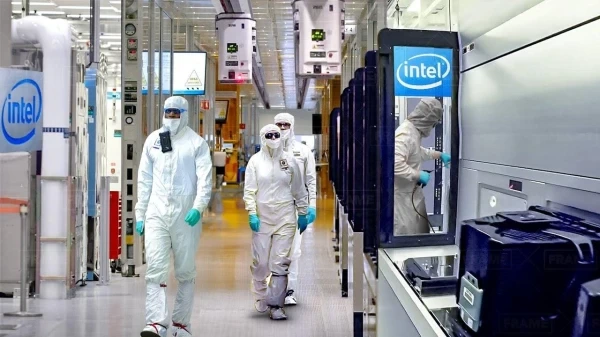
Intel Unveils $5.7 Billion AI Investment That Could Reshape Europe's Chip Industry
Intel has announced a major $5.7 billion investment to strengthen its semiconductor operations in Ireland, underscoring how the global race for artificial intelligence is increasingly being fought through chip manufacturing rather than software alone.
The investment is expected to expand Intel's production capabilities for processors used in AI workloads, cloud computing, enterprise infrastructure, and next-generation data centers. As demand for AI computing continues to surge worldwide, the announcement represents one of the largest technology investments in Europe this year.
The expansion comes at a time when governments and technology companies are investing unprecedented amounts of money to secure access to advanced semiconductor production. Artificial intelligence models require enormous computing power, and that demand has placed chip manufacturers at the center of the global AI economy. Intel's latest investment reflects the growing importance of building more manufacturing capacity closer to major markets while reducing dependence on a limited number of global suppliers.
Ireland has become one of Intel's most important manufacturing hubs outside the United States. The company has invested in the country for decades, but the latest funding signals an even greater commitment to producing advanced chips that can support AI training, inference, cloud services, and enterprise computing. The expansion is also expected to create new opportunities across engineering, manufacturing, construction, and technology services while strengthening Europe's semiconductor ecosystem.
The announcement highlights how artificial intelligence is reshaping competition throughout the semiconductor industry. While companies such as Nvidia currently dominate AI accelerators, Intel is investing aggressively to strengthen its position in a market expected to generate hundreds of billions of dollars over the coming decade.
Every major technology company now depends on increasingly powerful processors to develop larger language models, autonomous AI agents, robotics, cybersecurity systems, and scientific computing platforms. Owning more manufacturing capacity could become a significant competitive advantage as AI demand continues to accelerate.
Intel's investment also aligns with broader efforts by Europe to increase domestic semiconductor production. Policymakers across the European Union have emphasized the need to strengthen regional chip manufacturing following recent supply chain disruptions and growing geopolitical competition surrounding advanced technology. By expanding one of its largest European facilities, Intel contributes to those objectives while positioning itself to meet rising customer demand for AI-ready infrastructure.
The timing is particularly important because spending on AI infrastructure continues to reach record levels. Meta, Microsoft, Amazon, Alphabet, and OpenAI are investing billions of dollars in new data centers, custom AI processors, networking equipment, and cloud infrastructure.
Every new generation of AI models requires substantially more computing resources, creating enormous opportunities for companies capable of producing high-performance semiconductors at scale. Intel hopes its expanded manufacturing footprint will allow it to capture a larger share of this rapidly growing market.
Industry analysts believe the next stage of artificial intelligence will be determined not only by software innovation but also by access to reliable chip production. AI companies can only expand their services if sufficient hardware is available to train and operate increasingly capable models.
This has transformed semiconductor manufacturers from behind-the-scenes suppliers into some of the most strategically important companies in the technology industry. Intel's latest investment demonstrates how essential manufacturing has become to the future of artificial intelligence.
As competition intensifies among Intel, Nvidia, AMD, TSMC, Samsung, and other semiconductor leaders, investments of this scale are expected to become increasingly common. The AI revolution is no longer limited to chatbots and language models—it now depends on factories, advanced processors, massive data centers, and global supply chains capable of supporting billions of AI interactions every day.
Intel's $5.7 billion commitment is another clear sign that the battle for AI leadership is being fought as much in semiconductor plants as it is in software laboratories.







0 Comments:
Leave a Reply