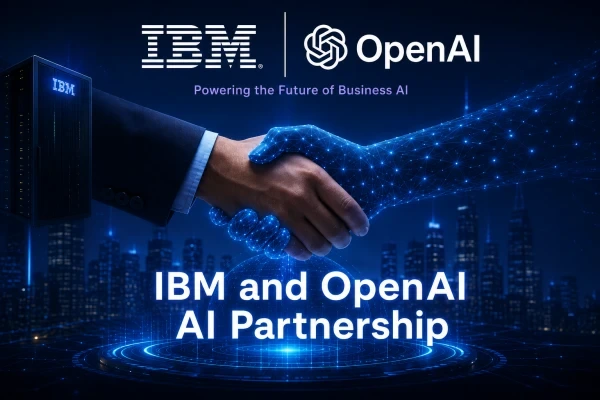
IBM and OpenAI Team Up to Bring GPT-5.6 Into Enterprise Work
-

- by THEFLGHT,
- August 13, 2026
- in Artificial-Intelligence
IBM and OpenAI have announced a new strategic partnership that could push GPT-5.6 much deeper into the business world. The two companies said today that they will work together to help enterprises deploy AI across core operations, complex workflows and cybersecurity, combining OpenAI's models with IBM's consulting, industry expertise and enterprise technology. The partnership is aimed at companies that want to move beyond experimenting with AI and begin using it across important parts of their daily operations.
The deal will bring OpenAI's frontier models, including GPT-5.6, together with products such as Codex and ChatGPT Work inside IBM Consulting Advantage. IBM describes the platform as an AI delivery system that combines AI agents, industry-specific resources and cybersecurity capabilities. The goal is to help organizations redesign existing workflows and introduce AI into areas such as finance, procurement, customer operations and human resources.
One of the biggest targets is the enormous amount of legacy technology still used by large organizations. Many companies have software and business processes that were created years or even decades ago, making them difficult and expensive to modernize. IBM and OpenAI want to use AI to help organizations analyze those systems, identify inefficient processes and gradually turn older workflows into AI-ready operations.
This could be especially important for companies that have already invested heavily in AI but are struggling to connect it to their existing systems. Having access to a powerful model is one thing; making that model work safely with financial systems, customer information, internal applications and regulated processes is much harder. IBM says its consultants and engineers will work directly with clients to help solve that integration problem.
The partnership will also expand the use of AI in software development. IBM plans to combine OpenAI Codex and ChatGPT Work with its engineering and industry expertise to help companies modernize applications and develop new digital products. Instead of AI being used only to generate small pieces of code, the companies are targeting larger software-development workflows where AI can assist with complex modernization projects.
Cybersecurity is another major part of the agreement. IBM and OpenAI are expanding their collaboration through OpenAI's Daybreak Cyber Partner Program, combining OpenAI's AI capabilities with IBM's autonomous security technology. IBM says the partnership will focus on vulnerabilities, AI risks, governance gaps and other security problems that could slow down enterprise AI adoption.
That cybersecurity focus could become increasingly important as businesses give AI agents access to more systems. An AI that can read documents and answer questions presents one level of risk, but an AI that can interact with databases, software, financial processes and customer systems creates a much larger security challenge. Companies will need strong controls around what AI agents can access, what actions they can perform and when humans must approve those actions.
IBM is also creating a dedicated OpenAI practice with thousands of consultants and engineers trained through the OpenAI Partner Network. That means the partnership is not simply about making GPT-5.6 available to IBM customers. The companies are building a larger implementation operation around OpenAI technology, with IBM professionals helping organizations introduce the systems into real business environments.
For OpenAI, the partnership provides another major route into the enterprise market. ChatGPT has become widely known among consumers, but businesses require much more than a chatbot. They need integration, security, governance, technical support and people who understand how to connect AI to complicated existing systems.
For IBM, the partnership strengthens its position in the rapidly growing enterprise AI market. The company already has decades of experience working with large corporations and governments, while OpenAI brings highly capable AI models and products. Combining those strengths could make it easier for large organizations to move from AI experiments to actual production systems.
The partnership also shows where the AI industry is heading next. The competition is increasingly moving away from simply producing better chatbots and toward putting AI agents directly inside business operations. Companies want AI that can analyze workflows, write and modify software, assist employees, monitor security problems and eventually complete entire processes with limited human intervention.
That could make enterprise AI one of the biggest battlegrounds of the next stage of the industry.
The IBM and OpenAI partnership does not mean every company will immediately replace its existing employees or software with AI. Instead, the more realistic change is likely to happen gradually, with AI taking over individual tasks before becoming responsible for larger workflows. As companies become more comfortable with the technology, those AI systems could eventually coordinate multiple tasks and operate as digital workers inside the organization.
Today's announcement therefore matters beyond IBM and OpenAI. It is another sign that advanced AI models are moving from experimental tools into the infrastructure of large businesses. GPT-5.6 may be known primarily as an AI model, but partnerships like this are about turning that model into something much more practical: a system that can actually participate in how companies operate.
The biggest question now is how quickly businesses can safely make that transition. IBM and OpenAI are betting that combining powerful AI models with enterprise expertise, cybersecurity and human consultants will make that process easier. If the strategy works, the next major AI competition may not be about which chatbot people prefer, but which AI systems can run the most useful parts of a business.



0 Comments:
Leave a Reply