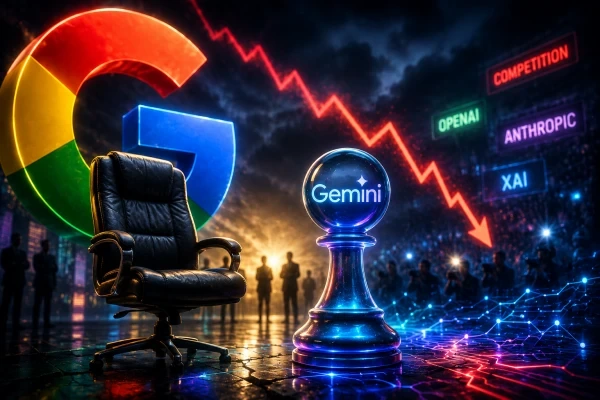
Google Shakes Up AI Leadership as Gemini Faces Growing Pressure
-

- by THEFLGHT,
- August 05, 2026
- in Artificial-Intelligence
Google has made a major change to the leadership of its artificial intelligence division, putting one of the industry's most closely watched companies through a significant restructuring at a critical moment in the global AI race.
Demis Hassabis, the CEO of Google DeepMind and one of the most influential figures in modern artificial intelligence, is stepping away from the unit's day-to-day management to become Alphabet's chief scientist and chairman of Google DeepMind. At the same time, veteran Google AI researcher Jeff Dean is leaving the company alongside several other senior researchers to launch a new artificial intelligence startup called Discovery Loop.
The changes come at a sensitive time for Google because the company is under increasing pressure from OpenAI and Anthropic, which have moved aggressively in frontier AI, coding tools and autonomous agents. Google's latest flagship Gemini model has also remained unreleased despite expectations that it would arrive earlier in the year.
The combination of leadership changes and delays has raised questions among investors and technology researchers about Google's ability to maintain its position at the front of the AI industry. Alphabet shares fell roughly 4% following the announcement.
Hassabis will now have a broader mandate across Alphabet, focusing more heavily on long-term AI research, artificial general intelligence and the potential impact of increasingly capable AI systems.
Alphabet CEO Sundar Pichai said the new position will allow Hassabis to concentrate more of his attention on the future of AGI rather than managing the company's daily AI operations. Hassabis will continue to chair Google DeepMind while also spending more time on Isomorphic Labs, the Alphabet-backed company using AI to accelerate drug discovery.
The change places Koray Kavukcuoglu in charge of Google DeepMind's daily operations. Kavukcuoglu, previously the company's chief technology officer, will become senior vice president while continuing as Alphabet's chief AI architect.
His responsibilities will include overseeing the development of Google's frontier AI systems and the Gemini family, putting him at the center of Google's response to the increasingly aggressive competition from rival AI companies.
The departure of Jeff Dean is arguably just as significant. Dean has been one of the most important technical figures in Google's history, spending 27 years at the company and helping build some of the infrastructure and AI research that eventually became fundamental to Google's technology strategy. He is now leaving to create Discovery Loop, a public-benefit company focused on accelerating breakthroughs in machine learning, science and engineering.
Dean will not be leaving alone. Sanjay Ghemawat, Oriol Vinyals and Quoc Le are also joining the new venture after leaving Google. Their combined experience represents a substantial concentration of AI research talent, making Discovery Loop one of the more closely watched new AI companies to emerge from Google's research organization.
The departures highlight a broader problem facing major technology companies: retaining elite AI researchers has become increasingly difficult as startups and competitors offer researchers enormous resources, greater independence and the opportunity to build their own companies. Several prominent AI researchers have already moved between Google, OpenAI, Anthropic and independent startups, creating a highly competitive market for technical talent.
Google's position remains fundamentally different from that of most AI startups. The company has enormous computing resources, its own AI accelerators, a global cloud business, billions of users and access to massive amounts of data through products such as Search, YouTube and Android. Those advantages give Google the infrastructure required to compete at the highest level of AI development even as individual researchers move between companies.
The bigger question is whether Google can turn those resources into faster AI product development. Gemini has become one of the company's most important strategic products, competing directly with ChatGPT, Claude and other AI assistants. Google's challenge is not simply building powerful models but releasing them quickly enough and integrating them deeply enough into consumer and enterprise products to keep pace with its competitors.
The delayed Gemini release has therefore attracted particular attention. Google has invested heavily in the Gemini family and has integrated the models across Search, Android, Workspace and Google Cloud. A delay gives competitors additional time to strengthen their own systems, particularly in areas such as coding, reasoning and autonomous AI agents.
OpenAI and Anthropic have been particularly aggressive in these areas. Their latest systems are increasingly designed to perform tasks rather than simply respond to questions. AI agents can write and modify software, research information, operate computer interfaces and complete multi-step workflows, creating a new competitive battlefield that extends beyond traditional chatbot performance.
Google is also betting heavily on AI agents, but the company has a much larger ecosystem to integrate them into. Gemini can potentially connect Search, Gmail, Maps, YouTube, Android, Chrome and Google Workspace, giving Google an opportunity to create an AI assistant that operates across many parts of a user's digital life.
That advantage could become increasingly important if AI agents eventually replace traditional application interfaces. Instead of opening individual applications and manually completing tasks, users could increasingly tell an AI system what they want and allow it to coordinate multiple services automatically.
Hassabis' new role suggests Google believes the next stage of the AI race will require more than incremental improvements to existing models. His focus on AGI indicates that Alphabet is preparing for a period in which AI systems could become substantially more capable across scientific research, software engineering and other highly complex areas.
The move also reflects Hassabis' long-standing interest in using artificial intelligence for scientific discovery. Through Isomorphic Labs, he has already pursued the application of AI to drug discovery, while Google DeepMind has developed systems such as AlphaFold that have demonstrated how machine learning can contribute to scientific research.
Google's leadership changes therefore come at a moment when the company is attempting to balance two different goals: building commercially successful AI products today while preparing for potentially transformative AI systems in the future.
The arrival of Discovery Loop adds another dimension to that challenge. Google is reportedly supporting the new company as a founding investor and cloud partner, meaning the departure of senior researchers does not necessarily represent a complete break between the researchers and their former employer. Instead, it could create a new relationship in which Google continues to benefit from research while giving the scientists greater independence.
For Google, however, the immediate priority remains clear. The company needs to maintain momentum in Gemini while continuing to develop the infrastructure and research necessary for the next generation of AI. The leadership changes suggest that Alphabet is reorganizing around that challenge rather than simply maintaining its existing structure.
The AI race has now reached a stage where leadership, talent and speed may be just as important as raw computing power. OpenAI and Anthropic continue attracting researchers and customers, while Google has the advantage of one of the world's largest technology ecosystems. The outcome will depend on which company can turn its resources and research into products that people and businesses actually use.
For users, the competition could mean faster progress. More capable AI models, better coding systems, stronger AI agents and deeper integration into everyday software are likely to emerge as the major companies compete for leadership.
Google's latest shake-up is therefore much bigger than an executive reshuffle. With Demis Hassabis moving toward long-term AGI research, Jeff Dean launching a new AI company and Gemini facing pressure from rival models, Alphabet is entering a new phase of its artificial intelligence strategy.
The decisions made now could determine whether Google remains one of the dominant forces in AI or gives competitors an opportunity to take the lead.



0 Comments:
Leave a Reply