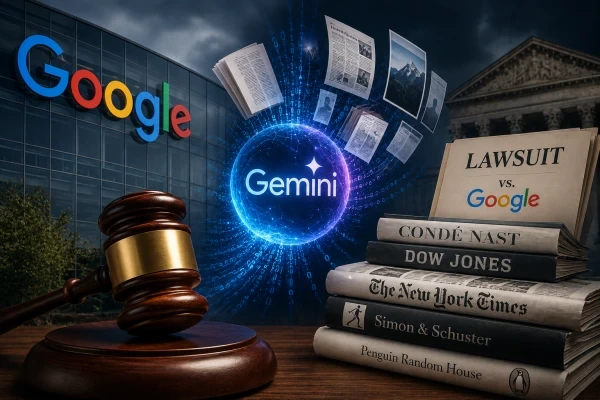
Google Faces New AI Lawsuit From Major Publishers Over Gemini Training Data
-

- by THEFLGHT,
- July 23, 2026
- in Artificial-Intelligence
Google is facing another major legal battle over artificial intelligence after a group of publishers filed a new lawsuit accusing the technology giant of using copyrighted content to train its Gemini AI models without obtaining proper authorization.
The case adds to the growing number of legal disputes surrounding generative AI and could become one of the most closely watched copyright battles in the technology industry. As artificial intelligence becomes increasingly dependent on massive datasets collected from across the internet, publishers and content creators are demanding greater control over how their work is used to develop commercial AI systems.
According to the lawsuit, the publishers argue that Google's AI systems were trained using copyrighted articles and other protected materials without compensation or licensing agreements. They claim that the company's AI products benefit commercially from content created through years of investment in journalism while potentially reducing traffic to the original publishers.
The legal action reflects broader concerns throughout the media industry that AI-generated summaries and conversational search tools may reduce the number of users visiting original news websites, affecting advertising revenue and long-term sustainability.
Google has consistently maintained that training artificial intelligence models on publicly available information is consistent with existing legal principles and helps create innovative products that benefit users worldwide. The company also argues that its AI services can help users discover information more efficiently while continuing to send valuable traffic to publishers.
However, courts in multiple countries are now being asked to determine where the legal boundaries should be drawn between technological innovation and copyright protection, making these cases increasingly important for the future of artificial intelligence.
The lawsuit arrives during a period of rapid growth for AI-powered search. Google has expanded Gemini across Search, Workspace, Android, Chrome, and Cloud, making artificial intelligence one of the company's highest strategic priorities.
These products depend on enormous amounts of training data capable of teaching AI systems language, reasoning, coding, writing, and general knowledge. As AI models become more capable, the debate over what information can legally be used for training has intensified across the publishing, entertainment, software, and creative industries.
Publishers argue that quality journalism requires substantial financial investment in reporters, editors, photographers, researchers, and fact-checkers. If AI companies can freely use professionally produced content without licensing it, many media organizations believe it could weaken the economic foundation supporting independent journalism. Several publishers have already begun negotiating licensing agreements with AI companies, while others have chosen litigation in an effort to establish stronger legal protections for their intellectual property.
The dispute is part of a much larger global conversation about artificial intelligence and copyright law. Similar legal challenges have been filed against several AI developers by authors, artists, musicians, software developers, and media organizations.
Governments and regulators are also examining whether existing copyright laws remain adequate for an era in which AI systems can generate articles, images, videos, music, and computer code that closely resemble human-created works. The outcome of these cases may influence how future AI models are trained and how licensing agreements evolve across the digital economy.
Technology companies continue investing hundreds of billions of dollars in artificial intelligence despite increasing legal scrutiny. Google, Microsoft, OpenAI, Meta, Anthropic, Amazon, and other AI leaders are expanding infrastructure, building larger language models, and integrating AI into consumer and enterprise products at an unprecedented pace.
At the same time, content owners are seeking clearer legal standards to ensure they receive recognition and compensation when their work contributes to the development of commercial AI systems.
The latest lawsuit against Google highlights one of the defining challenges facing artificial intelligence today. While AI promises to transform search, education, business, healthcare, and scientific research, questions surrounding copyright, licensing, and fair compensation remain unresolved.
The decisions reached in these legal battles could shape not only the future of Google's Gemini platform but also the rules governing artificial intelligence development across the global technology industry.






0 Comments:
Leave a Reply