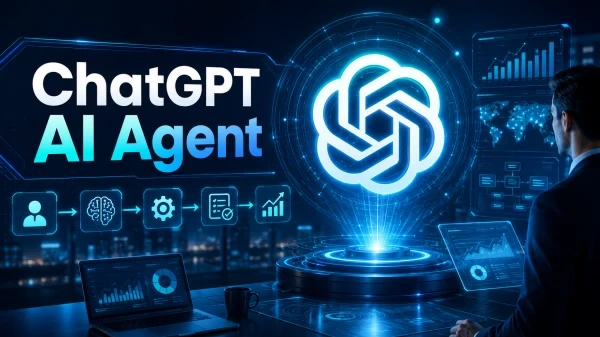
ChatGPT AI Agents Are Changing How Businesses Get Work Done
-

- by THEFLGHT,
- July 27, 2026
- in Artificial-Intelligence
Artificial intelligence is entering a new era where AI systems are no longer limited to answering questions or generating content. OpenAI is rapidly expanding ChatGPT's AI agent capabilities, enabling the platform to perform increasingly complex tasks that once required hours of manual work.
Instead of simply responding to prompts, AI agents can now plan projects, conduct research, organize information, write reports, analyze documents, and complete multi-step workflows with minimal supervision. This evolution represents one of the biggest shifts in enterprise technology since the rise of cloud computing.
Businesses are beginning to deploy ChatGPT AI agents across nearly every department. Marketing teams use AI to generate campaign ideas, analyze customer trends, and prepare reports. Software developers rely on AI to write code, debug applications, and explain technical documentation.
Customer support teams automate responses to routine questions while finance departments use AI to summarize financial records and identify important insights from large datasets. Human resources teams are also integrating AI into recruitment, onboarding, and internal knowledge management. The ability to automate repetitive work is helping organizations reduce operational costs while allowing employees to focus on strategic decision-making.
One of the biggest advantages of AI agents is their ability to maintain context throughout long-running projects. Traditional chatbots often responded to one question at a time, requiring users to provide repeated instructions.
Modern AI agents can remember objectives, organize multiple tasks, retrieve relevant information, and continue working toward a goal without constant human guidance. This makes them particularly valuable for business environments where projects involve numerous documents, deadlines, and collaboration across different teams.
The growing adoption of AI agents is also changing software development. Developers increasingly use ChatGPT to generate production-ready code, review pull requests, identify security vulnerabilities, optimize performance, and explain unfamiliar programming languages.
Rather than replacing software engineers, AI is becoming an intelligent development partner capable of accelerating routine engineering tasks while allowing developers to concentrate on architecture, innovation, and complex problem-solving. As organizations seek faster software delivery, AI-assisted development is becoming a competitive advantage.
Security remains a major priority as AI becomes more deeply integrated into enterprise operations. Businesses require confidence that AI systems can process sensitive information responsibly while complying with privacy regulations and internal governance policies.
OpenAI continues improving permission controls, security safeguards, and enterprise features designed to protect confidential data. These capabilities are especially important for industries such as healthcare, finance, legal services, education, and government, where organizations handle large volumes of sensitive information every day.
Competition in the AI agent market is accelerating rapidly. Microsoft continues expanding Copilot throughout Microsoft 365, Google is integrating Gemini into Workspace, Anthropic is strengthening Claude for enterprise customers, and Salesforce is investing heavily in AI-powered business automation.
Rather than competing solely on chatbot quality, technology companies are racing to build intelligent systems capable of completing meaningful work on behalf of users. Analysts believe AI agents will become one of the largest software categories of the decade as organizations seek practical ways to improve productivity.
Industry experts expect AI agents to become increasingly autonomous over the next few years. Future systems may schedule meetings, coordinate projects, negotiate routine business processes, monitor company performance, generate executive reports, and proactively recommend actions based on changing business conditions.
As AI models continue improving, these assistants are expected to evolve from productivity tools into trusted digital collaborators capable of supporting employees throughout their workday.
The rapid expansion of ChatGPT AI agents demonstrates how artificial intelligence is moving beyond conversational interfaces into real-world business operations. Organizations adopting these technologies early are already discovering new ways to increase efficiency, improve decision-making, and accelerate innovation.
As AI continues advancing, intelligent agents are likely to become an essential part of everyday work, fundamentally changing how businesses operate in the years ahead.




0 Comments:
Leave a Reply